Product4 publishers3 min readPublished
Meta lets small business owners plug its Muse agent into Shopify, Stripe and QuickBooks
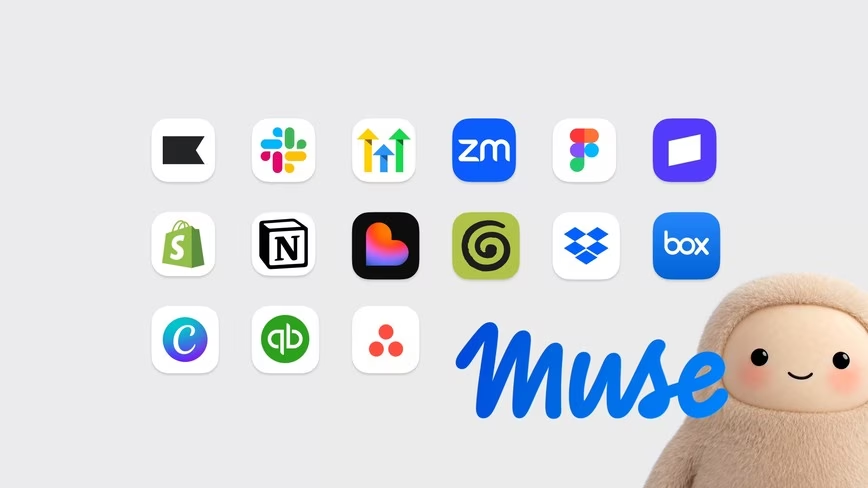
Meta has opened its Muse AI agent to small businesses, listing 15 outside services it can connect to, including QuickBooks, Stripe and Shopify. Owners approve each post, message and purchase, so the bigger choice is which accounts Muse may read at all.
The Product Desk · Product desk
What happened
- Vishal Shah, Meta's vice president of AI products, told Axios that roughly one in three early Muse users had already connected it to a business account.
- Muse can also read analytics from Instagram business accounts and Facebook Pages and can work inside Meta ad accounts.
- The launch came a day after Meta announced an enterprise platform for selling its AI to larger companies, with MongoDB CEO CJ Desai at its head.
- Muse is free for most use with paid plans for higher limits, and Meta did not offer different pricing for the business version.
- Amazon removed Muse from its store last week, saying the agent did not identify itself and appeared to store customer logins, a claim Meta denies.
Compiled by The Product DeskSomething wrong?How this is made
Why it matters
- capability Because owners can write their own connectors, the agent can reach whatever system an owner is willing to wire in, including tools Meta never vetted or listed.
- exposure Any shop or service Muse uses for an owner can refuse it, and an owner whose weekly routine runs through Muse loses that step the day one does.
- cost The daily, heavy use a business agent invites is the use Meta says may need a subscription, so an owner cannot yet budget for Muse once it is doing real work.
Tom Mulholland runs a grocery in Iowa and works about 65 hours a week, according to Meta's announcement [7]. "I need to free up time for the work that actually makes my business money: cutting the steaks, making the sausages," he said [8]. Muse for Small Business is built for him. To save him those hours, it draws on his brand, his online shop, his accounts and his customer records [5].
Meta's evidence that owners want this comes from Vishal Shah. "People are using Muse to run their business," Shah said. "We're going to make it easier to do so." [10] The figure Shah gave Axios counts accounts connected [9]. It is a setup number. An owner who linked a Shopify store once and never came back counts the same as one who now runs the week through Muse.
Most of the work Meta advertises for Muse is reading. One suggested prompt is "How was my business's financial performance this month? Find any expenses that look off." [18] To answer it, Muse needs the books, and Meta says the agent can pull in data from an app once the owner connects it [17]. The approval step Meta described applies to posting, messaging and buying [6]. Engadget notes that the agent could behave unpredictably or misread an instruction, while Meta says Muse was built with layers of privacy and security [20].
The ad account is the unclear case. Muse can carry out ad campaign tasks [16], and advertising brings in nearly all of Meta's revenue [12]. Another suggested prompt asks Muse to analyze the year's sales and campaigns and "make me a growth plan to meet my business goals for next year." [19] That plan comes from an agent made by the company that sells the ads. The announcement, as reported, does not say whether raising a campaign budget counts as buying something under the approval rule.
I'd sort each account on two questions before connecting it. The first is whether a mistake there would reach a customer or a bank before the owner noticed. The second is whether Muse's action there waits for the owner's sign-off [6]. Drafting Instagram posts is low harm and waits for approval, so start there [3]. Reading Notion or Figma files is low harm and sits outside the approval rule; connect those and look at what Muse did once a week [4]. Messages to shop customers are high harm but gated, so every request gets read in full [6]. QuickBooks, Stripe and the ad account are high harm with no clear approval step [2]. A custom connector goes through the same two questions [4].
For Mulholland, I'd connect Canva and Instagram first and keep QuickBooks, Stripe and the ad account back for now [2]. The tradeoff is that the expense check in Meta's own sample prompt needs exactly the accounts he held back [18].
What to watch
- Whether other stores or services follow Amazon in blocking Muse, or Meta changes how the agent identifies itself when it signs in for a user.
- Retention and usage figures from Meta for business owners, beyond the share who connected an account.