Invest1 publisher2 min readPublished
Memory fabs take 59% of South Korea's 1,350 trillion won AI and chip plan
Samsung and SK Hynix are committing about $518 billion to new Gwangju memory fabs, the largest line in South Korea's roughly $900 billion decade plan. Company balance sheets supply much of that capital, so the two chipmakers will set how fast the new supply actually arrives.
The Investor · Invest desk
What happened
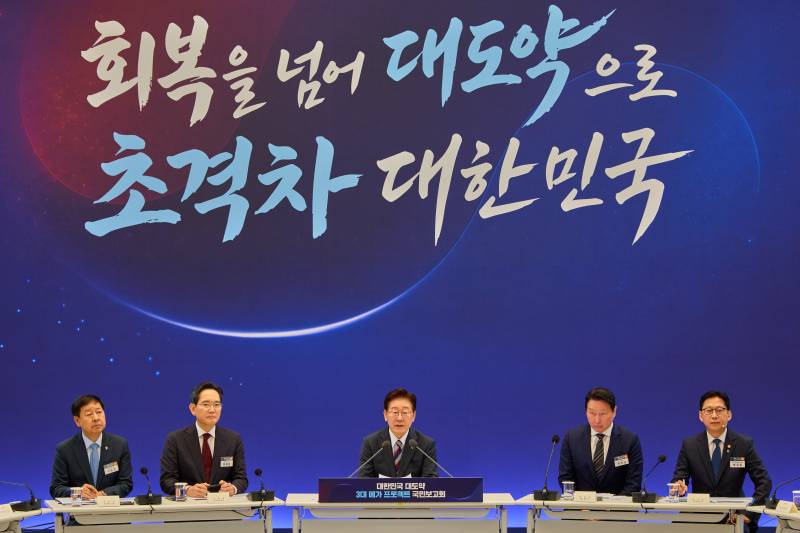
- President Lee Jae Myung presented the decade-long plan on June 29, 2026, sharing the stage with the leaders of Samsung and SK Hynix.
- A further roughly $52 billion is set aside for a high-bandwidth memory packaging hub, where memory chips are stacked to feed data to AI processors faster.
- AI data centers get about $356 billion, and SK Group, GS Group and Naver are backing that buildout.
- Seoul also wants to rank among the top three AI robot powers by 2030 and to train 10,000 physical AI specialists by the same year.
Compiled by The InvestorSomething wrong?How this is made
Why it matters
- exposure Semiconductor-equipment suppliers gain a ten-year Gwangju order prospect that is only as firm as the first groundbreakings, since the pledge is a corporate target with no published schedule.
- constraint The data-center gigawatt targets depend on the grid: Crypto Briefing says they imply a major expansion in electricity supply that has to be delivered on schedule.
- capability A dedicated HBM packaging hub moves Korea's bid from selling raw memory chips toward owning the assembly step AI processors depend on, in Crypto Briefing's reading.
The two biggest lines account for the whole headline. Gwangju fabs get 800 trillion won [4] and AI data centers get 550 trillion won [6]. Together that is 1,350 trillion won [1], the full decade total Seoul announced [1]. In dollars the same pair sums to $874 billion [2], just under the $880 billion to $900 billion range given for the plan [1]. The $52 billion HBM packaging hub is described as additional [5], and the robotics project is stated as a ranking and a headcount [8]. So either the package is bigger than its headline, or those pieces sit inside the two large lines without being broken out.
Memory fabs take 59% of the won total [3], and that is before the packaging hub is counted. Paced evenly over ten years, the fab pledge comes to 80 trillion won a year, or about $52 billion [4]. One year of fab spending at that pace is about the same as the whole HBM hub budget [5].
The data-center line pairs one budget with two capacity targets. Spread across the more than 18 GW Seoul wants by 2035 [7], 550 trillion won is no more than about $19.8 billion per gigawatt [5]. Set against only the 8.4 GW due by 2029 [6], it is about $42 billion [6].
Corporate balance sheets supply much of the capital while the state sets direction and targets [9], so Seoul is not passing a 1,350 trillion won spending bill. Nor is it funding standalone superintelligence projects. The money goes to computing power and chip manufacturing, and Crypto Briefing calls the superintelligence framing aspirational [10]. Lee still called the plan a "national survival strategy" [2].
How the fab number plays out depends on pacing. Spent near the even pace [4], Gwangju adds a decade of steady memory capacity and a steady order book for equipment makers. Back-loaded, most of the spending lands in the 2030s and the near-term memory supply outlook barely moves. And if the first groundbreakings slip, 800 trillion won [4] becomes a ceiling the two companies never reach. The plan as reported does not split the fab money by year or say how much of it was already in either company's budget.
I think the back-loaded case is the likeliest. The money is the companies' own [9], and its timing will follow their returns on memory more than a presidential target. What would prove that wrong is groundbreaking progress at Gwangju, the first milestone Crypto Briefing lists [13], at a speed consistent with about 80 trillion won a year [4].
What to watch
- Groundbreaking progress on the Gwangju fabs, and whether Samsung or SK Hynix ties annual capex guidance to the 800 trillion won pledge.
- Whether South Korea reaches 8.4 GW of AI data-center capacity by 2029, and which power supply arrangements sit behind it.
- Whether Seoul says the $52 billion HBM hub sits inside or on top of the 1,350 trillion won total.