Science1 publisher2 min readPublished
Lutetium clock sets an accuracy record ahead of the second's expected 2030 redefinition
Physicists including Singapore's Murray Barrett report in Nature a lutetium-176 clock accurate to the 19th digit, 41% better than the prior record. The team pitches lutetium as cesium's successor in defining the second, where its tolerance of heat may count as much as the record.
The Scientist · Science desk
Drafted by a language model from the sources cited here and checked against its claim ledger before publication. How we use AISend a correction
What happened
- Lutetium-176 keeps the clock ticking through a 5-degree external temperature swing, while other elements may need their surroundings held within a few thousandths of a degree.
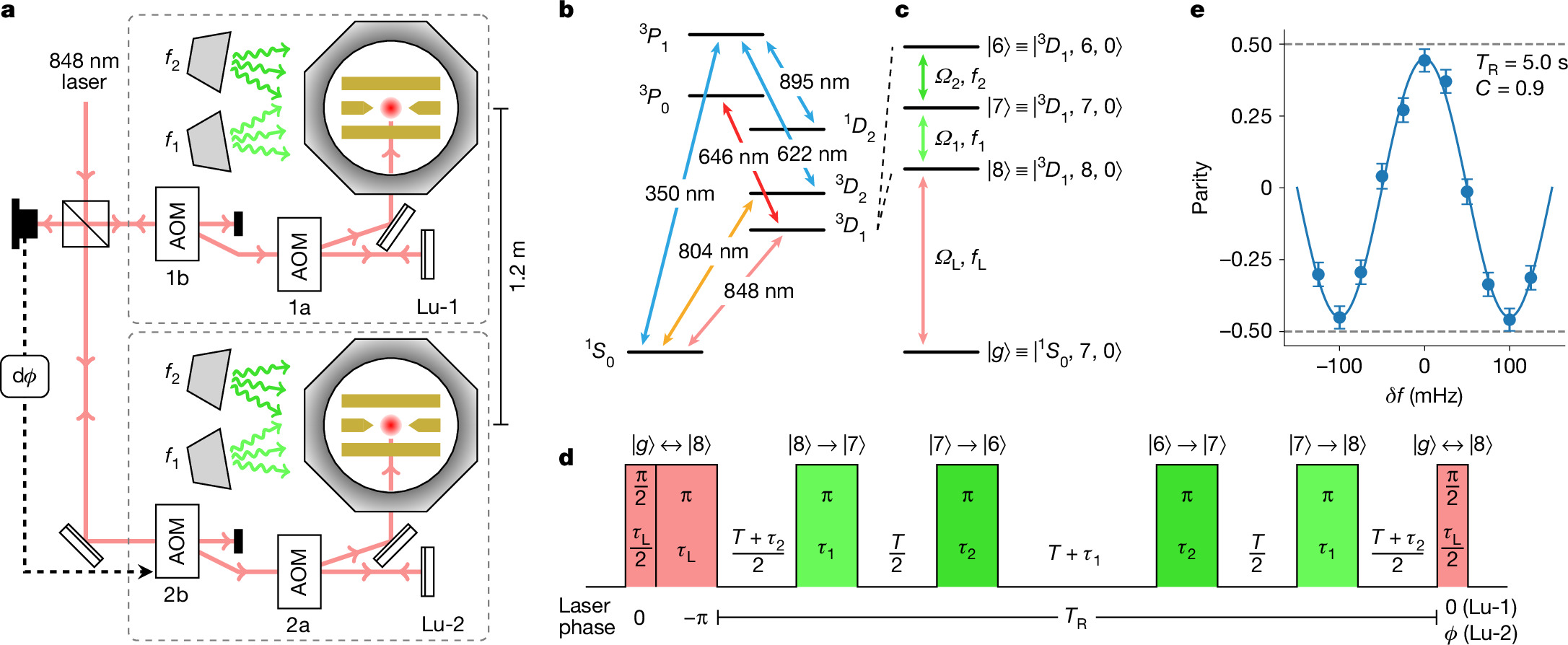
- Barrett's lab also developed a technique it calls hyperfine averaging to blunt the most important environmental effects on the clock's ticking.
- The BIPM has defined the second by cesium-133 since 1968, setting one second at 9.19 billion vibrations of that atom.
- The BIPM is expected to redefine the second in 2030, basing the new definition on modern atomic clock technology.
Compiled by The ScientistSomething wrong?How this is made
Why it matters
- decision The BIPM's 2030 decision gains a lutetium candidate whose published case so far rests on accuracy, the one property this paper set out to verify.
- capability A clock that holds its accuracy through degree-scale temperature swings needs far less environmental control, a practical edge for any clock asked to anchor the SI second.
- constraint Because the 41% supports two readings of the gain's size, rankings of lutetium against other record clocks stay provisional until the uncertainties are set side by side.
Live Science measures the 41% gain against "the previous record holder" but does not name that clock or give either clock's uncertainty, and it does not say whether a second laboratory has repeated the result [1]. The phrase supports two readings. If the error budget shrank by 41%, the new clock's budget is 0.59 of the old record's. If the clock is 1.41 times as accurate, the budget is about 0.71 of the old one [2].
The paper's title states the claim more exactly: "Lu+ optical frequency references with accuracy verified at the 19th digit" [2]. As a fractional figure, an error in the 19th digit is an uncertainty of roughly one part in 10^19 [1].
Holding a clock at that level is hard. Even modern, ultraprecise atomic clocks shift with minuscule changes in temperature, magnetic fields and gravity, and the researchers say theirs largely sidesteps those effects [8]. Lutetium-176 is not very sensitive to magnetic fields or temperature to begin with [5]. Murray Barrett, a physicist at the National University of Singapore and a co-author, compared precise timekeeping to an ultramarathon with the isotope as the runner [3]. "Our job is to make sure the runner can go the distance. Lutetium, as it turns out, is a natural born endurance athlete," he told Live Science in an email [4].
I think that insensitivity counts for as much as the record in the job the team has in mind, a new standard for the SI second [12]. The record comes from a single paper [2]. The insensitivity is a property of the clock itself, and it would matter each time the clock runs as a standard. Atomic clocks are the cornerstone of GPS, the internet and military technology [11].
Lutetium would not be the first element to challenge cesium in the field; ytterbium and strontium have also been used to build atomic clocks [11]. The definition itself has moved before. Until 1968 the second was 1/31,556,925 of the length of the solar year 1900 [10]. Live Science puts its own verdict this way: "So far, lutetium seems to be the front-runner for accuracy" [14].
Barrett also named a use outside timekeeping. "There is some speculation that fundamental constants may actually be changing," he said. "So ultra-precise clocks give us the tools to explore that" [15].
What to watch
- A second laboratory reporting a lutetium clock with accuracy verified at the same level.
- Direct comparisons of the lutetium references against strontium and ytterbium clocks, with the prior record holder named.
- The BIPM's published criteria and shortlist for the expected 2030 redefinition of the second.