Science2 publishers2 min readPublished
AI-tuned nanoparticle recipe keeps mRNA vaccines stable for a year at room temperature
MIT researchers used an AI algorithm to reformulate mRNA vaccine nanoparticles that stay stable for a year at room temperature and two months near 38C. In mice the shots matched a Moderna-like vaccine. The lab says the change could loosen the ultracold cold chain.
The Scientist · Science desk
What happened
- Standard RNA-LNP vaccines have to be stored between minus 20 and minus 80 degrees Celsius, which is what makes them hard to ship to regions without cold-storage facilities.
- Earlier heat-stable particles from the same lab diverged from the FDA-cleared Moderna and Pfizer recipes, so this work set out to harden the approved formulations instead.
- The team built the tool with MIT's CSAIL to predict promising formulations from very small datasets, the opposite of a brute-force screen.
- The work appears in Nature Biotechnology, with Ana Jaklenec and Robert Langer as senior authors and Jinbi Tian and Khanh Tran as lead authors.
Compiled by The ScientistSomething wrong?How this is made
Why it matters
- capability Heat tolerance would allow delivery by dissolving microneedle skin patches, which hold hundreds of vaccine-filled needles and are impractical for frozen doses.
- precedent Konakovic Lukovic says the same optimization approach had been used for other design problems but never vaccine stability, so it could shorten future formulation searches on small data.
- constraint The immune-response match was in mice and against a Moderna-like vaccine, so protection in people, and whether a heat-aged dose still immunizes, is untested.
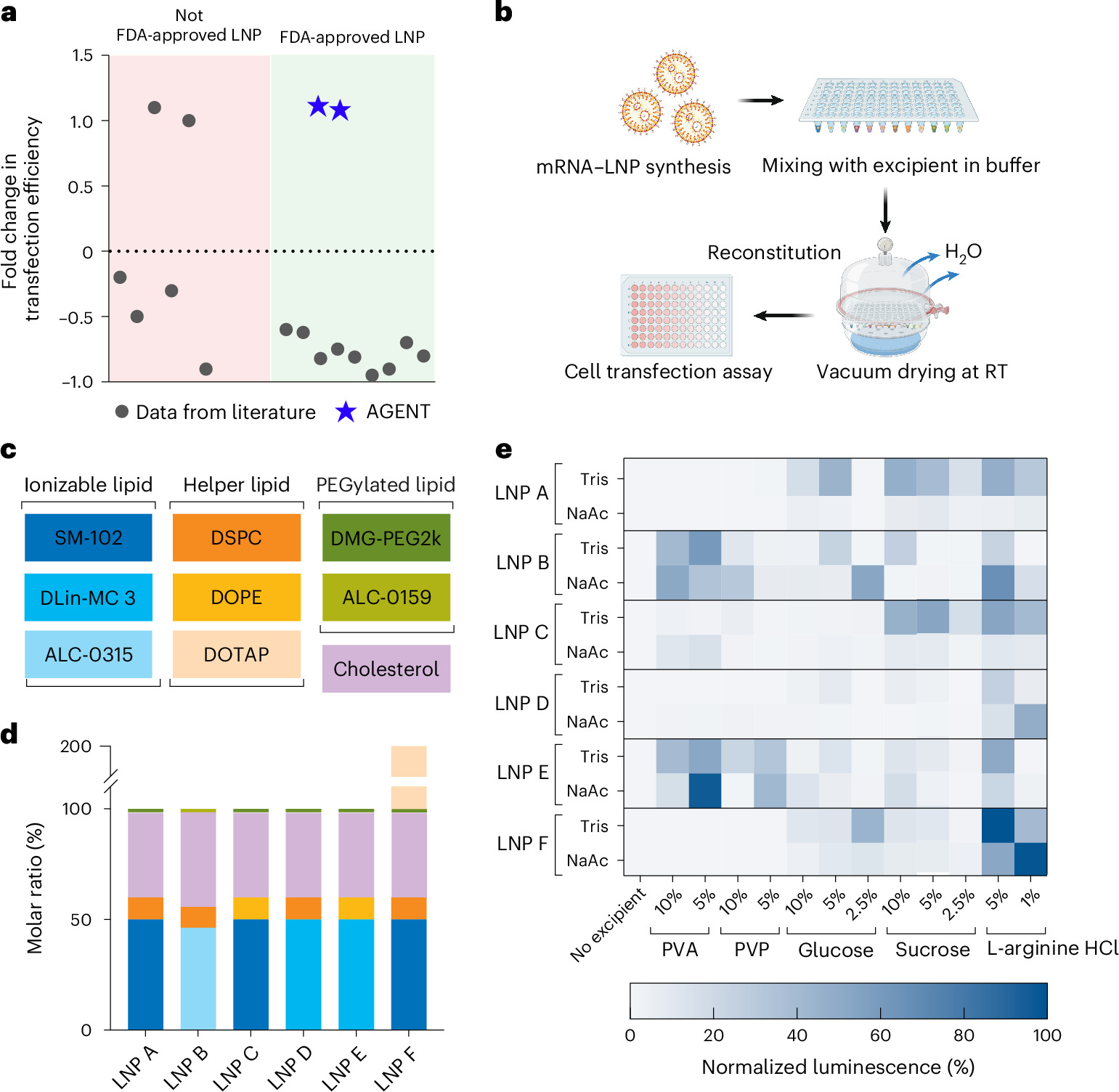
RNA falls apart easily on its own, so vaccine makers wrap it in lipid nanoparticles that shield the molecule and carry it into cells [8]. To push those particles to tolerate heat, formulators mix in excipients, the sugars, salts and polymers that hold a formulation together [11]. The MIT team started with excipients that had stabilized nanoparticles in its earlier work, and stalled.
"We were trying to use and screen excipients that we've previously used successfully to stabilize LNPs, but it just wasn't working. It was really frustrating for the team," Jaklenec said [13].
So they turned to software, adjusting the formulation around the nanoparticles until it held up in heat [1]. Built with MIT's CSAIL, the algorithm scored nearly 50 FDA-approved excipients. For each one, the team packed a nanoparticle with mRNA coding for firefly luciferase and measured the light the cells emitted, a proxy for how much intact RNA got through [16]. It then predicted ratios for the five most promising excipients, which cut the number of bench experiments the team had to run [17][4]. Konakovic Lukovic, a CSAIL assistant professor and co-author, said she was surprised by how quickly the algorithm converged on a stable formulation, getting there in just a handful of iterations rather than the exhaustive search that would normally be required [15][18].
The functional test was in mice, where the reformulated COVID vaccine raised an immune response as strong as a shot similar to Moderna's [3]. The storage figures and that mouse comparison are reported separately, and the account does not say the mice received heat-aged doses. So the work shows the particles survive heat, and that they immunize, without yet demonstrating in one animal that a dose held warm for months still protects [2][3].
What to watch
- Whether a dose stored at room temperature for a year, or at 38C for two months, still immunizes in animals and then in people.
- Whether regulators treat a modified formulation of an FDA-approved product as a minor change or a fresh filing.
- Whether the small-data algorithm generalizes to mRNA payloads other than COVID and the firefly luciferase test protein.