Science1 publisher2 min readPublished
ISTA chemists design a ligand that cuts the nickel needed for light-driven cross-coupling
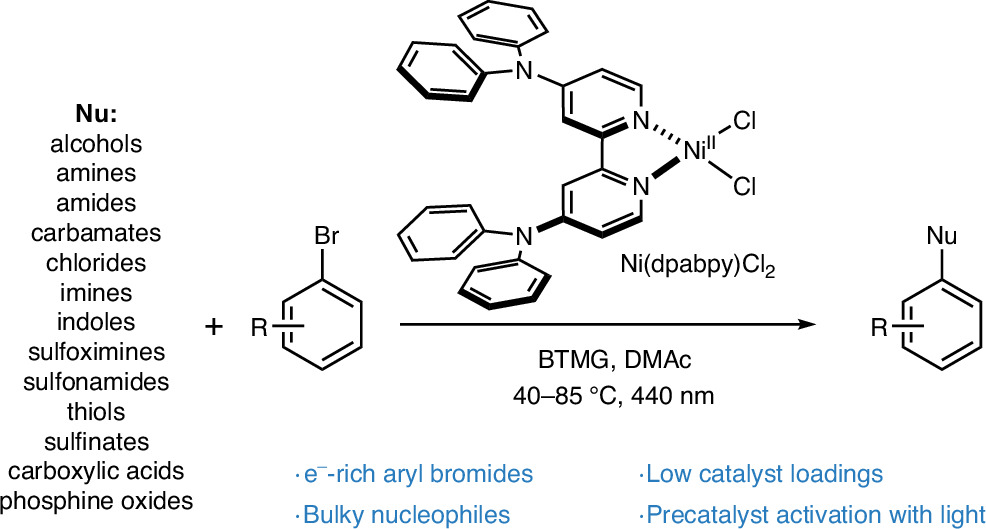
ISTA chemists report a light-activated nickel catalyst that made more than 150 products while using substantially less nickel. The design widens what nickel can build as a stand-in for scarce, costly palladium in the bond-forming reactions behind many drugs.
The Scientist · Science desk
Drafted by a language model from the sources cited here and checked against its claim ledger before publication. How we use AISend a correction
What happened
- Palladium catalysts run many cross-coupling reactions efficiently, but palladium is a scarce and expensive noble metal.
- About ten years ago, studies showed that nickel paired with a second catalyst that turns visible light into chemical energy could stand in for palladium.
- In 2020 the Pieber group showed nickel catalysts break down with difficult building blocks unless conditions are tightly controlled, though those reactions were slow and used a lot of nickel.
- Ph.D. student Aleksander Bena designed a new ligand for nickel catalysts that visible light can activate directly, easing some remaining limits of the light-driven method.
Compiled by The ScientistSomething wrong?How this is made
Why it matters
- cost If the lower nickel demand holds at scale, drug and fine-chemical makers who now pay for scarce palladium in cross-coupling steps gain a cheaper-metal alternative.
- capability As the report describes the design, nickel is activated directly by light, a route that may not need the separate light-harvesting catalyst the decade-old approach relied on.
- decision Medicinal chemists making drug analogues at bench scale can try the nickel system on drug-like substrates now, while any switch in a manufacturing route waits on scale-up evidence.
The study, led by Bartholomäus Pieber, appeared in Nature Catalysis [1]. The new part is the ligand, the organic molecule bound to the metal atom. Ligands shape how a metal behaves, and chemists can design them to tune its catalytic properties [15]. In Pieber's lab at the Institute of Science and Technology Austria, blue LED lamps shine on small reaction vessels. That light supplies the energy that drives the nickel catalyst [14].
Pieber is blunt about his group's 2020 result. "Of course, that was still far from an efficient method," he said [8]. The lab's approach since then has been to diagnose first. "In our lab, we try to understand why contemporary nickel catalysis systems have limitations, and based on that understanding, we design, make, and study alternative candidates and methods," he said [12].
Bena described the design work as trial and learning. "I like the challenge of solving a chemical puzzle. You develop an idea, test it experimentally, and learn something from each result," he said [13]. Five other group members, Trisha Banik, Christos Giannoudis, Florian Ortis, Haralds Baunis and Gayathri Palissery, then tested how generally the catalyst worked [18]. Daniel Bím of the University of Chemistry and Technology in Prague collaborated on the study [2].
The products range from simple building blocks to complex molecules, including derivatives of fluoxetine, one of the most commonly prescribed antidepressants [11]. This is a substrate scope, the standard test of breadth. It shows how many kinds of starting material survive the conditions and couple. Breadth is the right thing to test here. Compared with palladium, nickel catalysts have been less efficient and have supported a narrower range of reactions [17].
A scope table does not measure what a process chemist weighs before replacing palladium. The Phys.org report says the system joins building blocks using "very small amounts of nickel" and needs substantially less of it [2][10]. It does not give a catalyst loading, yields, reaction times or any scale beyond laboratory vessels.
I think the breadth result is solid on the evidence published so far. The cheaper, more sustainable case is the one made for nickel-and-light chemistry about a decade ago, and it was framed then as potential [16]. For drugs and fine chemicals, that potential becomes a result once someone reports nickel loadings and runs the coupling at production scale against an existing palladium route.
What to watch
- The nickel loadings and yields in the Nature Catalysis paper, set against the conditions typical of palladium cross-coupling.
- Any report of the ISTA system running beyond small laboratory vessels at a drug or fine-chemical manufacturer.