Science1 publisher2 min readPublished
Rice chemists make a carbon act like fluorine to bond it onto an alkene
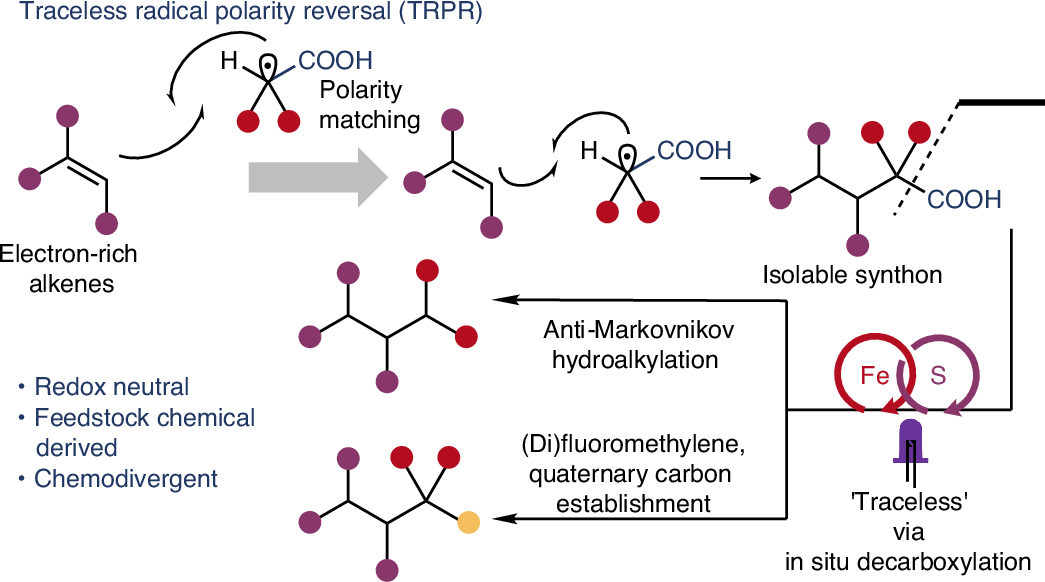
Julian West's lab reports in Nature Catalysis that a pair of carboxylic acids, plus iron, sulfur and a change of light color, adds a carbon fragment across an alkene double bond, a job usually given to palladium.
The Scientist · Science desk
What happened
- Rice University's iron, sulfur and purple light system could add fragments across alkene double bonds only when the incoming building block carried a highly reactive element such as fluorine.
- Plain carbon shares its electrons evenly and stays stable, and the phys.org account names palladium as the metal usually used to attach it to a double bond.
- The work appears in Nature Catalysis as "Anti-Markovnikov alkene hydroalkylation via iron photocatalysis," with Shih-Chieh Kao and Kang-Jie Bian as co-first authors.
Compiled by The ScientistSomething wrong?How this is made
Why it matters
- cost Any saving lands per bond formed, on routes where this specific addition is the step being paid for, and it accrues to the lab buying the catalyst.
- constraint The chemistry needs an alkene sitting exactly where the new carbon-carbon bond is wanted, so it cannot follow palladium into every route palladium is bought for.
- capability With a cheap acid as the carbon donor, a chemist can consider target designs too marginal to justify a precious-metal step.
- precedent Making a reluctant atom temporarily electron-poor and then washing the modifier out is a strategy other radical additions can copy without reaching for a new metal.
"We realized we couldn't manipulate the carbons when they were nicely sharing electrons," said Shih-Chieh Kao, a Rice doctoral alumnus and co-first author on the paper [9][11]. "But then we thought, what if we could, just temporarily, make a carbon behave like a fluorine? Then we could manipulate it." [10]
Fluorine matters here because of what it does to a bond. Tied to carbon, it takes the larger share of the shared electrons and sits with a partial negative charge. West's group had already used that charge to attach fluorinated fragments to double bonds with iron, sulfur and purple light [3][1].
The stand-in for fluorine is a pair of carboxylic acids, the class of compounds to which vinegar belongs [7]. Used together, they leave the target carbon holding more of the electron density. Make a small change to the color of the light and the iron system attaches that carbon to the double bond of choice [6]. "The carboxylic acid is very cheap to use," said Kang-Jie Bian, a doctoral student and co-first author [12][14]. "Then once the reaction is finished, we can wash it away and the carbon returns to its normal state." [13]
Acid goes in and a small amount of carbon dioxide comes out, the only waste the team reports [8]. Decarboxylation produces exactly that pattern, with the acid group leaving as gas and the carbon fragment it held ending up on the alkene [19].
The regiochemistry is in the paper's title, "Anti-Markovnikov alkene hydroalkylation via iron photocatalysis" [15]. Anti-Markovnikov means the alkyl group lands on the less substituted carbon of the former double bond, the reverse of the classical rule's preference [20].
The phys.org account calls the palladium approach environmentally and financially costly, and the new one inexpensive and reliant on widely available reagents [5][22]. It does not report yields, how many substrates were tried, how dilute the reaction runs, or how long the light has to be on [21]. Those are the numbers that decide whether a cheap reagent list becomes a cheap process. A photochemical step has to compete with a metal-catalyzed one on throughput as well as on price per gram.
West said the method "opens up ways to develop and test entirely new molecules, which could be the key to discovering the medicines of tomorrow" [18][16]. The published summary supports a narrower claim. A lab already running iron and sulfur photocatalysis for fluoroalkylation can reach a carbon-carbon bond by changing the additive and the color of the lamp [6][2].
What to watch
- The substrate table in the Nature Catalysis paper, and whether drug-like scaffolds survive the two-acid conditions.
- A head-to-head comparison against a palladium route on the same substrate, reporting yield and cost per gram.
- Whether the temporary-charge trick works with carbon donors other than the acid pair reported here.