Science1 publisher3 min readPublished
Pandoraea bacteria clip a swarming peptide's lipid tail to make a better iron binder
Leibniz-HKI researchers found Pandoraea bacteria use the enzyme PdnM to cut a swarming surfactant's lipid tail, turning it into a better iron binder. In five strains the mix of the two forms seemed to follow habitat, a link that still needs a controlled test.
The Scientist · Science desk
What happened
- Researchers at Leibniz-HKI and the University of Jena described pandorachelins, iron-capturing siderophores made by Pandoraea bacteria, in Angewandte Chemie International Edition.
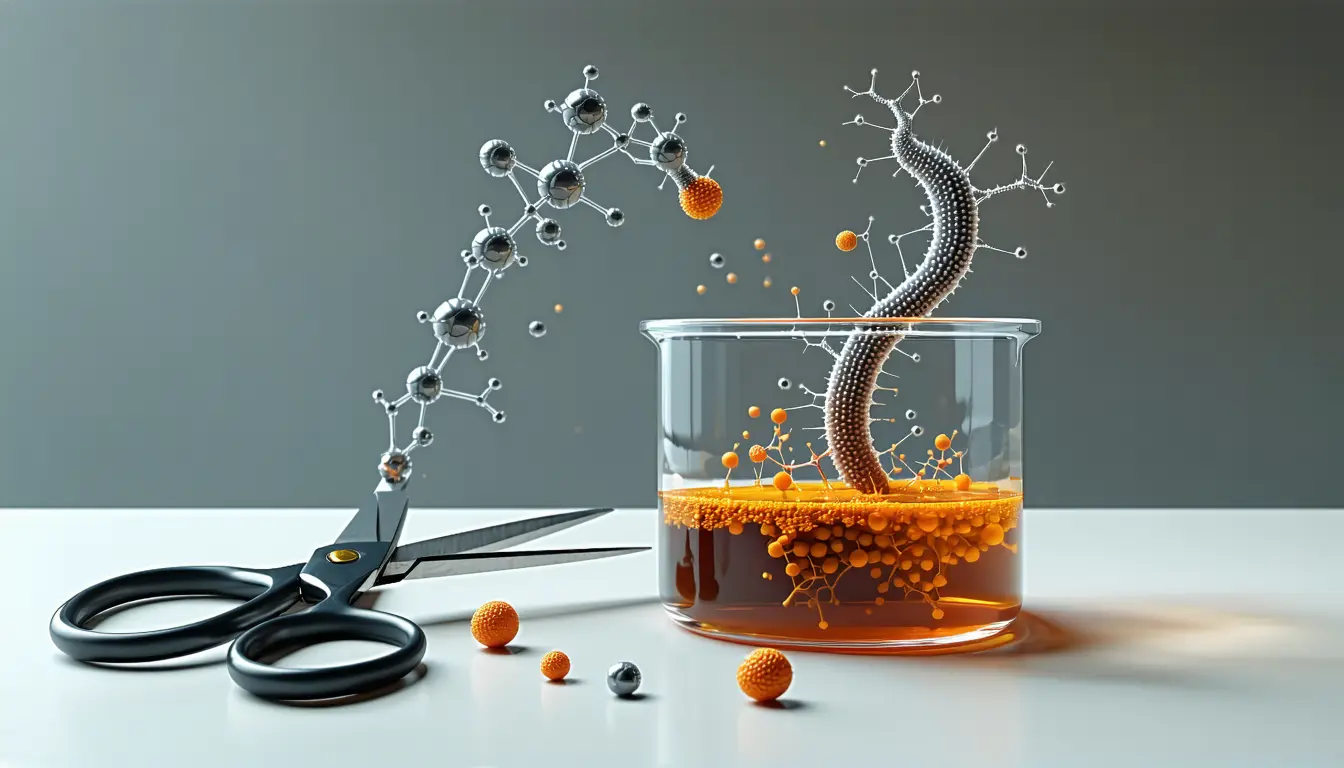
- An acylase called PdnM cuts the lipid tail off pandorachelin B, setting off an internal rearrangement and head-to-tail fusion that turns it into pandorachelin A.
- Pandorachelin B acts as a surfactant that helps the bacteria swarm, while pandorachelin A is the better iron binder of the two.
- Among the strains studied, one from lake sediment made only pandorachelin A, while one from a soil sample made both forms.
Compiled by The ScientistSomething wrong?How this is made
Why it matters
- precedent When a lipid predicted from a genome is missing from an isolated natural product, chemists now have a documented case to check against: a lipidated parent molecule and an enzyme that strips the tail.
- decision Researchers studying Pandoraea infections now have one enzyme, PdnM, to delete when asking whether swarming or iron capture matters more to the bacterium inside a host.
- constraint The habitat pattern cannot yet predict a strain's chemistry from where it was collected, since the public account profiles only two of the five strains.
The discovery ran in reverse order. Early bioinformatic analysis predicted that Pandoraea make a peptide carrying a fatty acid, but when Keishi Ishida and Elena Herzog found pandorachelin A, the fatty acid was missing [3]. Looking for it led them to pandorachelin B, a lipocyclopeptide [4]. The lipid the analysis predicted sits on B. The molecule they found first was A, the form made once PdnM trims that lipid away [4][5].
Herzog did the work for her doctorate alongside Ishida, a postdoctoral researcher, in Christian Hertweck's lab at Leibniz-HKI [8]. "We discovered that certain bacteria can transform a peptide with minor changes into another peptide, changing its function from supporting movement to capturing iron more efficiently. This remarkable transformation shows how bacteria can adapt their molecular tools to meet different needs," she said [7].
Her second sentence generalises from one pair of molecules. For that pair, the structural case is well supported: a single named enzyme makes a defined cut that converts B into A [5], as set out in a paper titled "Structural and Functional Siderophore Remodeling by Enzymatic Delipidation" [2]. The functional case is comparative. The report says A binds iron better and B supports swarming, but it does not include binding constants or swarming measurements, so the size of either effect cannot be read from it [6].
The habitat argument needs its denominator. The team analysed five species, collected from lake sediment, two soil samples, root-associated soil in India and human phlegm [9]. The published account gives profiles for two of the five [16]. The researchers described PdnM's control over the A-to-B ratio as a "sophisticated bacterial strategy" [10]. Their proposed reason is that swarming is easier in water, so bacteria in nonaquatic environments may need extra swarming support from B [12].
I think that explanation is plausible. It also rests on a correlation between where a strain was collected and what it makes. A direct test would grow one strain under wet and dry conditions, or delete PdnM, and measure swarming and iron uptake side by side.
The medical interest comes from the genus. Pandoraea species can live under many different conditions and develop antibiotic resistance, and some are opportunistic pathogens that are especially dangerous for people with compromised immune systems [13]. The team says the findings may help researchers work out how to prevent and treat those infections [14]. The work reported so far is enzyme chemistry and a survey of bacterial strains [5][9].
Herzog also looked further ahead. "Bacteria are remarkable chemists, and there is still so much we can learn from the way they produce and transform molecules," she said [15]. "Such insights may ultimately inspire new approaches in various areas ranging from drug delivery to more sustainable chemistry," she said [15].
What to watch
- Published iron-binding affinities for pandorachelins A and B, showing how large the gain from removing the lipid tail is.
- The pandorachelin profile of the strain isolated from human phlegm, and whether either form affects Pandoraea in an infection model.
- Reports of acylases like PdnM stripping lipids from siderophores in other bacterial genera, a test of how general this kind of molecular reuse is.