Science1 publisher2 min readPublished
Astronomers detect the first globular cluster star stream outside the Milky Way
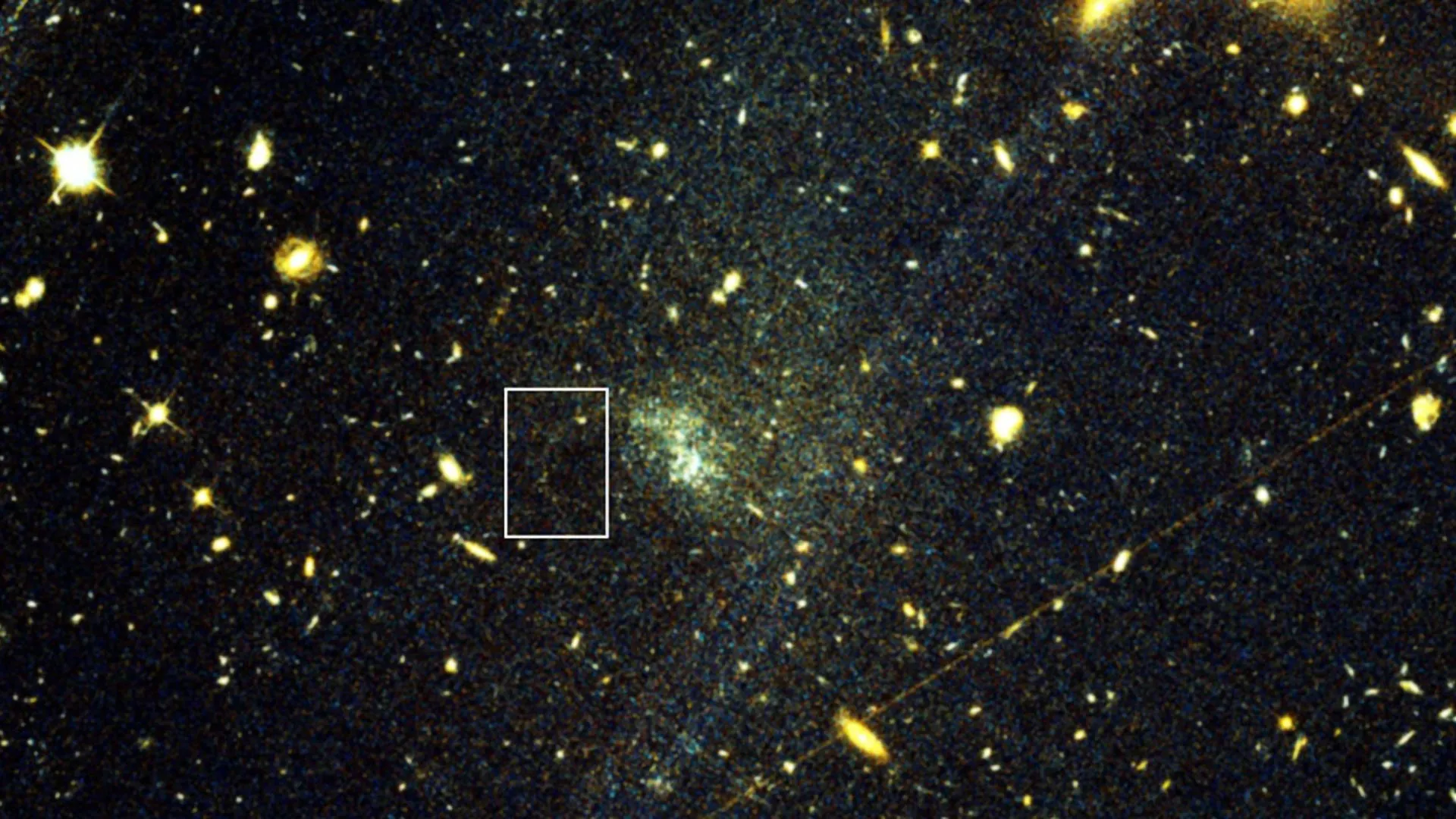
A Copenhagen-led team reports in Nature a faint trail of tidally stripped stars inside the ultra-diffuse galaxy UGC9050-Dw1, where the mass it implies agrees with earlier estimates for the same galaxy.
The Scientist · Science desk
What happened
- A team led by PhD student Julie Kiel Holm of the Niels Bohr Institute and Associate Professor Sarah Pearson of DTU Space reported a globular cluster stellar stream in a galaxy other than the Milky Way.
- The result was published in Nature, and Holm says it is the first time such a stream has been observed outside our own galaxy.
- The stream sits in UGC9050-Dw1, an ultra-diffuse galaxy, and the team's new estimates of its total mass and mass distribution point to a large amount of dark matter.
Compiled by The ScientistSomething wrong?How this is made
Why it matters
- capability Dark matter in an ultra-diffuse galaxy can now be probed with a tracer that does not require the observer to sit inside the galaxy being weighed.
- constraint The approach needs a surviving stream and imaging deep enough to see it, so candidate galaxies will stay few until wider deep surveys arrive.
- precedent More detections would give ultra-diffuse galaxies a mass estimate that does not depend on how much light they emit.
A new way of measuring a galaxy is judged first on whether it reproduces what other methods already found. "Our results are consistent with previous studies and what they have shown about dark matter in this ultra-diffuse galaxy. We are measuring it with a completely new tool, demonstrating that this method also works beyond our own galaxy," Julie Kiel Holm said in the University of Copenhagen release dated 23 September 2026 [6][17]. The release does not report the mass value, its uncertainty, or which telescope supplied the images [18]. Agreement is informative in proportion to the precision of the two numbers being compared, and two loose estimates overlap easily.
The physical picture is straightforward. A globular cluster orbiting inside a larger galaxy has stars pulled off it by the host's gravity, a process called tidal stripping, and the escaped stars trail out into a long, narrow line [7]. Because gravity sets that line's shape and motion, the stream responds to the mass it is moving through whether or not that mass emits light [8]. It constrains how much mass there is and where it sits, not what the mass is made of, and the release says dark matter accounts for roughly 80 to 85 percent of all matter in the universe with its fundamental nature still unknown [9]. The remaining 15 to 20 percent is ordinary matter [10].
Both objects in this detection are dim. The stream's own signal is weak, and its host galaxy gives off very little light [4]. Until recently that faintness made streams very hard to detect and analyse at all, and the release credits larger astronomical datasets and better analysis methods for the change [16].
The work centres on one galaxy [15]. "We show that a well-established tool from studies of the Milky Way can be used to understand other galaxies, where measuring the distribution of dark matter has traditionally been very challenging," Holm said [12]. Sarah Pearson, who contributed to the discovery while employed at the Niels Bohr Institute [14], said: "This opens entirely new possibilities. Not only can we now search for globular cluster stellar streams in other galaxies, but in the long term, we may also be able to measure the dark matter content of more ultra-diffuse galaxies" [13].
What to watch
- Whether the Nature paper's stated uncertainty on the stream-derived mass of UGC9050-Dw1 is tighter than earlier estimates for the same galaxy.
- Whether searches in other galaxies turn up a second globular cluster stream, which would move this from one detection to a sample.
- Whether deeper imaging finds these streams in hosts that are not ultra-diffuse, where the background light is stronger.