Invest1 publisher3 min readPublished
Korea's rural water agency puts its possible renewable-quota fine at 1.3 trillion won
Korea Rural Community Corporation says it could owe 1.3 trillion won in fines if assigned 1 gigawatt of renewables a year and it builds none. The estimate lands as the agriculture ministry fights to keep a farm-water agency out of Korea's renewable quota.
The Investor · Invest desk
What happened
- A draft decree lets the climate minister designate public power producers holding 100 megawatts or more of renewables, and the corporation holds 165 megawatts directly.
- The agriculture ministry will tell the climate ministry by Oct. 8 that it opposes the designation, arguing a power target could undermine the agency's water-supply mission.
- The rules implement a January law that swaps the Renewable Portfolio Standard's generation-volume duty for a capacity obligation backed by fines.
- Shortfalls left after deferrals or alternative compliance can draw fines of up to 150% of an amount set by an officially announced unit price.
Compiled by The InvestorSomething wrong?How this is made
Why it matters
- cost If designated, revenue the corporation built up to plug its water funding gap would go first to a capacity quota set by another ministry, the diversion people inside and outside the agency have warned of.
- exposure Any public institution holding 100 megawatts or more of renewables can be designated at the minister's discretion, so the quota can reach bodies whose main job is not electricity.
- decision The test counts capacity held, so agencies near 100 megawatts have a reason to develop projects they do not hold directly. The corporation already holds only 165 of the 306 megawatts it developed.
The 1.3 trillion won is the corporation's own worst case. It assumes the agency is handed 1 gigawatt a year and meets none of it [14]. If the estimate also assumes the 150% penalty ceiling [13], it implies a base of about 867 billion won per gigawatt, or roughly 867 million won for each missing megawatt [1]. The officially announced unit price was not reported, so that per-megawatt figure is a back-calculation.
Set that gigawatt against what the agency owns. It holds 165 megawatts directly and developed 306 megawatts through 2025 [9][10]. A single year's assignment of 1 gigawatt would be about six times its directly held fleet and more than three times everything it developed through 2025 [2][3]. The worst-case fine is 6.5 times the roughly 200 billion won it falls short each year on agricultural water supply and aging irrigation facilities [4][15].
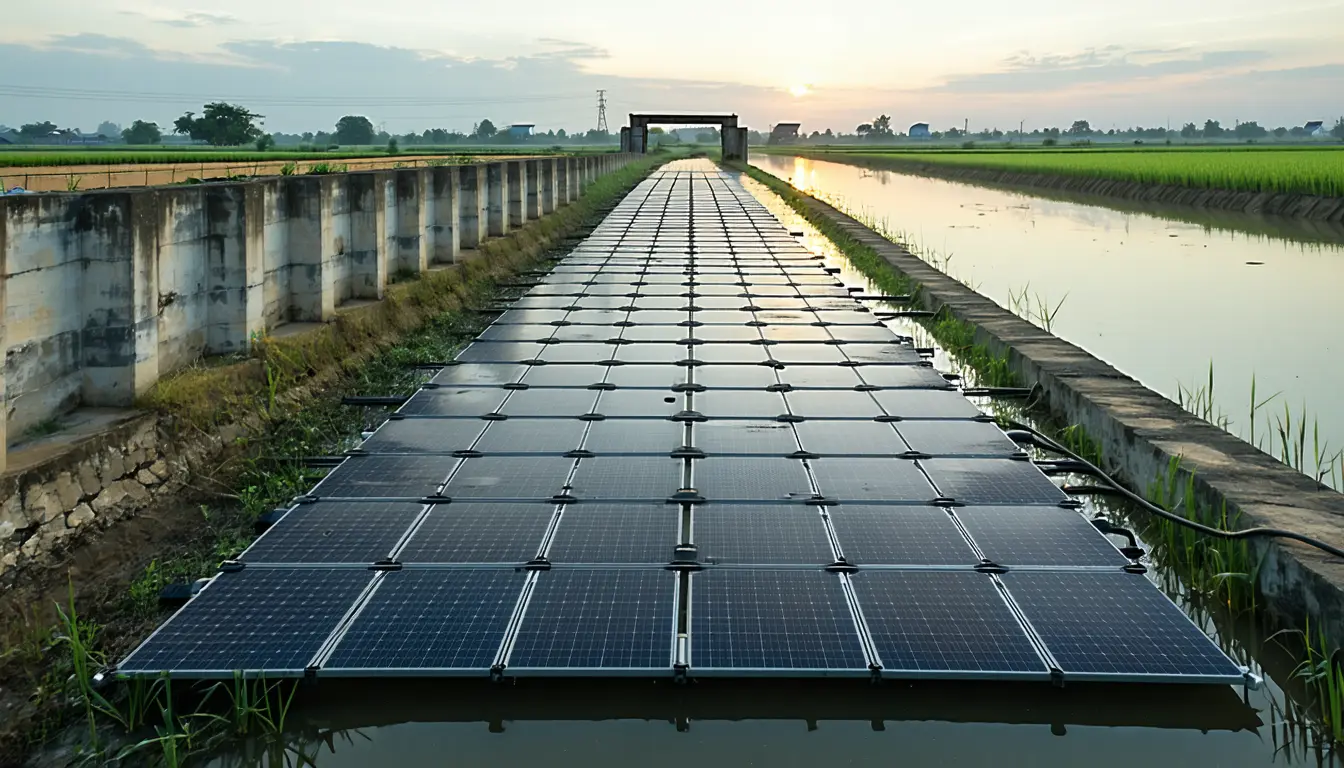
At 165 megawatts the corporation sits 65 megawatts above the decree's line [5]. Its own power business put it there. It expanded solar on reservoirs and freshwater lakes to cover that irrigation funding gap [15]. The corporation made the same objection as the agriculture ministry a day earlier, at a briefing held at its floating solar project in Saemangeum [5]. "Imposing an obligation based solely on the scale of renewable energy facilities held is an inappropriate standard that fails to consider the agency's founding purpose and duties," an agriculture ministry official said [4].
Under the capacity rule, a designated party must install, or secure through investment, the megawatts the government sets each year [12]. Designation would let the climate ministry decide how many megawatts the corporation has to finance annually [12].
The climate ministry can still leave the corporation out. "Not everyone exceeding the 100-megawatt threshold will be designated as a party subject to the obligation," a climate ministry official said [17], adding that details would be finalized through consultations [18]. A second path designates the agency with an assignment near the size of its current fleet, and the fine exposure shrinks with the shortfall [13]. The third assigns something close to the 1 gigawatt the corporation modeled. According to the agricultural sector, the climate ministry's hearing included a plan to consider designating the corporation [11].
I think the 1.3 trillion won is a ceiling built for the negotiation, and the real contest is the size of the annual assignment [14]. The counter-case is that an agency which has already put 306 megawatts on reservoirs and lakes is the kind of builder a capacity rule needs [10][15], and the climate ministry has reason to use it. The draft as reported does not say whether adding public agencies raises the national build or spreads the same target across more balance sheets. If the final decree assigns the corporation anything near 1 gigawatt a year, its estimate was a forecast and this view is wrong.
What to watch
- Whether the final decree names other public institutions above 100 megawatts, showing how far the obligation reaches beyond power companies.
- The officially announced unit price behind the 150% fine, the number that converts any shortfall into won.
- Whether the agriculture ministry's submission proposes a designation test based on an agency's mission in place of capacity held.