Invest1 publisher3 min readPublished
Korea's state forecaster puts 0.6 of a 0.7-point growth upgrade on semiconductors
KDI lifted this year's GDP forecast to 3.2% from 2.5% and attributed almost all of it to the AI-driven chip cycle. It also cut its jobs forecast by 60,000.
The Investor · Invest desk
Drafted by a language model from the sources cited here and checked against its claim ledger before publication. How we use AISend a correction
What happened
- The Korea Development Institute (KDI), a state-funded research institute, sharply raised its forecast for South Korea's economic growth this year to 3.2% from 2.5%, lifting its outlook by 0.7 percentage points in just three months, citing a semiconductor upturn driven by expanding global AI investment.
- KDI estimated that about 0.6 percentage points of the upward revision stemmed from semiconductors and their ripple effects.
- In its revised outlook released on the 19th, KDI projected real GDP growth of 3.2% this year, 0.7 percentage points above the 2.5% in its May first-half outlook, and raised next year's growth forecast to 2.2% from 1.7%, an increase of 0.5 percentage points.
- KDI's forecast is 0.2 percentage points higher than the 3.0% the government presented last month, and 0.3 percentage points lower than the 3.5% projected the previous day by Moody's.
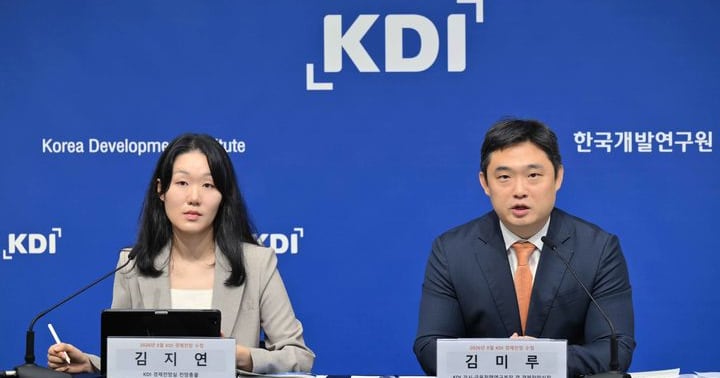
- Kim Mi-ru, head of KDI's macroeconomic and financial policy research department, said of the 0.7-percentage-point increase that "roughly about 0.6 percentage points is a rise from semiconductors and their ripple effects"; KDI said the remaining 0.1 percentage point came from non-semiconductor factors.
Compiled by The InvestorSomething wrong?How this is made
Why it matters
The Korea Development Institute, the government-funded research institute, raised its growth forecast for this year to 3.2% from 2.5%, a 0.7 percentage point revision in three months, and attributed about 0.6 points of that to semiconductors and their ripple effects [1][2]. That is not a forecast that happens to include a strong sector; it is a national growth number that now rests on one industry's capital cycle [5].
Kim Mi-ru, head of KDI's macroeconomic and financial policy research department, said "roughly about 0.6 percentage points is a rise from semiconductors and their ripple effects," with the remaining 0.1 point coming from everything else [5]. On those figures, chips account for roughly 86% of the upgrade [1]. The 0.6 points is not exports alone: it bundles chip exports, facility investment for production plants, and consumption effects from rising incomes [6]. KDI also estimates semiconductors and related sectors will account for more than half of this year's total increase in GDP [7]. The inputs behind the revision were a significant improvement in the global memory chip market outlook since KDI's May forecast and a second-quarter GDP print that beat expectations [8].
The pass-through into the trade and investment lines is where the size shows. Total export growth was raised to 8.7% from 4.6%, goods exports to 8.6% from 4.5%, and facility investment growth by a full 4.6 points to 7.9% from 3.3% on expectations of substantially higher spending on chip production facilities [9][10]. Better terms of trade from rising chip prices push the current account surplus forecast to $359.7 billion from $239.0 billion, an increase of $120.7 billion, or about 51% [11][3]. Against the roughly $100 billion in annual surpluses Korea has typically posted, that is about 3.6 times normal, and KDI's department head called $360 billion "an extraordinarily large figure" [11][2].
What has not moved is the part households experience. Private consumption growth for this year was raised by 0.1 point, to 2.3% from 2.2%, because the income gains are concentrated in semiconductor-related sectors and have not fed sufficiently into real wages or into most households [12]. The employment forecast went the other way: KDI cut expected job growth by 60,000, to 110,000 from 170,000, citing chips' relatively small job-creation effect, weak construction and non-semiconductor manufacturing, and slowing services hiring [13]. "Because the semiconductor gains are quite concentrated, economic conditions as people feel them will be much worse than the growth rate," Kim said [14].
KDI's 3.2% sits 0.2 points above the 3.0% the government published last month and 0.3 points below the 3.5% Moody's projected the previous day, so the argument now is about the size of the chip effect, not its direction [4].
Watch three things. First, the memory market outlook, since it is the single input that carried the revision; a downgrade there reverses the same arithmetic [8]. Second, the lag thesis: KDI raised next year's private consumption forecast to 2.0% from 1.5% on the expectation that the boom spreads to domestic demand [15]. Third, whether facility investment at 7.9% actually lands, because that line, not exports, is where a capex pause would show up first [10].