Product2 publishers3 min readPublished Updated
Divine bans AI video and bets two million old Vines can hold an audience
The Vine successor from Evan Henshaw-Plath enforces its human-only rule by refusing uploads entirely. The interesting question is what that constraint costs in production and in moderation.
The Product Desk · Product desk
Drafted by a language model from the sources cited here and checked against its claim ledger before publication. How we use AISend a correction
What happened
- Divine, an app seen as a spiritual successor to short-form video service Vine, has been released to the public.
- Like Vine, Divine lets users create and share videos that are six seconds long and repeat on a loop.
- Divine hosts more than two million original Vine videos.
- Divine bans content made by AI, in a bid to further distance itself from other platforms.
- Divine's founder is former Twitter employee Evan Henshaw-Plath, who told the BBC he wanted to create the app because he felt social media needed "a reset".
Compiled by The Product DeskSomething wrong?How this is made
Why it matters
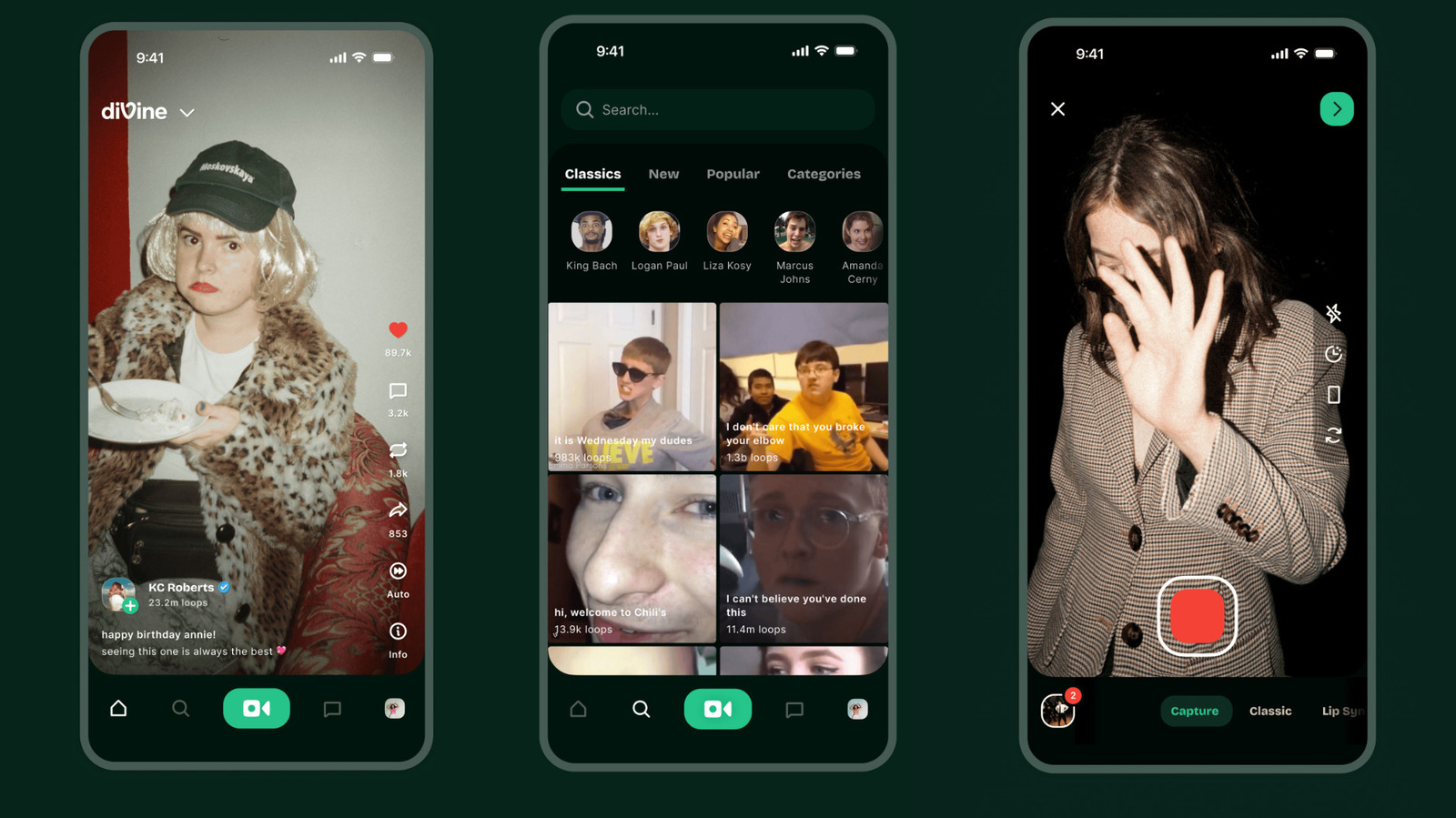
Divine, a short-form video app widely described as a spiritual successor to Vine, has opened to the public with six-second looping videos, more than two million original Vine clips, and a ban on content made by AI [1][2][3][4]. The ban is the product decision worth watching, because unlike most "authenticity" positioning it is enforced by a rule that removes capability from users.
The mechanism, per Divine's own FAQ, is that videos must be recorded live in the app rather than uploaded from elsewhere [7]. That is a hard constraint, not a policy statement: it rules out any workflow that touches another tool between camera and post. On top of it, Divine says it will use ProofMode, a verification tool that works like a digital receipt and can attach information about when a file was recorded and whether it has been altered since [8]. Users can flag suspected AI content, and both automated systems and humans will look for signs of the technology [9]. So the stack is four layers deep: capture restriction, provenance metadata, user reports, and mixed machine and human review. Three of those four are recurring cost lines, and the first one is a permanent tax on creator convenience.
Founder Evan Henshaw-Plath, a former Twitter employee, told the BBC he built the app because social media needed "a reset" and that he was "sick and tired of seeing videos and not knowing whether it was real" [5][6]. The commercial question is whether users price that the same way he does. Divine is backed by Twitter co-founder Jack Dorsey, who held a senior role at Twitter when it bought Vine in 2012 [12][13]; Twitter shut Vine down in 2017, five years later, after a peak of more than 200 million monthly active users [11][10][1].
The archive is the acquisition strategy. Henshaw-Plath found that the Internet Archive had preserved a copy of Vine's data and spent months reconstructing it [19]; the platform's back catalogue includes work by stars such as Jake Paul and Lele Pons [21]. He expected a few thousand people to care, and instead 10,000 installed the app in its first few hours, overwhelming the servers [20]. That is a useful signal and a small number: it is one twenty-thousandth of Vine's peak monthly audience [2].
Retention is the harder half, and Divine has made it harder on purpose. The app is built on Nostr, a decentralised system, so it is not controlled by a single company in the way TikTok or Instagram are, and users can potentially move their accounts and content to other services on the same protocol [14][15] - the approach taken by Bluesky and Mastodon [16]. Portability means lock-in is unavailable as a retention tool. Social media analyst Matt Nevarra told the BBC that "the mechanisms people dislike about modern social media are often the same that made those platforms extraordinarily good at keeping people there", and that Divine "has to prove you can remove some of the addiction without removing the magic" [17][18].
Watch three things. Whether the record-in-app rule survives contact with creators who want to edit, since that is the first constraint a growth team will be asked to relax. Whether ProofMode receipts and human review scale past flagging into actual removals at volume. And whether six seconds still reads as a form rather than a limitation, in a market where YouTube and TikTok have moved towards much longer videos and where Henshaw-Plath's own defence of the format is that Vine was closer to poetry than prose [22].