Invest1 publisher3 min readPublished
Treasury's 10-Basis-Point Rule Turns Trump Accounts Into a Compliance Problem
Proposed regs cap eligible investments at 0.1% in annual fees and require an unleveraged US equity index fund until the year the child turns 17. Seven million accounts are already open.
The Investor · Invest desk
Drafted by a language model from the sources cited here and checked against its claim ledger before publication. How we use AISend a correction
What happened
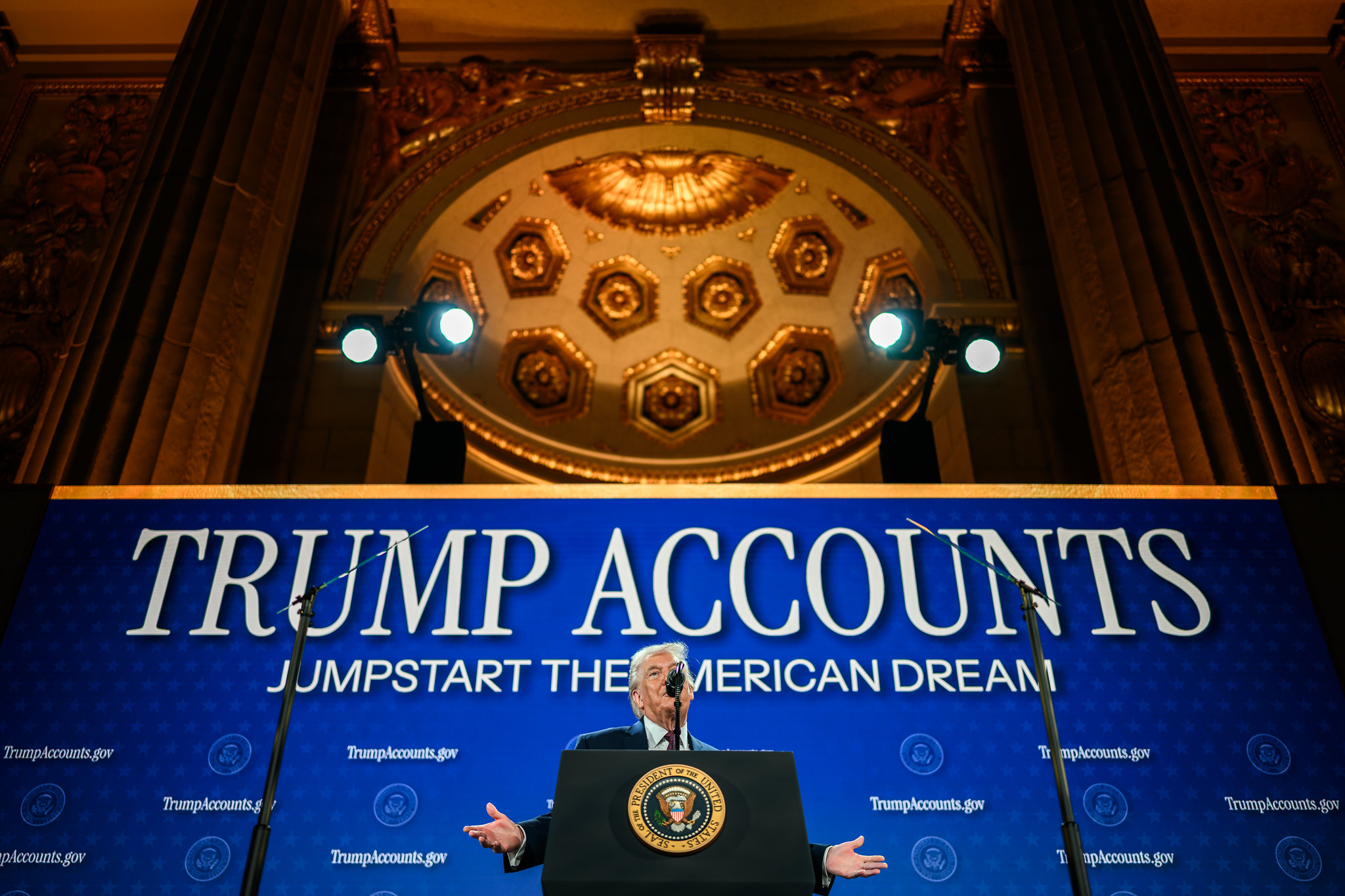
- The Treasury Department and the IRS have proposed regulations on eligible investments for Trump Accounts, a new investment vehicle created by the One Big Beautiful Bill Act to help children build wealth from an early age.
- Trump Accounts are available to any child in the U.S. under age 18 with a Social Security number. Babies born between Jan. 1, 2025, and Dec. 31, 2028, are eligible for $1,000 in federal seed money, regardless of family income.
- As of the end of July, 7 million Trump Accounts have been established, and 1 million people have claimed the federal money for their newborns.
- The accounts officially launched on July 4.
- Under the proposed regulations, funds in a Trump Account can only be invested in eligible investments during the growth period, which begins when the account beneficiary's initial Trump Account is established and ends on Dec. 31 of the calendar year in which the beneficiary turns age 17. After the growth period, the eligible investment restrictions no longer apply.
Compiled by The InvestorSomething wrong?How this is made
Why it matters
Treasury and the IRS have proposed regulations defining what a Trump Account may hold during its growth period, limiting eligible investments to mutual funds and ETFs that track an equity index of primarily US companies, do not use leverage, and charge annual fees and expenses of no more than 0.1% of the balance in the fund [1][6]. Because 7 million accounts had already been established as of the end of July, the rule lands on an installed base rather than a hypothetical one [3].
The perimeter is narrow and it is time-boxed. The growth period starts when the beneficiary's initial account is established and ends on Dec. 31 of the calendar year in which the beneficiary turns 17, after which the eligible investment restrictions fall away [5]. For a child born in 2025, the first year eligible for the $1,000 federal seed payment, that means roughly 18 calendar years inside the fence, running through Dec. 31, 2042 [2][19]. A 0.1% ceiling is 10 basis points, or about $1 a year per $1,000 of balance [17]. That excludes most actively managed products by construction, which is the stated intent: Treasury said the proposal would limit eligible investments to choices with low expense ratios and exclude products with excessive fees or unnecessarily complex strategies [15].
Defaults do the real work here. If a beneficiary does not select an eligible investment offered by the trustee, funds are automatically invested during the growth period in an eligible investment chosen by the trustee [7]. Treasury has already named the State Street SPDR Portfolio S&P 500 ETF (SPYM) as the default for all Trump Accounts, plus four additional low-cost index ETFs a parent or other responsible party may choose [13]. The proposal also sets a framework for designating eligible investments for future trustees, including rollover trustees [16].
For benefits teams, this is the second half of a two-part rulemaking. Earlier in the month, Treasury and the IRS issued proposed rules for employers that choose to contribute to Trump Accounts for employees or their dependents, including nondiscrimination requirements for Trump Account contribution programs and dependent care assistance programs [9]. The investment rules generally would apply to tax years beginning on or after Jan. 1, 2026 [8], so a payroll-side program designed this year has to assume a menu constrained to 10-basis-point index funds.
The adoption numbers are worth reading carefully. Accounts launched on July 4 [4], and by the end of July 7 million accounts existed while 1 million people had claimed the federal money for their newborns [3]. That leaves about 6 million accounts not tied to a claimed newborn seed payment [18], which is where advisor and employer contributions will show up, and where the fee cap will actually bite.
IRS CEO Frank Bisignano said on Aug. 20 that the proposals would provide clarity for trustees and beneficiaries and encourage participants to invest in low-fee funds growing on a tax-deferred basis [11]. Treasury Secretary Scott Bessent framed the fee ceiling as commonsense protection so families keep more of their returns [12].
What to watch: comments are due Oct. 20, 2026 [10], and the current draft already reflects stakeholder feedback on Notice 2025-68 from December 2025 [14], so the 0.1% threshold and the primarily-US-companies index test are the two lines fund complexes will push on. Also watch how rollover trustee designation is finalised [16], since that determines whether an account can move without breaking eligibility mid-growth-period.