Invest1 distinct publisher3 min readPublished
Goldman puts regional export flow at 15 to 16 million barrels a day, so the defended Omani corridor is carrying roughly two-thirds of it. That is what an eroding chokepoint premium looks like in volumes rather than in quotes.
The Investor · Invest desk

Compiled by The InvestorSomething wrong?How this is made
The premium a cargo owner pays to cross Hormuz buys one thing, an option on closure, and the underlying of that option is less Iranian intent than Iranian eyesight. Two weeks of American bombing last month degraded Tehran's radar and maritime surveillance to the point where tankers now run the strait at night with transponders off, shuttle out, and hand cargo to other tankers that carry it to customers [14]. Enforcement on the other side has gone administrative: of the 87 vessel interactions Central Command tallied, 82 were redirections against three disablings and two boardings, which is 94% of the file settled by radio [22].
Set the defended lane against the whole basket. Goldman Sachs has total crude and product exports out of the region at 15 million to 16 million barrels a day [10], which puts the corridor's roughly 10 million at between 62% and 67% of everything leaving [20]. Kpler's read, Gulf flows at about 70% of pre-war levels [11], implies a normal somewhere near 21 million to 23 million barrels a day and 6.4 million to 6.9 million barrels still absent each day [21]. The two houses are not counting identical cargoes, so treat the missing volume as directional rather than audited, but it is the honest form of the risk premium, paid in barrels that did not sail rather than in insurance quotes.
The macro is the part Tehran cannot escort around. The IMF in April had the economy shrinking 6.1% this year, the worst contraction in decades [4], and a labour ministry official put job losses above one million by late May [5]. Iran is still attacking ships and the attacks are not stopping traffic [15], which is the expensive kind of failure, because each sortie spends degraded surveillance and finite munitions on a lane that keeps getting cleared.
This is probably wrong in one specific way. Or rather, the more interesting version of the thesis is that the Hormuz premium was never a price on Iranian capability at all but a price on whether somebody else would escort, in which case what has changed is a deployment schedule, and Central Command's completed clearance of mines from the international routes last week [9] is a maintenance task rather than a settlement. If the escort thins, the same water reprices within a session; if Iran lands one mining that halts traffic for a week, the option holders are vindicated at a price they will enjoy. The dull path is flows grinding back toward normal while the premium bleeds away and transponder-off shuttle runs become ordinary freight. I lean to the dull one, and I would drop it the day Kpler's 70% prints below 50.
Ranked by verification strength, evidence, and original report placement.
Iranian inflation has soared above 80%, with prices for certain food staples up 100%.
The International Monetary Fund said in April that Iran's economy will shrink 6.1% this year, the worst contraction in decades.
An Iranian labour ministry official estimated that more than 1 million jobs had been lost by late May.
US officials told Axios that about 10 million barrels of oil a day are being transported out of the strait through the Omani corridor that the US military is defending.
The naval blockade has prevented Iran from exporting oil via its ports and has kept out imports of refined fuels, creating shortages and long lines at petrol stations, made worse by deep subsidies that encourage excess consumption.
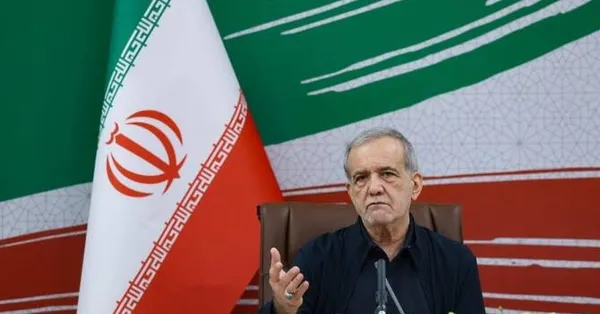
Pezeshkian described efforts to curb fuel demand and hike prices but hinted they cannot go too far, saying "People are on the edge now; if I put more pressure on them, they might fall off the edge."
Distinct publishers with included, body-backed reporting in this cluster.
fortune.com
1 article · August 30, 2026
Follow any of these and your For You feed starts watching them — no settings page required.
invest
Hormuz tolls look permanent: price the chokepoint, not the spike1 distinct publisher
invest
US strikes Iranian launchers on Larak Island days after declaring Hormuz mines cleared3 distinct publishers
invest
Iran's new security chief puts every Gulf barrel behind his sanctions threat1 distinct publisher
invest
Iran calls third-country compliance an act of war as Bessent readies new measures1 distinct publisher
Evidence-backed comparisons of source perspectives and observed adoption signals. Read the methodology
Which Builder, Operator, and Investor concerns the observed source mix emphasized—not a truth score.
Evidence, demonstrated adoption, hype gap, incentives, and confidence are assessed independently, each on its own current evidence. How these are measured.
Named sources, one relay
The figures are attributed rather than asserted — Goldman Sachs, Kpler, the IMF, Central Command — which is better than most geopolitics reporting manages. But every one arrives through a single publisher, and the number the headline rests on, 10 million barrels a day, is unnamed US officials quoted to Axios and then quoted again by Fortune. Two hops from the measurement to the reader, with no manifest, no baseline and no dissent.
Barrels actually moving, still short of normal
Adoption here is traffic, and traffic is observable: Kpler counts Gulf flows at roughly 70% of pre-war, Goldman counts 15 to 16 million barrels a day leaving the region, and Central Command's 87 vessel encounters show a lane being used under supervision. This is behaviour, not intention — shipowners are sailing. The ceiling on the score is that the recovery is explicitly partial and Iran's own loadings are excluded from it entirely.
The ratio is cleaner than its inputs
Two-thirds is an arresting fraction, and it is arithmetically fair — but it divides a corridor volume from anonymous officials by a regional export total from Goldman, and nothing in the reporting establishes that the two count the same barrels. The direction of travel is well supported by Kpler and by Central Command's operations; the precision of the share is not. Fortune's own hedge, that estimates vary and volumes remain well short of normal, does more to keep this honest than the framing above it.
Nobody quoted here is a neutral counter
Central Command is scoring its own campaign and volunteers the tally that flatters it. Pezeshkian needs sanctions to look painful enough to justify negotiating and survivable enough to keep him in office, and the interview does both jobs in the same breath. Kpler and Goldman sell exactly this data to people trading on it, and Eurasia Group's Brew is publicly graded on calls like the one he made on X. That is not disqualifying, but no source in this story loses anything by the picture it paints.
Right shape, unverified magnitudes
We would defend the claim that Hormuz risk is being repriced downward in volume terms: too many separate observations — mine clearing, redirections, dark transits, Iranian loadings collapsing while regional flow recovers — point the same way to be an artefact. We would not defend the specific fractions to the decimal, and with one publisher and one anonymously sourced keystone number, a single correction upstream would move the story materially.