Invest1 distinct publisher3 min readPublished
Mohsen Rezaei took over Iran's Supreme National Security Council in the August decrees and says continued economic war ends oil exports from the Persian Gulf. The collateral is mostly other producers' cargo, and the supreme leader who would sign any deal has not been seen in 182 days.
The Investor · Invest desk

Compiled by The InvestorSomething wrong?How this is made
An option is worth what exercise costs whoever holds it, and this one has a peculiar feature: much of the writer's own collateral is already impounded, because the American blockade is squeezing Iranian exports before anybody carries out anything [6]. So the barrels genuinely at stake sit on other producers' berths, or rather, the more interesting version, they sit in transit, which is why the transit claim rather than the cash claim [16] describes what the new leadership believes it still owns.
This account gives no price [5]. There is no Brent quote here, no war-risk insurance line, so any claim that the market has already written this tail off is an assertion nobody in the material has measured, and I would rather say so than dress a guess up as arithmetic.
What the material does support is a calendar. Feb. 28 to Aug. 29 is 182 days [1], and in every one of them the man whose decrees constitute this government [3] has not appeared in public, on video or on audio, and is believed to have been wounded [10]. He is 56, and the post he inherited was held by his father for some 37 years [10][11]. Seventeen days after his own appointment decrees [3], the loudest output of the new structure was a threat rather than an offer [5].
The appointments read the same way. Rezaei, 71, ran the Revolutionary Guard from 1980 to 1997, which is seventeen years starting at roughly twenty-five [12][2]; Vahidi, 68, was confirmed atop the Guard he had been running since his predecessor was killed alongside the elder Khamenei [13]; the IISS analyst Sascha Bruchmann, who notes that Rezaei was Vahidi's commander for years, reads the whole set as internal cohesion, a clique of older officers who have served together for decades [14]. Handing the Basij to a veteran intelligence chief is read in Tehran as intent to pre-empt new unrest while economic discontent spreads [9], which is a leadership spending its scarcest capacity on domestic control instead of on the reopening that would relieve the discontent.
This is probably wrong, but the deal space now looks nearer zero than merely narrow, and the reason is less ideological than procedural: there is no visible principal to sign, since the decrees issue from a man nobody has seen in half a year [10], and his most prominent negotiating advocate, President Masoud Pezeshkian, is arguing from outside the security core [17]. The counter comes from Kpler's Homayoun Falakshahi, who wrote both that these appointments hand greater influence to officials with a tougher stance and that Iran may struggle to escalate enough to restore deterrence without triggering retaliation that leaves it worse off [15]. On that reading the threat is posture, cargoes keep loading, and the premium expires worthless. He may well be right; posture has moved oil for a week before. What would move me off my read is narrow and observable: Pezeshkian acquiring an actual portfolio in the next round of decrees, or Khamenei appearing in public at all, which would restore a counterparty capable of signing something.
Ranked by verification strength, evidence, and original report placement.
Hossein Taeb, a hard-line cleric and longtime intelligence chief who led one of the first major crackdowns on protests in 2009, was named head of the Basij.
The Basij, the Revolutionary Guard's volunteer street force, played a major role in crushing January's nationwide protests, when thousands were killed.
Taeb's appointment is seen as a sign that the leadership intends to prevent any new unrest as discontent over the economy spreads.
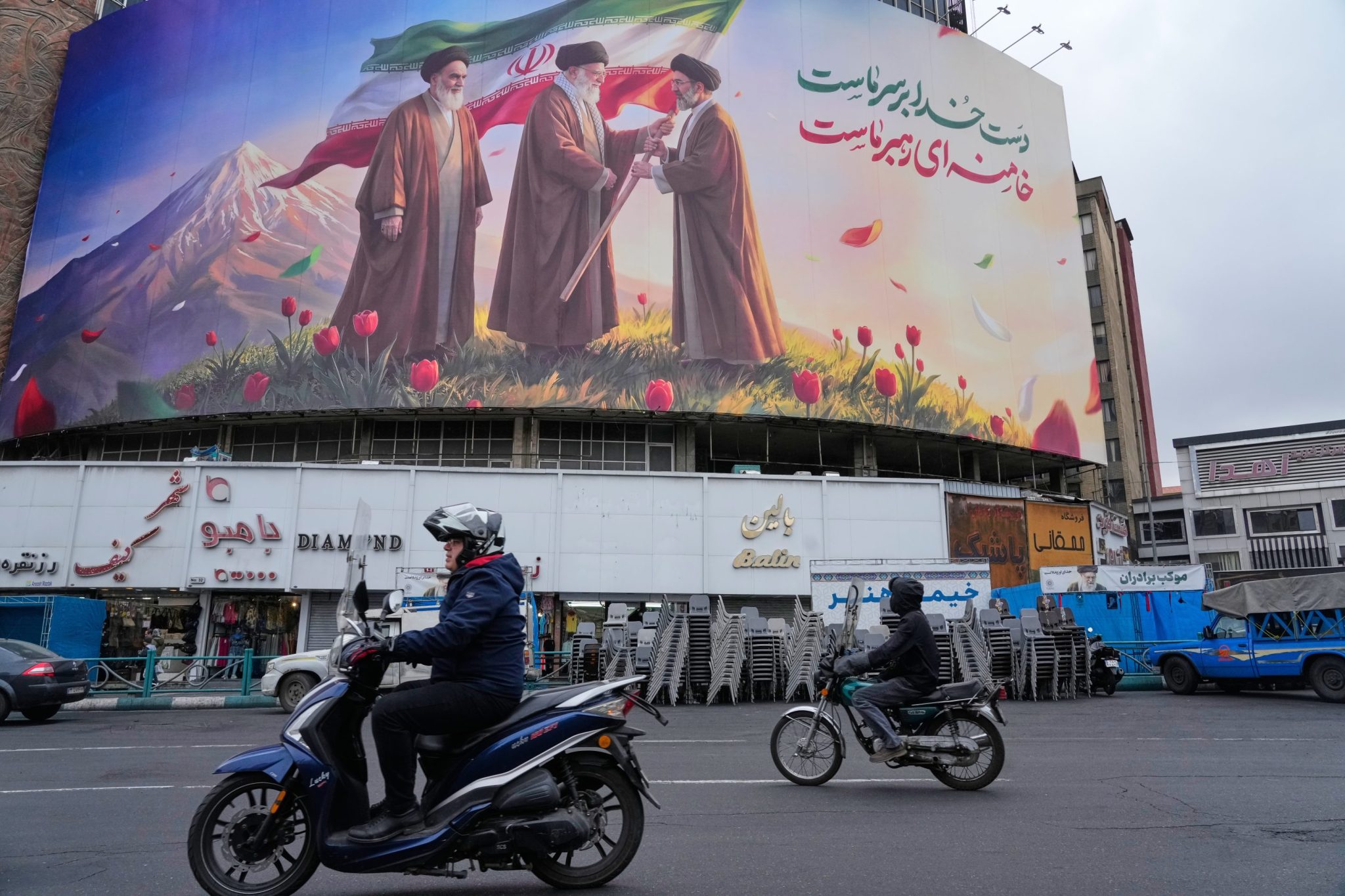
Mojtaba Khamenei, 56, has not been seen in public or appeared in video or audio since Israeli strikes killed his father, and is believed to have been wounded in those strikes.
After six months of war, Iran's leadership has coalesced around a hard core of military generals and clerics long entrenched in the theocracy, ready for a potentially long confrontation with the U.S. and determined to prevent unrest at home.
The bombing campaign launched by the U.S. and Israel began on Feb. 28 and killed Mojtaba Khamenei's father along with much of the highest echelons of Iran's leadership.
Distinct publishers with included, body-backed reporting in this cluster.
Follow any of these and your For You feed starts watching them — no settings page required.
invest
Iran's negotiators want out; the Guard does not. The oil premium now tracks a factional fight1 distinct publisher
invest
Iran calls third-country compliance an act of war as Bessent readies new measures1 distinct publisher
invest
Hormuz transit falls to two vessels a day, and the risk premium becomes a delivery problem1 distinct publisher
invest
Bessent's 'Economic D-Day' puts the Iran sanctions bill on intermediaries, not Tehran1 distinct publisher
Evidence-backed comparisons of source perspectives and observed adoption signals. Read the methodology
Which Builder, Operator, and Investor concerns the observed source mix emphasized—not a truth score.
Evidence, demonstrated adoption, hype gap, incentives, and confidence are assessed independently, each on its own current evidence. How these are measured.
One dispatch, named appointments, unnamed casualties
Fortune's report does the things a solid wire dispatch does: it dates the decrees, names the man in each post, and puts two experts on the record — Sascha Bruchmann of IISS in Bahrain and Kpler's Homayoun Falakshahi. What it cannot do is check itself. The February toll among Iran's top leadership, the 'thousands' killed in January's protests, and the belief that the new supreme leader was wounded all arrive without a named source, and there is no second newsroom in this coverage to test them.
Decrees enacted, threat unexecuted
Separate what has happened from what has been announced. The Aug. 11-12 decrees are done and in force: Rezaei sits at the security council, Vahidi is confirmed at the Guard, Taeb has the Basij, the naval and staff posts are settled. The action those men attached to it — not a drop of oil leaving the Gulf — has been taken nowhere. No closure, no interdiction, no interrupted cargo appears anywhere in this reporting.
Widest claim, thinnest support
The threat is the biggest thing in the story and the least substantiated: a total stop to Gulf exports, most of that cargo belonging to other producers, promised seventeen days into a new appointment. Fortune supplies its own discount, though — Kpler's caution that Iran may struggle to escalate enough to restore deterrence without ending up worse off, and Pezeshkian's argument that Tehran is overplaying its hand. The overstatement sits in the framing of the threat, not in the reporting around it.
Everyone quoted is bidding for something
Rezaei's post is deterrence advertising aimed at Washington and at hard-liners at home; Pezeshkian and his allies need the June ceasefire defended; the Tehran analyst who says hard-liners survive on hostility writes in a paper Fortune openly notes backs Pezeshkian. Even the outside experts sit somewhere — Kpler sells oil-flow intelligence to the people who trade exactly this risk. The disclosure is what keeps this from scoring higher: Fortune labels the alignments instead of laundering them.
Two hedges carrying heavy weight
Khamenei is 'believed' to have been wounded; the new leadership 'may be' waiting for American interceptor stocks to refill. Both hedges do structural work — the first goes to whether anyone in Tehran can sign anything — and both rest on a single unattributed account. The appointments themselves we can be firm about; the intentions and the injuries much less so.