Invest4 publishers3 min readPublished Updated
Brent slips 1% to $105.56 on Iran's conditional offer to reopen Hormuz in seven days
Brent fell 1% to $105.56 after Iran's foreign minister said Hormuz could reopen in seven days if Washington accepts the terms of the failed Islamabad MOU. The clock starts only once Washington accepts, so budgets should treat the dollar drop as a bet on talks.
The Investor · Invest desk
What happened
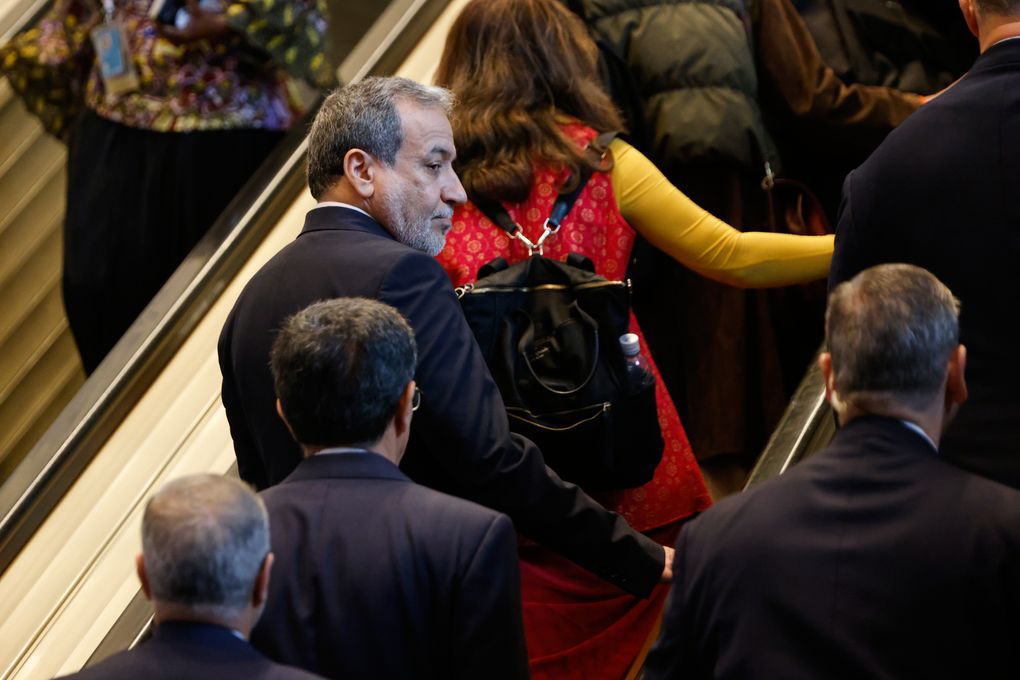
- Iranian Foreign Minister Abbas Araghchi told reporters at the UN General Assembly that Hormuz would open seven days after certain conditions are met, with talks restarting.
- The Islamabad MOU, the June ceasefire arrangement between Iran and the US that Araghchi's conditions point back to, fell apart in early July.
- November Brent futures fell 1% to $105.56 a barrel and November WTI fell 1.8% to $92.94 as traders watched the talks.
- Open-source reports using Sentinel-2 imagery say US carriers and destroyers have been absent from their earlier blockade positions in the Gulf of Oman and Arabian Sea since early September.
Compiled by The InvestorSomething wrong?How this is made
Why it matters
- cost Energy-exposed budgets still carry a barrel near $105.56, because a reopening that has not started has so far saved buyers about $1.07.
- decision Only Washington can start the seven-day clock, and starting it means accepting again the MOU terms that collapsed in early July.
- contradiction The naval evidence cuts both ways: ships left blockade positions after a claimed missile attack, yet two carriers stay in the area as CENTCOM plans strikes, so the pullback does not prove a stand-down.
Abbas Araghchi named the condition that starts his clock. "The conditions we have asked the U.S. to meet are nothing new, nothing more than what was already in the Islamabad MOU, which was signed by the U.S. President," he said [2]. Tehran is asking Washington to accept again terms that have already failed once [3]. The order runs US acceptance, then seven days, then an open strait and restarted talks [1]. Iran set out the same sequence through intermediaries months ago, when it said nuclear discussions could resume if Hormuz reopened [14]. Nothing in the offer opens the strait before Washington moves [1], and the source does not report a US answer.
The price response was about a dollar. Working back from the reported percentages, November Brent stood near $106.63 before its 1% fall and November WTI near $94.64 before its 1.8% slide, so the offer took roughly $1.07 off Brent and $1.70 off WTI [1][2]. The gap between the two widened by about 63 cents, to $12.62 [3]. Cryptopolitan quotes Brent while trading and WTI at settlement, so the two prints may not come from the same moment [5].
In my view that dollar is a price on the odds of talks, and Cryptopolitan attributed the slide to the potential of Washington-Tehran negotiations [6]. A fuel or freight budget should keep Brent near $105 as its base case and carry a reopening as an upside with no start date. The counter-case is the naval pullback, since a fleet stepping back can be the first half of a deal. Open-source trackers place the USS George Washington, the USS George H.W. Bush, the USS Tripoli and several Arleigh Burke-class destroyers outside the original blockade zone [10]. Navy logs show the USS Gerald R. Ford ending an 11-month deployment [11].
The timing argues against that reading. The pullback followed Iran's claimed first operational use of the Qasem Basir anti-ship ballistic missile against US forces, though the exact missile used has not been independently established [8]. The missile's official range is around 1,200 km, enough to reach most of the Gulf of Oman [9]. Ships moved out of a missile's reach send a different signal from ships sent home. Independent trackers still report two carriers in the broader area while CENTCOM plans "short and strong strikes" [12].
The US effort on the record is aimed at Beijing. David Perdue, the US ambassador to China, told CNBC that warning China against aiding Iran had taken up "much of my personal time and much of President Trump's time over the last month" [13]. Iran's president, Masoud Pezeshkian, told Fox News that Iran does not want the war to go on, and he put the blame on Washington [15].
The paths from here are a US acceptance that starts the seven days, silence that probably hands the dollar back, or strikes [12]. I would be wrong if Washington accepts the MOU terms and ships pass through the strait inside the week. In that case a one-dollar move underpriced the reopening.
What to watch
- A public US response to the Islamabad MOU terms, which would either start the seven-day clock or end it.
- Whether CENTCOM carries out its planned "short and strong strikes" and where the two carriers still in the area move.
- Whether November Brent holds the roughly $1.07 decline or gives it back if Washington says nothing.