Build1 publisher3 min readPublished
A letter grade, not a megawatt, is the binding constraint at Port Washington
We Energies' very large customer class makes any sub-A- offtaker post guarantees. S&P's July 9 cut to BBB- put Oracle three notches under that line.
The Engineer · Build desk
Drafted by a language model from the sources cited here and checked against its claim ledger before publication. How we use AISend a correction
What happened
- On Thursday, July 9, S&P cut Oracle's issuer credit rating from BBB to BBB-, one step above junk.
- On Friday, July 10, Wisconsin's Public Service Commission let a deadline expire without putting on its agenda the request to revisit a rule it approved in April as part of We Energies' new 'very large customer' rate structure.
- Under the rule, any customer in We Energies' 'very large customer' class rated below A- must post financial guarantees before the utility will sell it electricity.
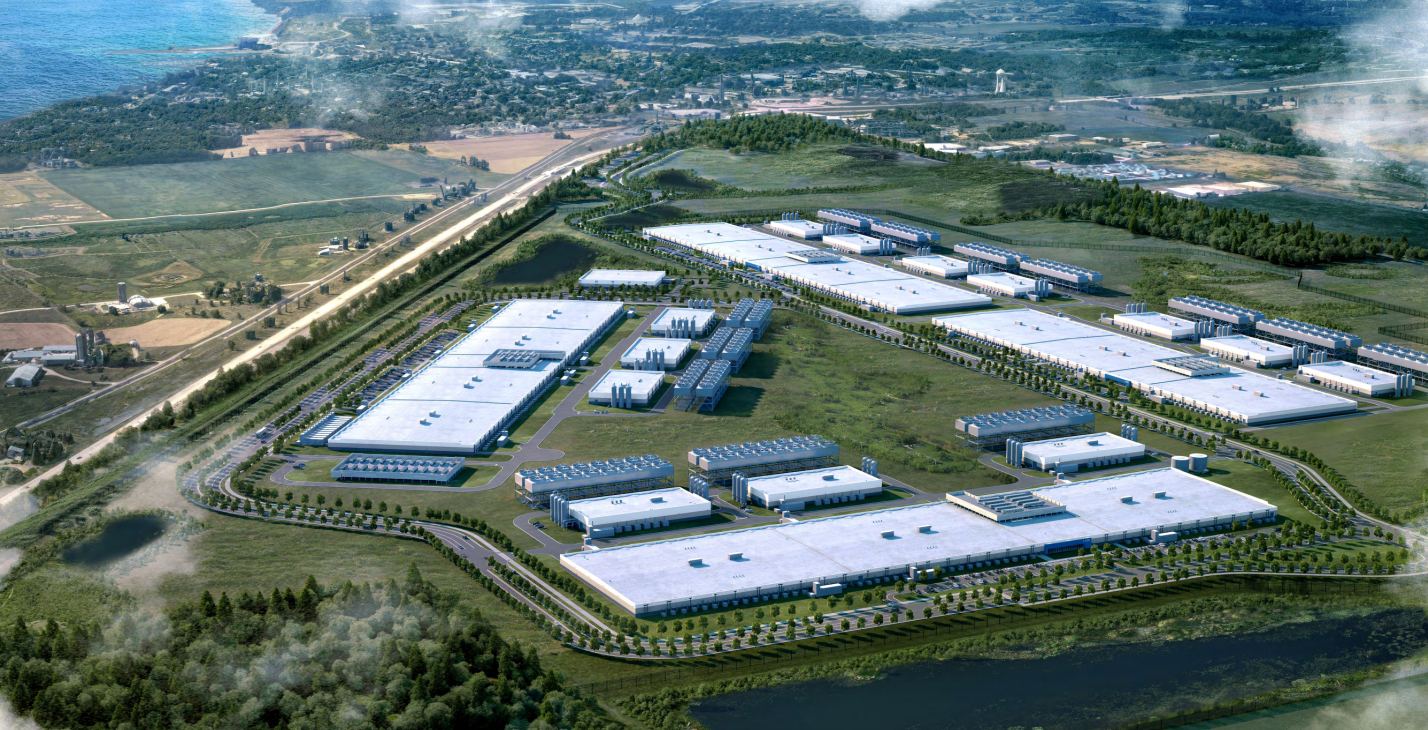
- The Port Washington campus is roughly a gigawatt on 672 acres, co-developed by an Oracle subsidiary alongside Vantage and OpenAI.
- The Oracle subsidiary co-developing Port Washington is facing more than $100 million a year in cash deposits or letters of credit before it can move forward.
Compiled by The EngineerSomething wrong?How this is made
Why it matters
On July 9, S&P cut Oracle's issuer credit rating from BBB to BBB-, one step above junk [1]. The next day, according to an account published on dev.to, Wisconsin's Public Service Commission let a deadline expire without putting on its agenda a request to revisit the rule that prices exactly that downgrade: under the "very large customer" structure the commission approved in April for We Energies, any customer in the class rated below A- must post financial guarantees before the utility will sell it electricity [2][3].
For the Oracle subsidiary co-developing the Port Washington campus, roughly a gigawatt on 672 acres alongside Vantage and OpenAI, the same account puts the bill at more than $100 million a year in cash deposits or letters of credit before the project can proceed [4][5]. Spread across a gigawatt of contracted capacity, that is upward of $100 per kW per year [6], paid not for energy but for permission to buy it.
The litigation predates the downgrade. Oracle sued the commission in Ozaukee County Circuit Court on June 19, arguing the PSC acted outside its authority and on insufficient evidence, and that the A- line is not needed to prevent harm to anyone [7]. When it filed, Oracle sat two notches under the threshold; three weeks later it was three [8].
The utility is on the customer's side of this. We Energies asked its own regulator on June 10 to back off the rule, warning it would push investment out of the state [9], and its lawyers argued that "tens of billions of dollars in Oracle's value would need to be destroyed before creditors or counterparties, such as Wisconsin Electric and its other customers, could experience losses" [10].
That is a statement about a balance sheet, and the commission is not underwriting a balance sheet. We Energies now bills large data centers directly for the generation built to serve them, and that generation includes the proposed Red Oak Ridge plant in the town of Paris, a build costing north of a billion dollars [11][12]. A gas plant is a thirty-to-forty-year asset; the demand it is being built against is about three years old, a ratio of roughly ten to one on asset life over demand history [13]. If the tenant walks, the plant stays, and the residual lands on schools, small manufacturers and residential meters in southeastern Wisconsin [14].
The credit file moved in the same direction while the reconsideration request sat. Oracle's AI borrowing had pushed debt-to-equity past 400% as of May [15], and the stock shed more than $50 in the month before the deadline [16]. S&P's note named OpenAI as a key credit risk inside Oracle's $638 billion backlog [17], projected a free operating cash flow deficit of roughly $42 billion for fiscal 2027 [18], and cited about $167 billion of debt already on the books [19].
Wisconsin is not an outlier. As of May, twenty-three states had approved at least one large-load tariff and another seven were pending [20], thirty jurisdictions in play [21]. Virginia's version of Dominion's GS-5 tariff begins applying automatically to customers at 25 MW and above in January 2027, with minimum fourteen-year terms [22].
Watch the Ozaukee County case for whether a court will treat a rating threshold as within a commission's authority [7]. Watch whether the tariffs already approved in other states import credit floors rather than just demand charges and term minimums [20][22]. And watch how quickly developers restructure offtake so the signing entity is not the one carrying the downgrade.