Science2 publishers3 min readPublished
CO2 is quietly adding fuel to Africa's savannas, and the models never counted it
A Nature study reports grass production in Kruger National Park rose 28% between 1989 and 2021, with rising CO2 the only explanation that fits. C4 grasses were assumed to be indifferent.
The Scientist · Science desk
Drafted by a language model from the sources cited here and checked against its claim ledger before publication. How we use AISend a correction
What happened
- A study led by the University of Sheffield and published in Nature finds that rising atmospheric carbon dioxide is boosting grass growth in Africa's water-limited savannas.
- African savannas cover half the continent's land surface.
- The research challenges the longstanding assumption that C4 grasses, which dominate many tropical and subtropical savannas, gain little benefit from increasing carbon dioxide.
- The international research team analysed 70 carbon dioxide addition experiments and a 32-year record of grass production from 533 locations in South Africa's Kruger National Park.
- Grass production in Kruger National Park increased by 28% between 1989 and 2021.
Compiled by The ScientistSomething wrong?How this is made
Why it matters
The working assumption in savanna science has been that C4 grasses, which already concentrate CO2 inside their leaves, gain little from more of it in the air. A study led by the University of Sheffield and published in Nature reports the opposite under dry conditions, and it matters because C4-dominated savannas cover half of Africa's land surface [1][2][3].
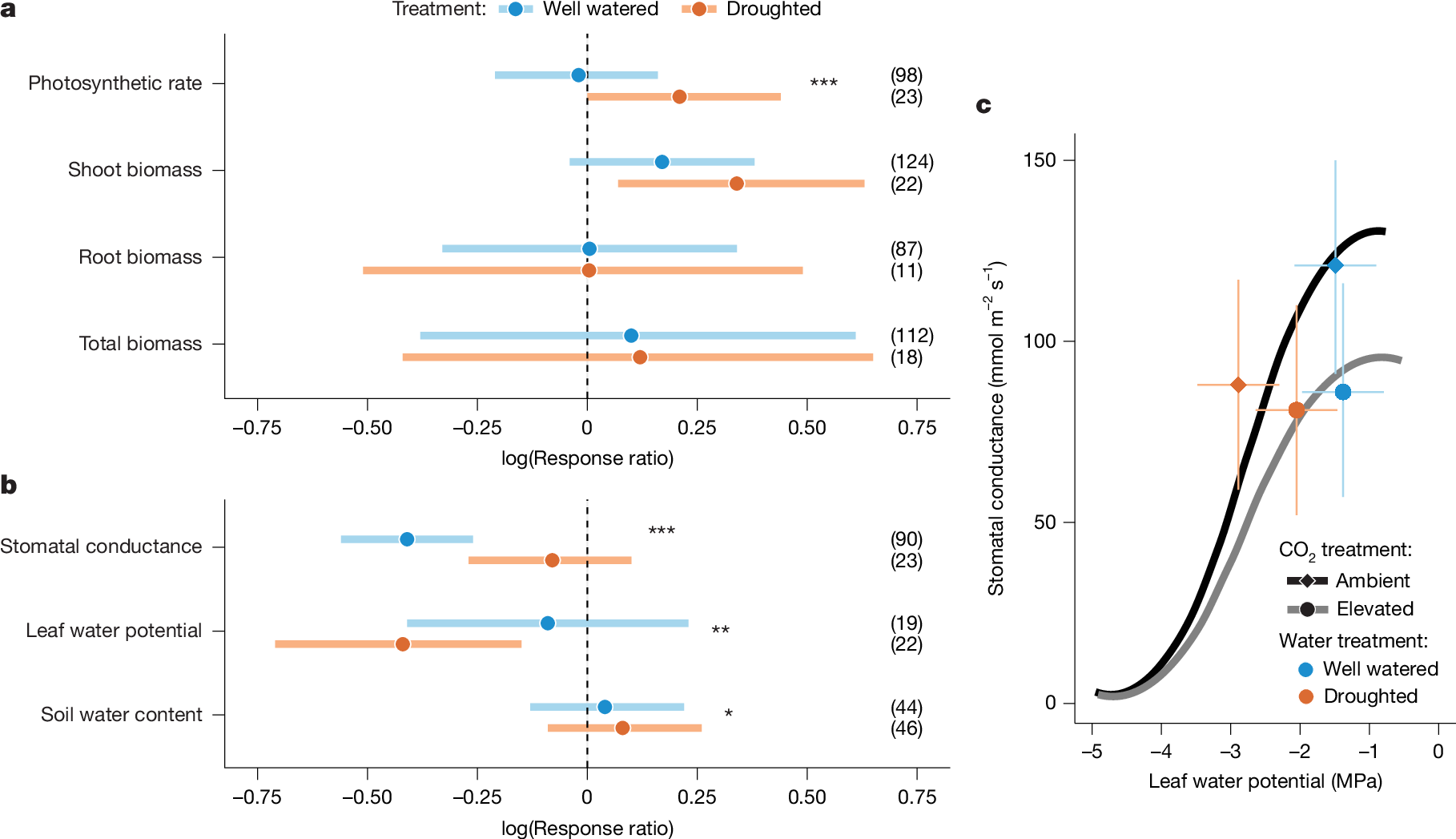
The evidence comes in two parts. A meta-analysis of 70 CO2-addition experiments plus a 32-year record of grass production from 533 locations in South Africa's Kruger National Park [5]. In the experiments, grasses narrowed their stomata at higher CO2, cutting water loss while still increasing carbon gain [12]. In the field, that improved water use efficiency showed up as biomass: production rose 28% between 1989 and 2021 [6], which works out to roughly 0.9 percentage points a year on average [24]. The paper puts the CO2-driven component at 75.1 g per square metre of annual production, with a 95% confidence interval of 74.5 to 75.8, or 0.37 tons of carbon per hectare [9]. That interval is about 1.7% wide relative to the central estimate, which tells you it is a modelled attribution rather than a spread of field measurements [26].
The authors worked through the alternatives: rainfall, temperature, grazing, fire, nitrogen deposition and shifts in grass species. None fully accounted for the increase [7]. The residual pattern tracked atmospheric CO2, and the relative gain was largest in the park's driest areas, which is what the stomatal mechanism predicts [8]. Professor Colin Osborne of Sheffield said finding the same pattern in controlled experiments and in three decades of field observation is strong evidence the effect has been operating for some time [23].
Why the assumption held for so long is instructive. The C4 pathway evolved as a CO2-concentrating mechanism that suppresses photorespiration, and in C4 crops bred hard for yield it eliminates CO2 fertilisation when water is plentiful; wild C4 grasses photosynthesise less efficiently, leaving room for a response [13]. In situ CO2 enrichment experiments have also largely skipped tropical and subtropical ecosystems [14], and the long-term savanna work that did exist was aimed at C3 woody encroachment, not the grass layer [15].
The consequences do not point one way. Savannas contribute about 30% of terrestrial net primary production [10], so a shift in the grass layer is not a rounding error in the carbon budget. But extra grass is not stored carbon. Dr Kimberley Simpson, the study lead, said the wider impact depends on where the grass ends up, and that if it is eaten or burned much of the carbon returns to the atmosphere quickly [18]. More grass also means more fine fuel for fires [22]. The Nature abstract is explicit that the fate of the carbon is uncertain, depending on feedbacks with fire, herbivory and woody vegetation [21]. Carla Staver of Princeton, the study co-lead, said the increase could matter for fire activity, wildlife and the carbon cycle [19].
Two things to watch. Simulations with the Community Land Model suggest the fertilisation effect on C4 aboveground productivity keeps increasing under future conditions [16], with warming and drying weakening it but not cancelling it [17]. And taller, more productive grass species became increasingly dominant in Kruger over the record, explaining part but not all of the biomass gain [20]. Fire-risk and land-carbon models that treat the savanna grass layer as CO2-insensitive are now carrying a known bias, and the size of it is being reported at 0.37 tons of carbon per hectare per year [9].