Science1 publisher3 min readPublished
Drone delivery stopped being a demo: thousands of tethered pod drops a day in Arkansas and Texas
Zipline lowers cargo on a line from a drone hovering 260 feet up, and says its network has flown more than 130 million autonomous miles. Last-mile planners now have something to price against.
The Scientist · Science desk
Drafted by a language model from the sources cited here and checked against its claim ledger before publication. How we use AISend a correction
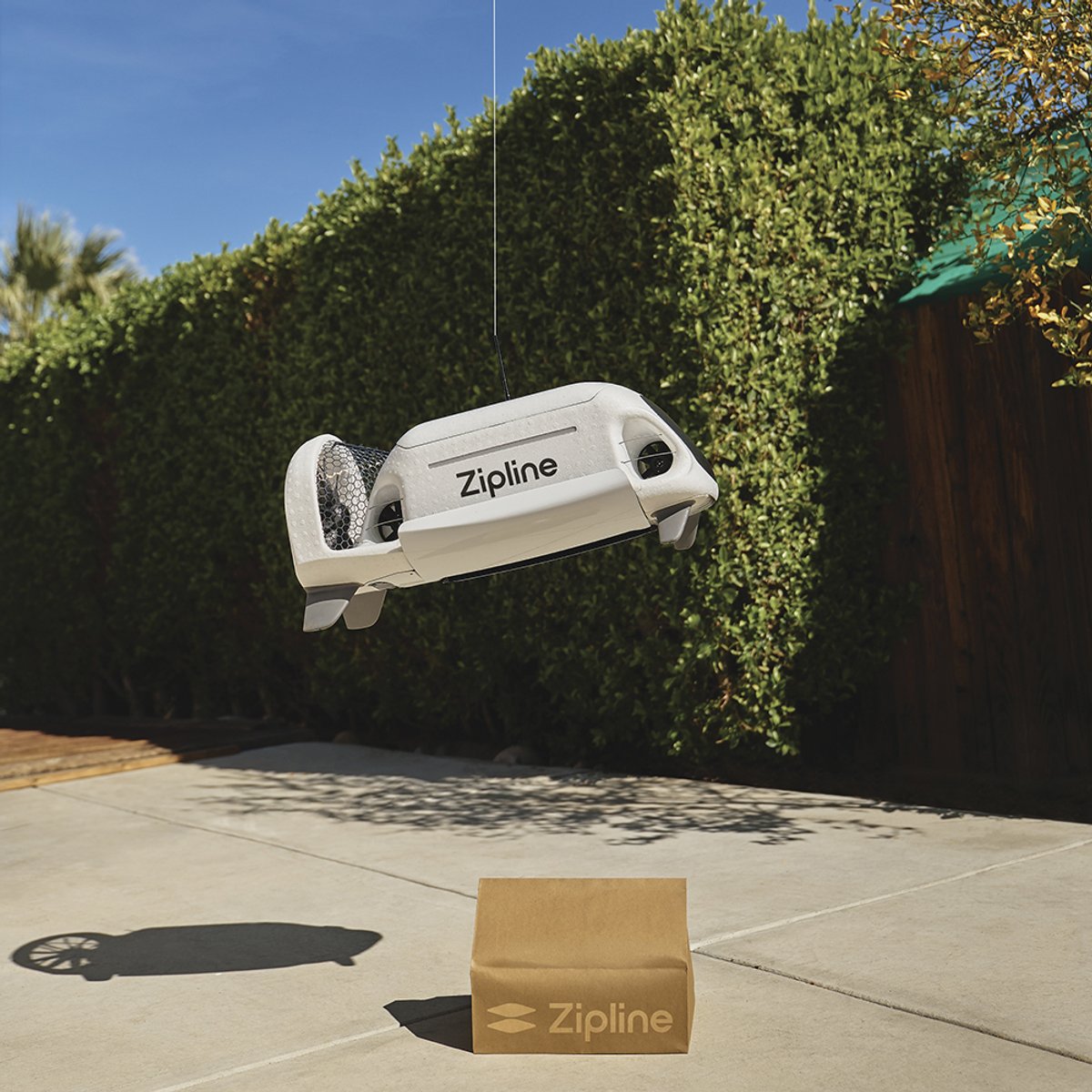
What happened
- Zipline's drone-and-pod system is operating thousands of times a day in Arkansas and across neighborhoods in Texas, flying items such as a Chipotle burrito bowl or a cat's special food to homes.
- During a delivery the pod drops from a drone hovering about 260 feet up, connected to the aircraft by a line.
- The pod is a smooth-cornered white box about the size of a gym bag; a dinner-plate-size rotor at its rear spins as it course-corrects in midair, and it sets down on four small gray fins.
- The pod has a clamshell lid over an insulated, carbon-fiber-paneled interior; during drop-off, doors on the bottom slide open and the contents fall about an inch to the ground.
- If the pod is loaded incorrectly, its electric motor grunts and a red light flashes; Zipline says most users get it right.
Compiled by The ScientistSomething wrong?How this is made
Why it matters
Zipline's suburban delivery system is now running thousands of times a day in Arkansas and in neighborhoods across Texas, dropping food and household goods including, by Scientific American's account, a Chipotle burrito bowl or a bag of special cat food [1]. That moves the relevant question for anyone routing last-mile vans from whether the aircraft work to what they cost per drop, because for more than a decade drone delivery was the tech industry's easiest joke: the demo that never became a service [19].
The mechanism is unglamorous and worth understanding, because it is what makes suburban precision possible. The aircraft does not land. It hovers about 260 feet up and lowers a pod on a line [2]. The pod is a smooth-cornered white box roughly the size of a gym bag, with a dinner-plate-size rotor at the rear that course-corrects on the way down before the box settles on four small gray fins [3]. Inside is an insulated, carbon-fiber-paneled compartment under a clamshell lid; at the delivery point, doors in the floor of the pod slide open and the cargo falls about an inch to the ground [4]. Then the pod winches back into the belly of the drone and the aircraft leaves [6]. Scientific American's reporter, expecting the buzz of a quadcopter, heard barely a whir [7].
The interesting engineering constraint is targeting, not range. Zipline's earlier fixed-wing aircraft, launched by magnetic slingshot and recovered midair by tailhooks and towlines, carried medical lab samples and blood products between metropolitan areas and remote clinics in Ghana and Rwanda, dropping cargo by parachute [14]. Those parachute drops needed a zone about the size of two parking spaces; a suburban delivery has to hit a target about the size of a lounge chair [17]. The tethered pod is the answer to that difference.
The scale numbers come from the company. Zipline says its global network, built largely on the older fixed-wing aircraft, has flown more than 130 million autonomous miles and completed more than 2.5 million commercial deliveries [11]. On those stated minimums that is roughly 52 autonomous miles per delivery, a fleet average shaped by long medical runs rather than suburban hops [12]. The public-health results from that era are documented: facilities in Ghana working with Zipline had vaccine stockouts 60 percent shorter than clinics that did not, and a 2022 review by researchers in Rwanda found blood products reached mountainous areas more than an hour and a half earlier than by truck, with a 67 percent reduction in expiration losses [15][16].
What the source material does not contain is a cost per delivery, a payload limit, or a container-return cycle time, and those are the numbers that decide whether this displaces a van route or supplements it. Zipline CEO Keller Rinaudo Cliffton frames the hard part as physics: an aerodynamically efficient airframe for range, an energy-dense battery, and electric motors designed from scratch to be very light [9]. Chief technology officer Keenan Wyrobek demonstrated the loading procedure at a test site on a cattle ranch an hour south of San Francisco [8][10], where a misload triggers a grunt from the motor and a flashing red light [5].
Watch the Federal Aviation Administration's proposed Part 108 rule, which would give a clearer path for flights beyond an operator's line of sight [13]. Watch also the four open questions Scientific American identifies: whether the aircraft is quiet enough to live under, precise enough to find a backyard, safe enough to share neighborhood airspace at scale, and whether anyone actually wants it [18].