Science1 publisher3 min readPublished
Recycled phosphorus helped hold oxygen up after the Great Oxidation Event, South African rocks suggest
UC Riverside's Andrey Bekker and colleagues tie oxygen's persistence after the Great Oxidation Event 2.3 billion years ago to recycled phosphorus. If that loop held oxygen up for long stretches, something besides scarce oxygen may have slowed the rise of complex life.
The Scientist · Science desk
What happened
- Earlier work could measure only the total phosphorus preserved in rocks, so it could not show how much had been available to ancient life.
- The results suggest oxygen swung more sharply after the Great Oxidation Event than previously thought, likely reshaping ocean chemistry over tens of millions of years.
- The paper, first-authored by Lewis J. Alcott, appears in Nature Communications as 'A nutrient control on oxygenation dynamics during Earth's Great Oxidation Episode'.
Compiled by The ScientistSomething wrong?How this is made
Why it matters
- constraint If oxygen stayed abundant for long stretches, a shortage of oxygen can no longer carry the whole explanation for why complex oxygen-breathing life appeared slowly.
- capability Ancient rocks can now be read for the phosphorus life could actually use, so arguments about nutrient limits in early oceans can be tested against that fraction instead of inferred from totals.
- exposure Run in reverse, the same loop describes a risk for today's oceans: as climate change strips oxygen, available phosphorus and marine productivity could fall.
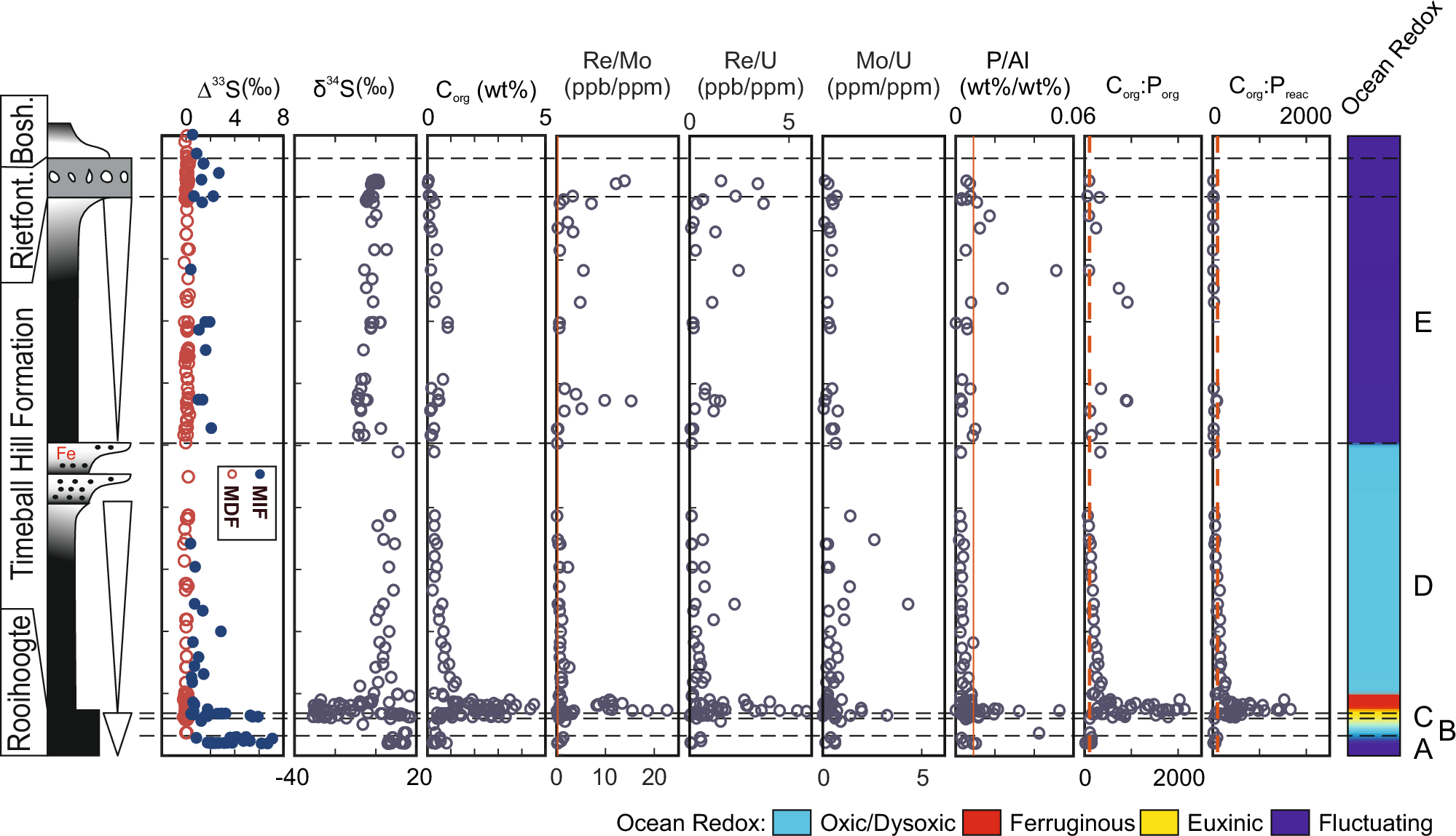
Until now, geochemists could measure only the total amount of phosphorus preserved in an ancient rock [8]. That total mixes phosphorus organisms could take up with phosphorus bound into minerals that life could not use [7]. The technique applied to the South African samples dissolves one type of mineral at a time, so each fraction can be assigned to one pool or the other [7]. "We can now separate the phosphorus that was available to organisms from phosphorus that was essentially locked away," Bekker said [9].
With the usable fraction measured, the team proposes a chain of cause and effect [6]. Oxygen entering the oceans raised sulfate concentrations. Microbes used the sulfate to break down organic matter more efficiently and released phosphorus back into seawater. That phosphorus fed new growth, more organic carbon was buried, and more oxygen accumulated in the atmosphere [6]. "Once more of it became available in the oceans, it allowed more organic carbon to be buried," Bekker said. "A side effect of that process is that more oxygen continued to be released into the atmosphere." [5]
As phys.org reports it, the cycle "helped keep oxygen levels high" after the first rise [4]. The claim concerns one contributing feedback, and that feedback addresses a question the Great Oxidation Event left open: how oxygen stayed high enough, over millions of years, to support more complex life [14].
The same findings suggest oxygen fluctuated more dramatically after the event than scientists had believed, with swings that likely reshaped ocean chemistry over tens of millions of years [10]. In my view the two results are compatible. A self-reinforcing loop amplifies a push in either direction, so it can hold oxygen high for a stretch and deepen a drop once one starts. The release itself runs the chain in reverse for the modern ocean: where climate change strips oxygen, phosphorus could become less available and marine productivity could fall [12].
The phosphorus measurements come from rocks in South Africa [7], so it is unclear how far one region's sediments speak for a whole ocean. The link from those sediments to atmospheric oxygen runs through the sulfate and carbon-burial steps of the proposed loop [6]. The phys.org account does not say how many samples were analysed, which formations they came from, or how large the oxygen swings were.
Bekker said that if oxygen remained abundant for extended periods, factors other than a severely limited oxygen supply may have slowed the emergence of complex organisms that depend on oxygen [11]. The larger swings reported in the same study make the length of those high-oxygen periods the open question [10].
"Earth's history shows that oxygen, nutrients and life evolved together," Bekker said. "Understanding those connections gives us a more nuanced perspective on our own planet's future and what we might look for on other planets." [13]
What to watch
- Whether phosphorus-speciation results from rocks of similar age outside South Africa show the same pattern, which would separate a regional signal from a global one.
- Whether the full paper puts numbers on the size and timing of the post-oxidation oxygen swings, so the loop can be checked against other oxygen records.