Science2 publishers2 min readPublished
SFPQ condensates keep neurons' two-megabase genes transcribing to the end
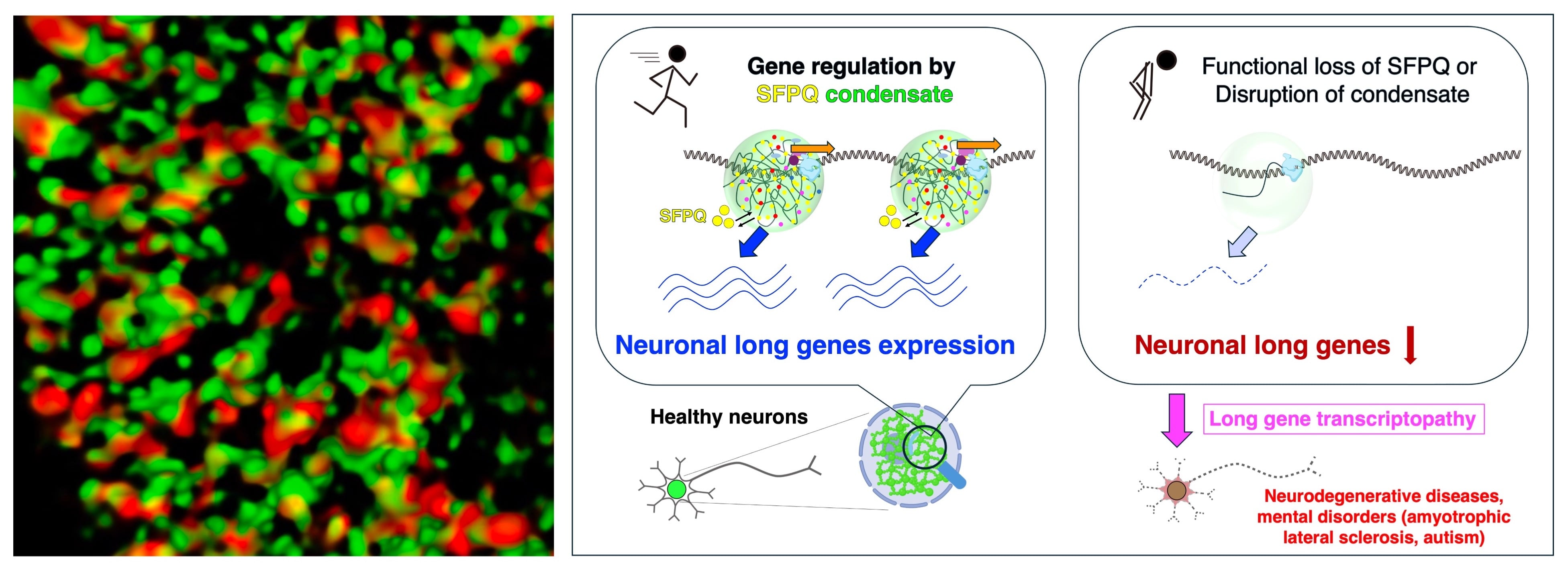
An Ehime University team reports that SFPQ binds newly made RNA and uses it to build nuclear compartments where elongation, splicing and chromatin remodeling proceed together. Its autism and ALS link rests on overlapping gene lists.
The Scientist · Science desk
What happened
- A team led by Akihide Takeuchi at Ehime University reports in Cell Chemical Biology that neuronal nuclei build membraneless SFPQ condensates that act as hubs for reading and assembling extra-long transcripts.
- Super-resolution imaging, paired with proximity-dependent biotin labeling and mass spectrometry, showed SFPQ binding newly made RNA and using those strands as scaffolding for meshwork-like condensates across the nucleus.
- When the team disrupted the condensates in functional assays, transcription of extra-long genes halted early, splicing faltered and overall gene expression fell sharply.
Compiled by The ScientistSomething wrong?How this is made
Why it matters
- capability Holding a nuclear compartment together is a different drug-design problem from correcting one protein's catalytic activity, and this work puts the compartment itself on the target list.
- constraint Because the disease link is a comparison of gene sets, it cannot tell anyone whether a given patient mutation destabilizes SFPQ condensates. Allele-level experiments in neurons are the only way to get there.
- precedent A category named for gene length invites neurological risk genes to be sorted by how far transcription has to travel, a grouping that cuts across the pathway maps those genes currently sit in.
The scaffold is the interesting part. SFPQ does not build these compartments out of protein alone; it binds newly synthesizing RNA and uses the strands as structural material [2]. So the transcript being made is part of what holds together the compartment making it. Cells partition their interiors this way, without lipid membranes, through liquid-liquid phase separation [12].
Pairing the methods made sense: super-resolution microscopy shows where things sit, and proximity-dependent biotin labeling with mass spectrometry reports what is close to SFPQ inside a nucleus [3]. Inside the condensates the team found chromatin remodelers, transcriptional elongation factors and splicing regulators concentrated together, working on genes from over 100 kb to more than 2 Mb [4]. "These condensates act as a shared 'workspace' bringing together several processes required for exceptionally long genes to function properly," the authors wrote [9].
A two-million-base gene transcribed in a single day means polymerase covering roughly 1,390 bases a minute for 24 hours without detaching [13], and the source gives hours to days as the range for these genes [5]. The stated size range spans at least twentyfold [14]. Neurons sit at the long end by necessity, since synaptic connectivity depends on giant structural and signaling proteins [11].
I would slow down on the disease claim. Disrupting the condensates produced premature transcription arrest and splicing errors in critical synaptic genes, many of which appear on autism and ALS risk lists [16]. SFPQ and its partner FUS have long-standing genetic links to both conditions [8]. But an overlap between two gene sets that are both biased toward long, neuron-expressed genes is close to what you would expect before any mechanism is tested, and the Ehime University summary reports the overlap without a count of the shared genes or a statistical test of the enrichment [15].
In the cells studied, removing stable SFPQ condensates broke long-gene transcription and splicing, and expression fell sharply [6]. Whether a patient's variant does the same thing in a patient's neurons is a separate experiment.
Takeuchi's group proposes "long-gene transcriptopathies" as a category, and stabilizing nuclear architecture as a therapeutic aim [10]. The test that would move the hypothesis forward is straightforward to state: express an autism-associated variant of a long synaptic gene in neurons, then ask whether SFPQ condensates still form and whether the transcript reaches its far end.
What to watch
- Whether an ASD- or ALS-associated variant, introduced into neurons, is shown to destabilize SFPQ condensates and truncate long transcripts.
- Whether the full paper quantifies the overlap between condensate-enriched proteins and published risk-gene lists against a length-matched background.
- Whether any compound stabilizes these condensates and restores full-length transcripts in a neuronal model.