Science1 publisher3 min readPublished
Cornell physicists argue condensates obey general rules, not case-by-case chemistry
A PNAS paper from Eric Dufresne's lab reports an experimental metric for comparing how chemicals act on three unrelated condensate types. The claimed payoff is prediction instead of enumeration.
The Scientist · Science desk
Drafted by a language model from the sources cited here and checked against its claim ledger before publication. How we use AISend a correction
What happened
- Eric Dufresne is a professor of physics in Cornell's College of Arts and Sciences and of materials science and engineering at Cornell Duffield College of Engineering, and works to understand how condensates function.
- Dufresne: "Proteins and nucleic acids spontaneously organize themselves into blobs called condensates."
- Droplet-like condensates form and dissolve as cells need them, bringing selected proteins, RNA and other molecules together to coordinate biochemical reactions, according to Takumi Matsuzawa.
- Matsuzawa: "Their timely formation and dissolution are essential for normal cellular function, and disruptions to this process have been linked to neurodegenerative diseases," including Alzheimer's and Parkinson's.
- The study was published July 30 in the Proceedings of the National Academy of Sciences.
Compiled by The ScientistSomething wrong?How this is made
Why it matters
A group at Cornell has published a way to compare, on one scale, how added chemicals change the behaviour of biomolecular condensates that hold themselves together by completely different physical means [7][14]. If the comparison holds up, the membraneless organelles that cells assemble and dissolve on demand become a system you can model and perturb by rule, rather than one you characterise one blob at a time.
Condensates are droplet-like assemblies of proteins and nucleic acids that form spontaneously inside cells [2][1]. Takumi Matsuzawa, a postdoctoral researcher in physics and first author of the study, describes them as forming and dissolving as the cell needs them, gathering selected proteins, RNA and other molecules to coordinate reactions, with timely formation and dissolution essential to normal function and disruption linked to neurodegenerative diseases including Alzheimer's and Parkinson's [3][4][6]. The paper appeared July 30 in the Proceedings of the National Academy of Sciences, with Eric Dufresne as corresponding author [5][6].
The interesting part of the work is the admission of defeat that motivated it. Condensates form by phase separation, the same unmixing that separates oil from water in salad dressing [9]. For a handful of components, that is a solved bookkeeping problem: you draw a phase diagram, the way water's states are mapped against pressure and temperature [10]. Cells do not offer a handful. Thousands of protein species are dissolved in the cytoplasm, hundreds of distinct condensates have been reported, each with its own composition and its own response to each chemical, and Matsuzawa says the true count is likely higher [11]. By his estimate, mapping the phase diagram of nearly 80 species would require more bits than there are atoms in the universe just to store the data [12]. Dufresne's framing is that the lab stopped trying to map the whole world and started mapping the neighbourhood [13].
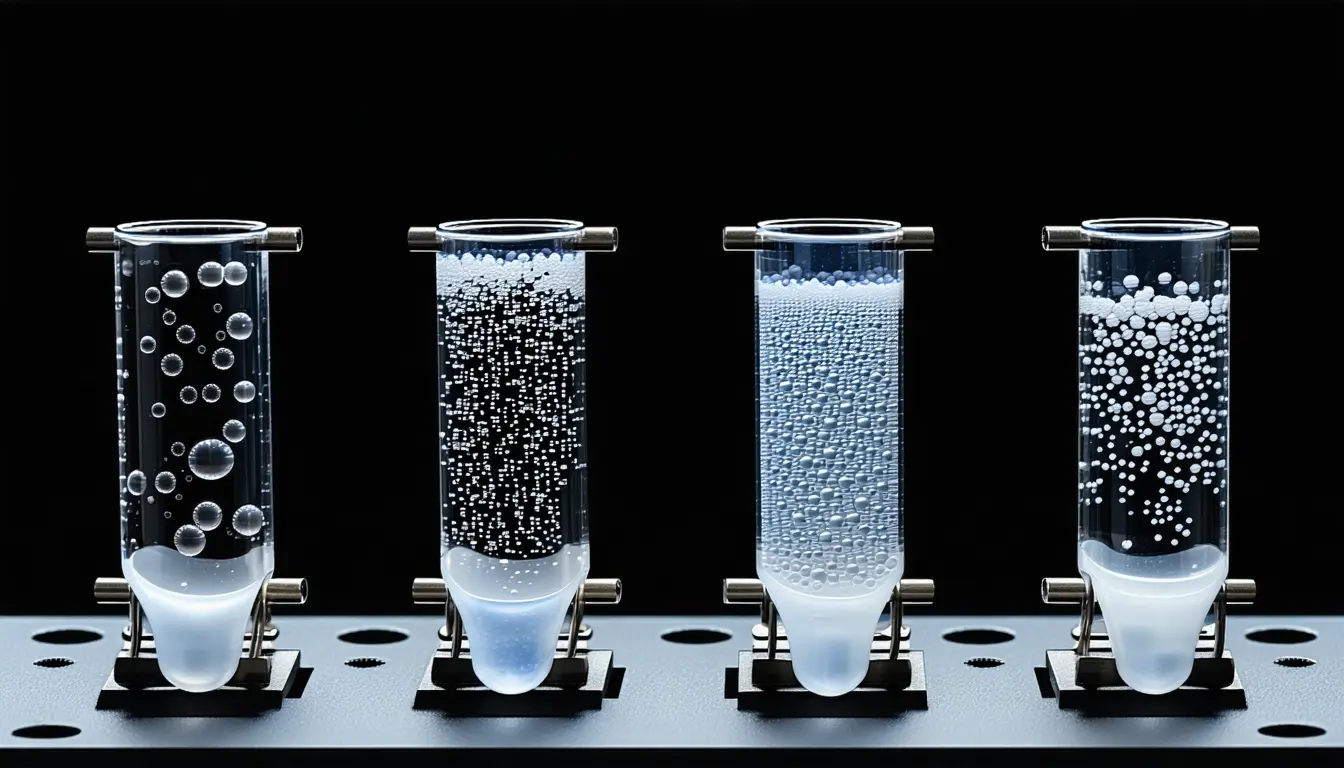
The neighbourhood, in practice, is three condensate types picked because they stick together for unrelated reasons: crowding, where surrounding molecules push the components together; stickers-and-spacers, where sticky segments along a protein chain bind; and ligand-and-pocket, where one molecule fits into a pocket on a macromolecule, which Matsuzawa notes is the interaction more typical of drugs [14]. Each was challenged with a wide range of molecules that occur naturally in cells, looking for patterns [15]. Dufresne says the central result was quantifying magnitude: some additions produce very weak responses, some very strong, and the team identified several distinct physical mechanisms behind them, then built both an experimental tool and a theoretical framework to interpret the data [16].
Three systems out of hundreds of reported condensate types is a thin base for the word "general" [17]. The announcement credits the framework with uncovering general rules and with pointing towards chemicals that could target disease-related condensates, but it does not state the rules, and no compound, target or assay is named [8][16]. Nothing here is a drug lead; it is a measurement convention.
What to watch is whether other labs adopt the metric and get comparable numbers on condensates they did not choose, particularly ones reconstituted from disease-associated proteins rather than model systems. Watch also for the ligand-and-pocket case, since that is where the pharmacology sits [14]. A framework that only ranks the chemicals the original lab tested is a tool for one lab.