Leadership1 distinct publisher3 min readPublished
Repainted scaffolding and same-day pothole fills have made Mamdani popular in a way his signature programs have not, which leaves the question of whether credit earned on visible work is spendable on the invisible kind.
The Board Room · Leadership desk
Compiled by The Board RoomSomething wrong?How this is made
What makes this work is attribution. A resident can verify a filled pothole without a briefing, assign the credit to City Hall, and do both inside a day. Nobody can verify a bus procurement or a childcare rollout on those terms. Justin de Benedictis-Kessner, the Harvard public policy professor writing The Fog of Accountability, separates the issues that are easy for voters to understand from the ones that are not, and notes that promises on the hard ones often get paired with clear ones [11]. Read that way, the paint and the asphalt are the receipt on the mandate rather than a diversion from it.
The conversion shows up in the numbers Vox reports, though modestly. The Siena Research Institute put Mamdani's favorable rating at 69 percent this month [6], while a third of residents told the New York Times last September that they would never vote for him [7]. Had that third held firm, his ceiling would be 67 percent, so at least two points of his current standing come from people who had already ruled him out [17]. Two pollsters, two questions, months apart: that is a direction, not a measurement. Vox also disposes of the obvious confound, noting he is more popular now than he was a few months ago when the Knicks won their first championship in decades [9].
A skeptic on the budget side would say paint and asphalt are the cheapest things a city can do, and prove nothing about running grocery stores. The evidence in the record speaks to responsiveness rather than transfer. Vox cites a study in which Chicagoans report measurably lower life satisfaction for every additional week their city takes to fix a nearby pothole [14], and a survey in which Bostonians became 14 percent more trusting of government after seeing it respond [15]. Nothing in that record links a filled pothole to a passed zoning reform or an accepted tax increase, which is precisely the question de Benedictis-Kessner leaves open [12]. On transferability, the honest answer is that we do not know yet.
So the tradeoff is between speed and stock. Fill rates are counted in days [5], while free buses and universal childcare are counted in years and remain undelivered [16]. Goodwill earned on a same-day metric is dated by that metric, which means the political capital has a shelf life shorter than the programs it is meant to underwrite. Don Moynihan of the University of Michigan describes a thirst for competence and credits Mamdani with bringing joy and fun to the nuts and bolts of public administration [10]; joy is not a substitute for a legislative window.
The defensible version of the strategy is the one Mamdani stated himself at his 100-day rally: "If government can't do the small things, how could you ever trust it to do the big ones? How can we promise to transform our city if we can't pave your street?" [13] For any leader who must be believed before being funded, that is a sound order of operations, and it is cheap to run. It also commits him to spending the credit early, while residents can still see the work that produced it, because the bill arrives when the first unpopular ask reaches a vote.
Ranked by verification strength, evidence, and original report placement.
Mamdani made good on his plan to give a facelift to New York City's ubiquitous green construction scaffolding, which envelops hundreds of miles of city sidewalks.
A New Yorker commented under a mayoral Facebook post, "If this is democratic socialism, maybe it is the change we need," referring to the candy-colored scaffolding rather than to the city-run grocery store plan, the pied-a-terre tax, or the free buses and universal childcare vision.
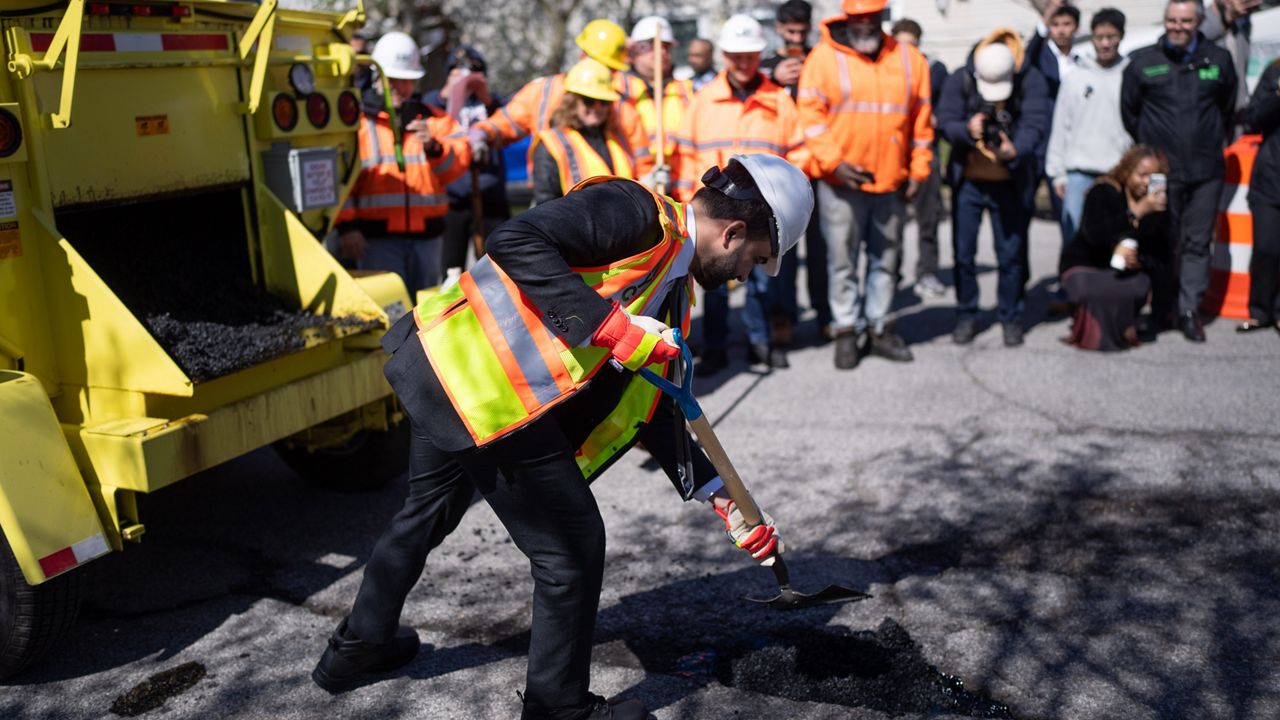
A New Yorker posted on TikTok complaining about potholes on his street; by the time he got home from work they had all been filled, setting off a wave of viral requests to the mayor, including one from a Brooklynite asking for dating help, which the mayor answered with a list of local meet-cute spots.
Mamdani calls his approach "pothole politics," which Vox describes as a modern twist on the "sewer socialism" that propelled some 20th-century leftists into office.
Sixty-nine percent of New Yorkers have a favorable view of Mamdani, according to a Siena Research Institute poll conducted earlier this month.
One-third of New York City residents told the New York Times last September that they would never vote for Mamdani.
Follow any of these and your For You feed starts watching them — no settings page required.
Evidence-backed comparisons of source perspectives and observed adoption signals. Read the methodology
Which Builder, Operator, and Investor concerns the observed source mix emphasized—not a truth score.
Evidence, demonstrated adoption, hype gap, incentives, and confidence are assessed independently, each on its own current evidence. How these are measured.
One outlet, one named poll, two unnamed studies
Everything in the cluster comes from a single Vox feature. The strongest documented items are the named Siena favorability figure, the prior New York Times vote-intention finding, and on-record expert quotes. The claims doing the most narrative work are the least documented: the pothole-rate superlative and the 'best ratings in decades' comparison have no supplied data or baseline, the Chicago and Boston studies are unnamed with no methodology, and the supplied body is truncated mid-sentence in the data section.
No adoption-class observations in cluster
The cluster contains no release, deployment, benchmark, pricing, licensing, or usage-disclosure events of the kind adoption measures. Pothole fills and scaffolding repainting are described qualitatively with no counts, coverage share, budget, or timeline, and no other city is documented copying the approach, so uptake cannot be scored without inventing figures.
Framing outruns the demonstrated mechanism
The story's thesis -- that visible maintenance is buying credibility spendable on hard policy -- is asserted more strongly than the supplied evidence carries. The unnamed studies and one favorability poll establish correlation between visible responsiveness and trust, but nothing in the cluster shows trust converting into zoning reform, tax increases, free buses, or childcare, and the article's own expert calls that the open question. The 'not the Knicks, it's the potholes' attribution is an inference from two snapshots. The gap is moderate rather than severe because the piece states plainly that the flagship programs are unrealized and quotes the caution against assuming transfer.
Subject-supplied framing amplified through his own channels
The organizing concept is the mayor's own coinage, and much of the sentiment evidence originates in his communications surface: comments under a mayoral Facebook post, viral request-fulfillment on TikTok, and a rally speech at the 100-day mark, all of which serve his political interest. The two academics quoted have no disclosed financial stake, though one is promoting a forthcoming book on accountability. Vox's Future Perfect framing is sympathetic to the competence narrative. Scored above midpoint because promotional interest is visible and largely unlabeled, not because a conflict is disclosed.
Directionally clear, quantitatively thin
Confidence is limited by single-publisher sourcing and by the fact that the most decision-relevant numbers are unverifiable inside the cluster. The narrative shape -- high early favorability, visible maintenance wins, flagship programs still pending -- is internally consistent and supported by on-record quotes and one named poll, so it is not speculative. But the pothole-rate and historical-ratings superlatives, the two unnamed studies, and the truncated source body leave meaningful room for revision, and the causal link between visible fixes and popularity is inferred rather than measured.
leadership
Mamdani's tax office says the data was always public, and sent a memo instead of a witness1 distinct publisher
product
Cinemas, classrooms and ICE: smart glasses now need a venue-policy contingency1 distinct publisher
product
From Omaha students to ICE: the shock glove sold as camera-proof force1 distinct publisher
science
Flow control gets a shared benchmark, and a 38% friction cut nobody had to simulate first2 distinct publishers
Distinct publishers with included, body-backed reporting in this cluster.
1 article · August 27, 2026