Product1 publisher3 min readPublished
Cinemas, classrooms and ICE: smart glasses now need a venue-policy contingency
Six kinds of venue moved against camera eyewear in a fortnight, for reasons that share almost nothing. Any roadmap assuming glasses are wearable in public needs a fallback.
The Product Desk · Product desk
Drafted by a language model from the sources cited here and checked against its claim ledger before publication. How we use AISend a correction
What happened
- Cinemas moved against Meta smart glasses on Thursday: the UK Cinema Association said many operators are introducing policies to restrict camera-enabled eyewear, giving two reasons, film piracy and customer privacy.
- Over the past fortnight American school districts, a federal immigration agency, a hacker conference, NBA arenas and a British pub chain all reached the same conclusion about the same product, and their reasons have almost nothing in common.
- Including cinemas, six distinct categories of venue or institution acted against camera-enabled eyewear in the same fortnight.
- The UK Cinema Association represents more than 90% of UK cinema operators by number and by market share.
- The association said many members now have policies "to prohibit and/or restrict the wearing of camera-enabled smart glasses in particular in their venues".
Compiled by The Product DeskSomething wrong?How this is made
Why it matters
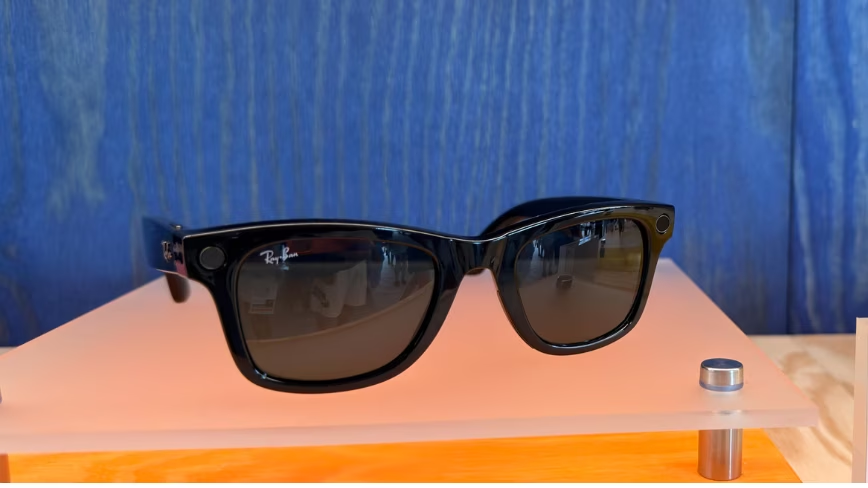
The UK Cinema Association said on Thursday that many of its members are introducing policies restricting camera-enabled eyewear, citing film piracy and customer privacy [1]. That puts cinemas alongside American school districts, a federal immigration agency, a hacker conference, NBA arenas and a British pub chain, all of which reached the same conclusion about the same product within a fortnight, and whose stated reasons have almost nothing in common, according to The Next Web [2] [3].
The association represents more than 90% of UK cinema operators by number and by market share [4]. It says many members now have policies "to prohibit and/or restrict the wearing of camera-enabled smart glasses in particular in their venues", and that it knows of no outright bans by members yet [5] [6].
The mechanism here matters more than the announcement. The rule already existed: a policy dated 2014 and last updated in January 2023 sits on the trade body's key issues page, telling cinemas to ask customers not to bring image-recording wearables into auditoriums at all, whether or not a film is playing, with staff instructed to ask wearers to remove them and permitted to ask them to leave [7] [8]. It was written for Google Glass, when the body was called the Cinema Exhibitors' Association [9]. Chief executive Phil Clapp, in post since October 2007, still runs the organisation invoking it [10]. In June 2014 he told The Register that Glass, then £1,000 in Britain, justified a precautionary approach because "it is generally more difficult to detect when they are and are not recording" [11] [12].
Glass never left beta and Google withdrew it from consumer sale [13]. Meta debuted its glasses in 2021, sells them through high street opticians at £359, and they now rank among its best-selling hardware [14]. So text drafted for a beta headset applies unchanged to a mass-market product priced £641 lower, seven years after it was written [15] [16]. No new decision was required, which is the part product teams should plan around: dormant policy reactivates without notice.
The school material is what will drive the next wave. Futurism's Maggie Harrison Dupre reviewed large numbers of videos filmed inside American middle and high schools on smart glasses, almost always Meta's, then posted to TikTok and Instagram [17]. A teenage boy filmed every video the publication found, and the behaviour was overwhelmingly directed at girls, including following them after they walked away and mocking their appearance [18]. Both platforms missed the material until Futurism flagged it; Meta then removed most of the videos and TikTok removed those brought to its attention [19]. The Next Web reported on 17 August that Instagram had blocked the relevant search terms while its algorithm kept recommending the videos [20]. One student filmed himself dropping his phone into a school confiscation pouch while still wearing a camera on his face [21]. Districts in Florida, California and Nevada have written explicit bans [22], and Andy Liddell of the EdTech Law Center told Futurism that "school is the last place that these glasses belong" [23].
Immigration and Customs Enforcement barred employees from wearing Meta smart glasses at work, treating them as body-worn cameras, in a Tuesday memo from acting director David Venturella warning that the devices "could unintentionally capture, record or transmit sensitive information" [24] [25].
The accessibility argument is caught in the same net. The association itself noted the glasses can deliver bespoke subtitles and help viewers with sight loss or hearing loss [26], and Meta said some pupils with disabilities benefit from the technology [27].
Watch whether any venue body publishes an exemption route for accessibility use rather than a blanket restriction, and whether cinema members convert the current restrict-and-remove approach into the outright bans the association says do not yet exist [5] [6] [7].