Science1 publisher3 min readPublished
Cells catch fusing viruses by spilling their own DNA, Harvard team finds
Harvard Medical School researchers found that a virus fusing with a cell ruptures the nucleus, spilling host DNA that trips the cGAS alarm within an hour. The team says the work could inform how viral-vector gene therapies and vaccines are designed.
The Scientist · Science desk
What happened
- The sensor cGAS finds those loose DNA fragments and raises the alarm that recruits interferon, which brings in other molecules to keep the virus from establishing infection.
- The triggering DNA is the cell's own, not the virus's; that resolves a long-standing puzzle about how cGAS also mounts a response against RNA viruses, which contain no DNA.
- The study, led by Nicolas Romero, now at Tufts, and senior author David Knipe of Harvard Medical School, appeared Aug. 18 in the Proceedings of the National Academy of Sciences.
Compiled by The ScientistSomething wrong?How this is made
Why it matters
- decision This hands vector designers a lever: a delivery virus that enters cells by endocytosis rather than by fusing may slip past the cGAS alarm, while any fusing vector is liable to trip it.
- capability With the trigger identified, the interferon response could in principle be tuned, the direction the authors point for stronger vaccines and for oncolytic viruses that need to infect tumor cells.
- constraint The evidence is human cell culture with a replication-deficient herpesvirus, so it identifies the trigger without showing the effect in an animal, in a patient, or in any actual therapy.
The alarm itself was not the mystery. Virologists have known for years that a cell hit by an enveloped virus such as herpes simplex sends out interferon within about an hour. A protein called cGAS, which senses stray DNA in the cell body, sets that off [16]. The open question was which DNA cGAS was reading. One idea held that some virus particles rupture after they enter the cell but before they reach the nucleus, spilling their own genetic material [17]. That could not be the whole story, because cGAS also fires against RNA viruses, which have no DNA [6].
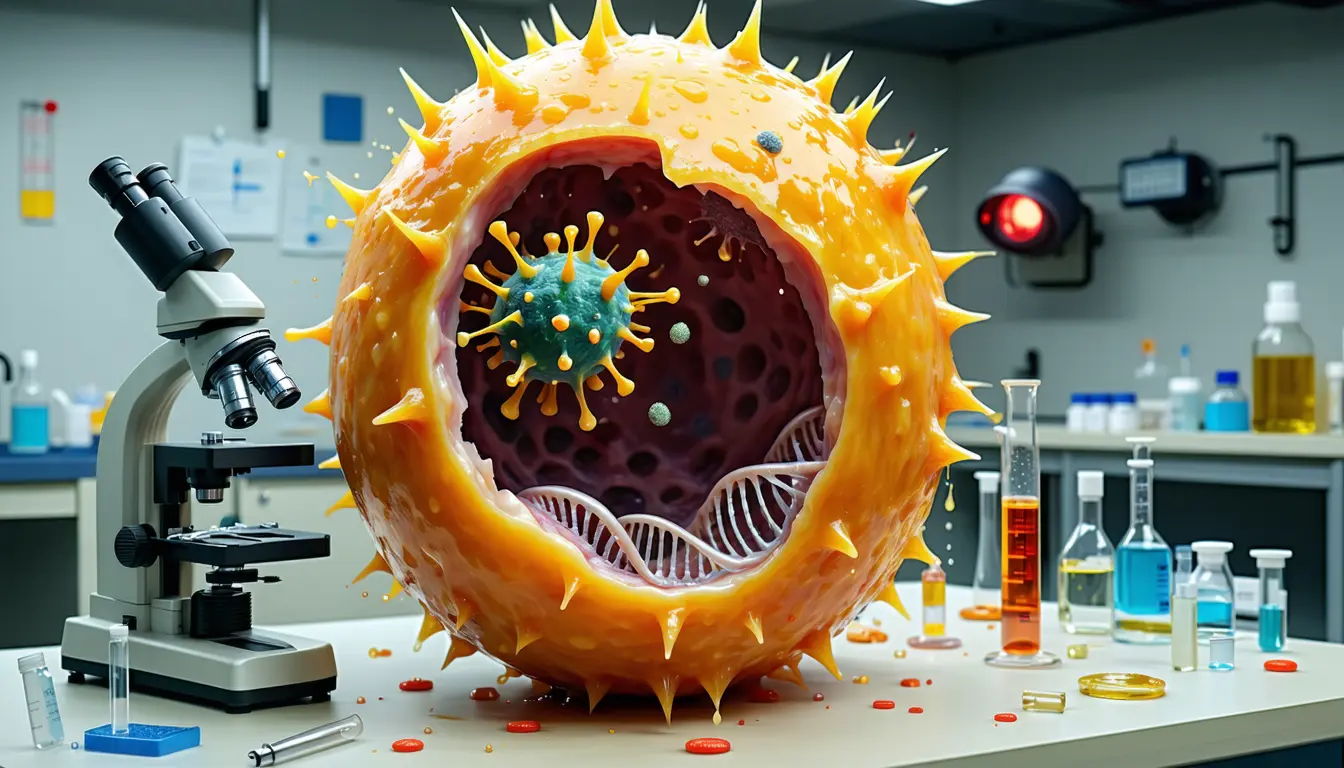
The answer the team reached is that the DNA is the cell's own [5]. Nicolás Romero and colleagues worked in human cell cultures with a herpesvirus engineered so it could not replicate on its own, which rules out the DNA coming from viral copying inside the cell [7][11]. As the virus's envelope fuses with the outer membrane and the particle enters the cytoplasm, the actin microfilaments that hold the cell's shape go into turbulent contractions. Those tremors tear an opening in the nuclear membrane [3]. Host DNA fragments leak out. cGAS finds them, raises the alarm, and interferon follows to block the virus from taking hold [4].
To check that this was not a quirk of herpesvirus, the researchers repeated the experiment with other enveloped viruses, including parainfluenza, and saw the same DNA expulsion. They concluded that any virus entering by membrane fusion sets it off [9]. The control that pins the cause is the pair of non-enveloped viruses they also tested: those get in by endocytosis, and they produced neither the DNA leak nor the interferon response [10]. The team confirmed the picture with light microscopy, transmission electron microscopy and immunogold labeling [8].
"It's important to understand the details of how viruses and the body's immune system interact," said David Knipe, the study's senior author at Harvard Medical School, "because those details give us a better idea of how we can use the same techniques to build better medicines" [13]. The team suggests the work could feed into better vaccines and into oncolytic viruses engineered to infect and kill cancer cells [15]. The experiments ran in human cell cultures with a replication-deficient herpesvirus, so they identify the trigger without showing that tuning it improves any vaccine or therapy in an animal or a person [7].
Knipe has studied the contest between herpesvirus and the immune system at the cellular and molecular level for decades [12]. He framed the value of that kind of question this way: "Answering chains of puzzling questions without obvious, immediate utility enables us to engineer unexpected mechanisms we wouldn't have been able to conceive of otherwise" [14].
What to watch
- Whether the DNA-leak trigger shows up in animal models or patients, not only in cell culture.
- Whether vector designers can use entry route, fusion versus endocytosis, to tune the interferon response.
- How far the mechanism generalizes across enveloped viruses of concern beyond herpes and parainfluenza.