Science1 publisher3 min readPublished
Meteorite grains from the solar system's first 200,000 years recorded a field stronger than Earth's
MIT researchers found magnetic traces in meteorite grains from the solar system's first 200,000 years that point to a field stronger than Earth's today. That places magnetism in the nebula while the sun was forming, though how much of the collapse it drove is still an estimate.
The Scientist · Science desk
What happened
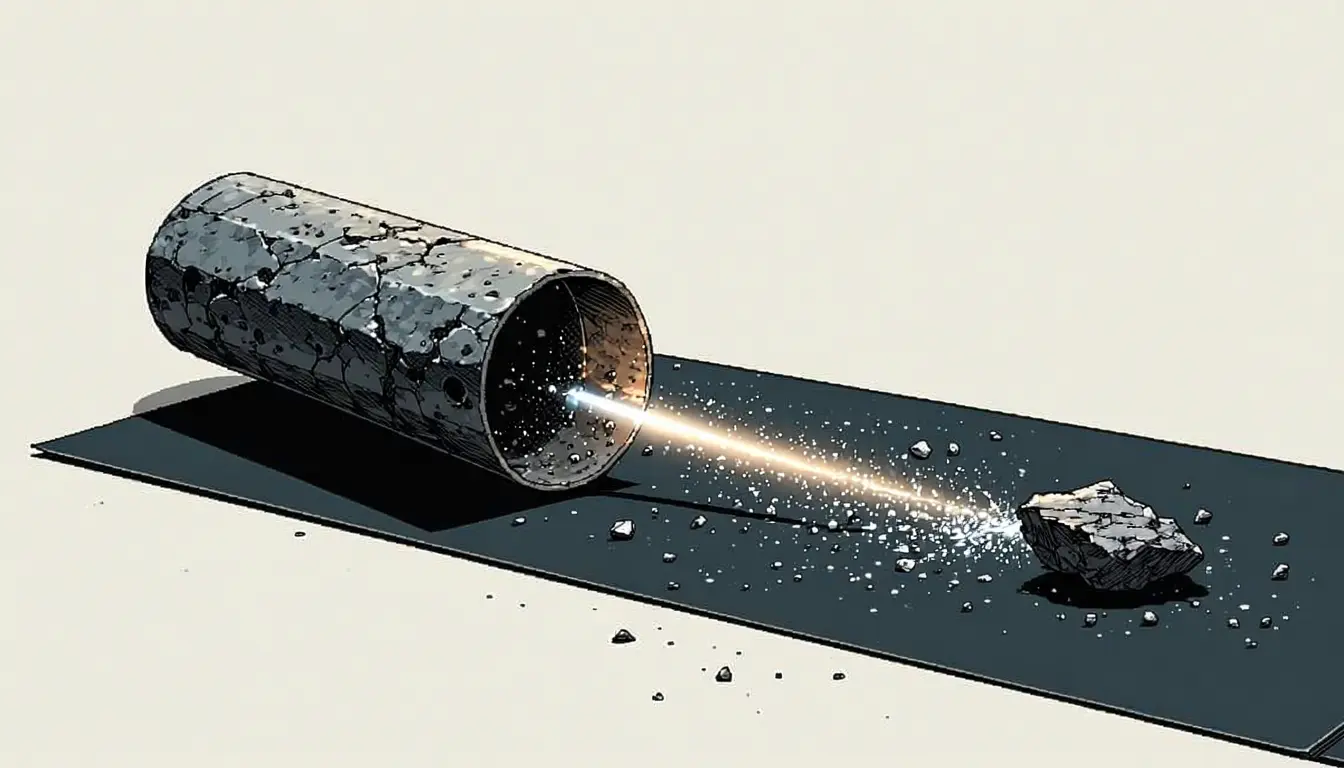
- MIT-led researchers measured magnetic signatures in calcium-aluminum-rich inclusions from DOM 08006, a meteorite found in Antarctica's Dominion Range in 2008.
- Those inclusions formed during the solar system's first 200,000 years and are the oldest known material from that period.
- The team estimates the field the grains recorded was stronger than Earth's magnetic field today and may have helped draw material inward as the sun formed.
- The study appeared in the Proceedings of the National Academy of Sciences, with collaborators at Tsinghua, Cambridge, Caltech and UCLA.
Compiled by The ScientistSomething wrong?How this is made
Why it matters
- capability Paleomagnetic evidence now reaches the pre-planet disk stage, the period Borlina says is still under debate, instead of stopping at the planet-building era.
- constraint If the grains' record holds, models of the nebula's collapse that use gravity alone have to accommodate a field stronger than Earth's present one at the sun's birth.
- exposure The early-field case rests on one meteorite's grains, so a CAI record from a second meteorite that disagreed would undercut it.
The method depends on minerals that hold a record of the field around them as they form. Moving charged matter makes a magnetic field. The collapsing cloud may have held a plasma whose charged particles, circulating through the young disk, could have created and sustained one [8]. Tiny magnetic minerals condensing in that disk could have recorded its strength. According to the MIT account, if they survived billions of years and reached Earth, their "remanent magnetization" would still carry that record [9].
The choice of grain sets the date. CAIs date to the first 200,000 years [4], so any field they recorded was present while the sun itself was still coming together. That is the window the study was built to test [13]. The group's earlier evidence came from about 2 million years in, when the sun is thought to have formed and planets were starting to assemble [10]. The new grains are at most a tenth of that age, which puts the record at least 1.8 million years closer to the start [1].
"Nowadays people don't debate whether magnetism is present when planets are forming. But the debate is around the very early solar system, before planets are forming, when there's just a disk," said Borlina, the first author, who led the work as an MIT graduate student and is now an assistant professor at Purdue University [11][12].
The measurement and the interpretation carry different confidence. The field's presence comes from the grains themselves. The idea that the field helped move primordial material inward is weaker: the release says only that it "may have" done so [5]. Benjamin Weiss, the Robert R. Shrock Professor of Earth and Planetary Sciences at MIT, put it more firmly. "It has long been theorized that gravity caused this, but our measurements show magnetism likely played a role," he said [6].
The thing this doesn't tell you is how much of the collapse the field did. A field that was present during the collapse is correlated with it. How much of the inward movement it caused depends on a model of the disk, and that is a separate claim from the magnetic reading. MIT's summary does not give the field strength as a number, the count of grains measured, or how the team ruled out magnetization picked up after the grains formed [5]. The release describes DOM 08006 as an unusually pristine record, studied extensively since its discovery [14]. The result depends on those grains having kept their original magnetization since the solar system began, about 4.6 billion years ago [1].
I think the dating can be taken at face value. Well-dated grains put a strong field in the nebula while the sun was forming [4][5]. Going from there to the claim that gravity needed help depends on the team's estimate of what that field could move [5].
What to watch
- Disk-collapse simulations that test whether a field of the estimated strength can move enough material inward to change how fast the sun and disk formed.
- Independent paleomagnetism labs measuring DOM 08006 subsamples; agreement on the recorded field would show how well later remagnetization has been excluded.