Science1 publisher2 min readPublished
A more human-looking hand drove stronger motor cortex firing in two implanted BrainGate participants
BrainGate researchers found motor cortex firing in two people with tetraplegia was strongest for a photorealistic hand and weakest for an abstract cube. The ordering bears on how assistive devices are shaped, though nobody was controlling anything during the recordings.
The Scientist · Science desk
What happened
- A PNAS study from Brown University, Mass General Brigham and the VA Center for Neurorestoration and Neurotechnology found motor cortex activity during action observation tracks how human-like the observed agent looks.
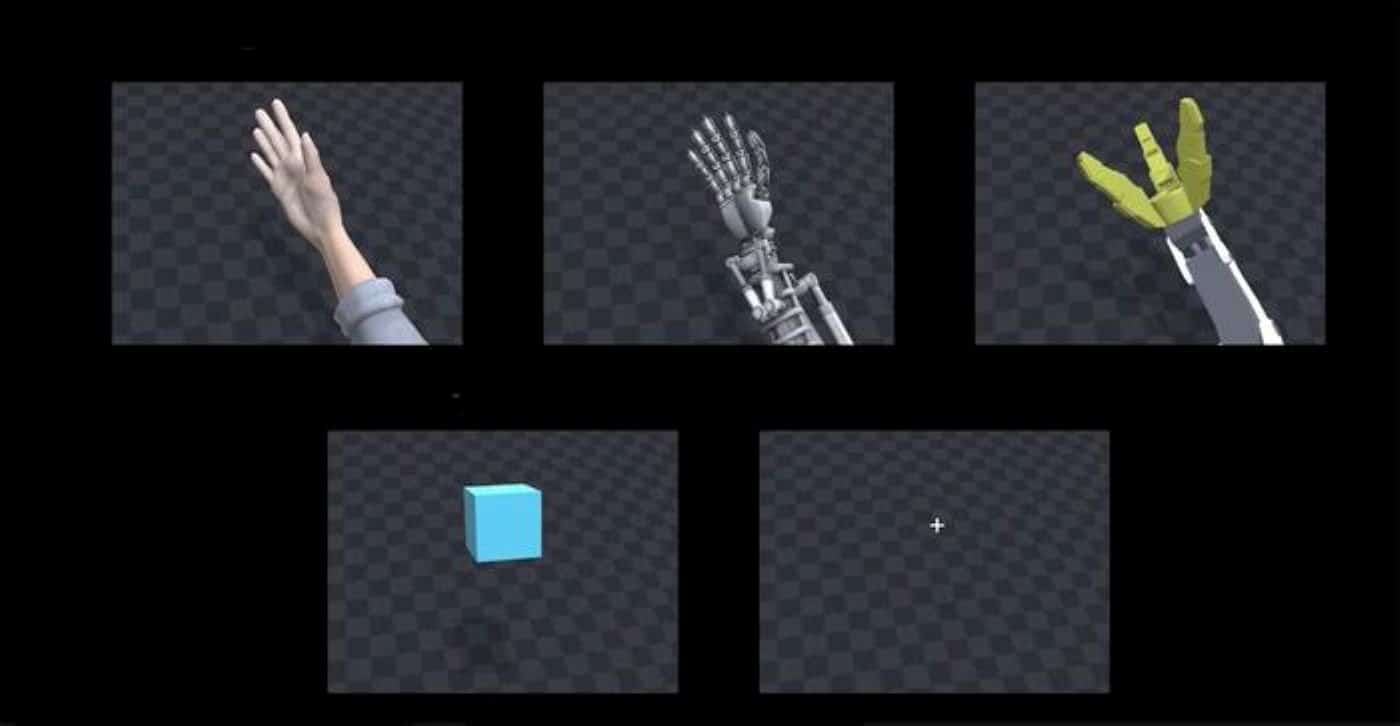
- Microelectrode arrays in the hand-knob area of the motor cortex recorded single-neuron and population activity in two people with tetraplegia as they watched animated effectors perform pinch and power grips.
- Discharge was strongest for the photorealistic human hand and tapered off as the effectors became more mechanical and abstract, through the robot hand, the three-pronged claw and the cube.
Compiled by The ScientistSomething wrong?How this is made
Why it matters
- constraint The work gives an ordering across effectors and not a magnitude anyone can design against, and it rests on two implanted participants.
- decision Groups choosing between a hand-shaped gripper and a three-prong claw for assistive robotics now have a neural argument for the hand shape, limited to the signals that watching generates.
- capability If recognizing a shape as a hand is enough to lift motor cortex activity, an interface can change its own readout by changing what the user understands the device to be, with no hardware change.
- precedent Accounts built on dedicated mirror neurons now have human single-neuron data across a continuous anthropomorphism spectrum to answer, and two-bin human-versus-robot comparisons will be harder to publish as sufficient.
Holding the action constant is what makes the comparison work. All four effectors performed the same two movements, a pinch grip and a power grip, so the thing that changed across conditions was how much the gripper looked like a hand [2][4]. A blank-space condition sat at the bottom of the set, five viewing conditions in all [6]. A dedicated class of cells that sorts agents into biological and not-biological would predict a step between the human hand and everything else. The arrays recorded a slope: strongest discharge for the photorealistic hand, tapering through the robot hand, the claw and the cube [7].
The grading appeared at two levels. More neurons were recruited as the stimulus got more realistic, and individual cells pushed their firing rates up [8].
"What this suggests is that observational activity isn't driven by specialized 'mirror neuron' cells," said Jacob Gusman, the lead author, who did the work as a graduate student at Brown University [11][12]. "It's really a network effect that's sensitive to how anthropomorphic the observed stimuli are" [11]. Motor observation has been attributed to dedicated mirror neurons for decades, and treated as central to motor learning, imitation and social cognition in humans and other primates [14].
The second result came from recognition. Observational activity in one participant increased after that person consciously recognized that an abstract dot-pattern animation depicted a hand [9]. The animation itself was identical before and after. The published summary describes this as proof that top-down cognitive context primes motor responses, on the strength of one participant [9].
A brain-computer interface group had a practical reason to run any of this. "The main motivation for this work was to look at how visual feedback may influence people's ability to use BCIs to control different types of external devices like computer cursors or assistive robotics," Gusman said [10]. The trial that hosted the study, BrainGate, develops intracortical interfaces meant to restore communication and movement to people paralyzed by injury or illness [3].
The recordings were made while participants watched. Whether a stronger observation-driven signal helps a decoder that is reading intended movement, or adds noise to it, is not a question these trials were set up to answer. An anthropomorphic gripper may produce a larger observational signal in the same cortex a decoder is listening to, and a bigger signal can still be a messier one. The published account does not include neuron counts, trial counts or effect sizes, and the study ran in two participants [16].
What to watch
- Whether closed-loop trials show decoding accuracy for intended movement changing with the appearance of the effector on screen.
- Replication in further BrainGate participants, and publication of neuron counts, trial counts and effect sizes in the PNAS paper.
- Whether telling a user to interpret an abstract effector as a hand raises the motor cortex signal, the manipulation the dot-pattern observation points to.