Science1 publisher2 min readPublished
Chemoradiotherapy reshapes which mutant clones win in the normal esophagus
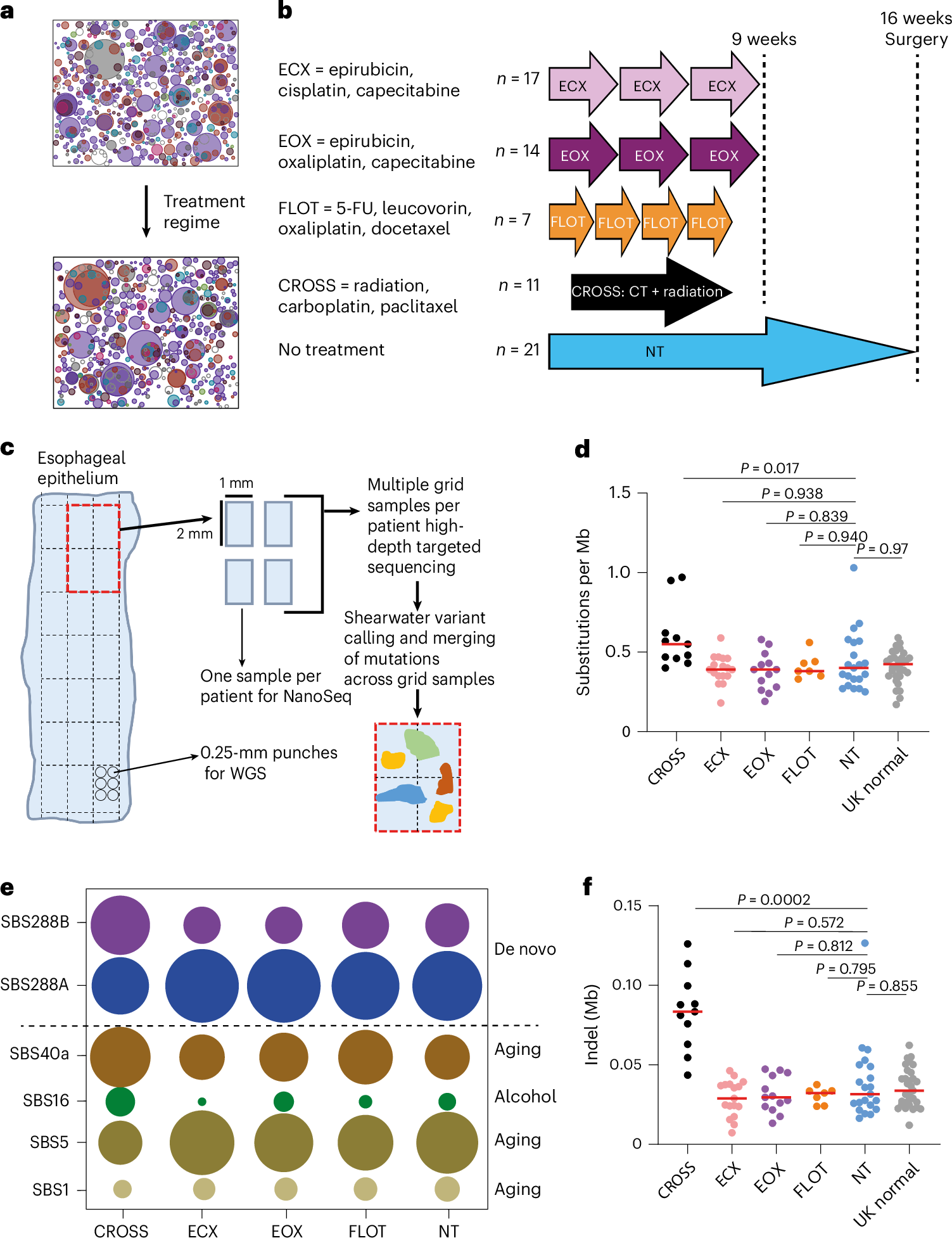
Sanger Institute researchers sequenced healthy esophageal lining from 70 patients treated for esophageal cancer and found that a few weeks of chemoradiotherapy left significantly more normal cells carrying cancer-related mutations.
The Scientist · Science desk
What happened
- Patients who received chemotherapy plus radiotherapy had significantly more normal cells carrying cancer-related mutations than the other groups in the study.
- The Wellcome Sanger Institute, University of Cambridge and University College London team says treatment gives a growth advantage to cells with particular genetic changes in healthy tissue.
- The baseline the treatment acts on is already dense: by age 60 to 70, almost all cells in the human esophagus carry somatic mutations.
Compiled by The ScientistSomething wrong?How this is made
Why it matters
- capability Surgical margins become a readout on how a drug regimen acts on healthy tissue. Trial endpoints do not capture that side-effect biology.
- exposure The population getting chemoradiotherapy for esophageal cancer in the U.K. skews old, so any selection effect lands on tissue that is already near-fully mutated.
- decision Nothing here supports changing a regimen; the open decision is whether follow-up sequencing gets built into future esophageal cancer trials.
Esophageal cancer surgery removes a margin of healthy lining along with the tumor, and that margin is normal epithelium from a patient whose treatment history is known [9]. The team compared three groups: patients who had combination chemotherapy, patients who had chemoradiotherapy, and patients who had no treatment before surgery [2][8]. Mutations in the untreated group are the control, and they matter because the baseline is already crowded. By age 60 to 70, almost every cell in the esophagus carries mutations [6].
That crowding is why the only way to read this was by comparison. The authors wrote that "aging epithelial tissues, including the esophagus, are colonized by somatic mutant clones under strong competitive selection" [5]. Against that background, the question is which clones expand.
The reported answer: mutation landscapes differed by treatment group, and the chemoradiotherapy group had significantly more normal cells carrying cancer-related mutations [3][4]. Phil Jones, a professor of cancer development at the University of Cambridge and a senior group leader at the Wellcome Sanger Institute, said: "We were surprised to find that only a few weeks of cancer treatment can drastically change decades of evolution in our cells" [10][11].
What the study does not tell you is whether any of those expanded clones went on to cause anything. No second cancers, no side-effect rates, no resistance measurements appear in what the team reported here. The paper's own claim is narrower than the clinical worry: sequencing normal epithelium reveals treatment-specific selection of mutations and may identify genes involved in cellular responses to therapy [12]. The authors present it as a discovery tool [13].
Three groups within 70 patients is a small denominator for genotype work, and the source does not report how the 70 split across arms [8]. Treatment was not randomized to test this question; it was assigned clinically, so the groups can differ in age, stage and prior exposure in ways that also shape a mutation landscape. The signal is a difference between treated and untreated tissue in the same organ, which is a good deal stronger than a cross-cohort comparison, and weaker than an experiment.
The clinical stakes are set by who gets this treatment. Around 9,500 people are diagnosed with esophageal cancer in the U.K. each year, and almost half of new cases are in people aged 75 and over [7]. Those are patients whose esophageal epithelium is already near-fully mutated before the first cycle [6].
What to watch
- Whether follow-up in these patients links expanded mutant clones to measured side effects, treatment resistance or second cancers.
- Whether the per-arm patient counts and the specific selected genes hold up in a larger or prospectively designed cohort.
- Whether the same treatment-specific selection appears in normal tissue from other organs and other regimens, including immunotherapy.