Product1 distinct publisher3 min readPublished
The stabilization works, by Engadget's account. But a single-market limited run tells you more about what a bespoke motor and a moving cover cost to build than about where Honor's cameras are going next.
The Product Desk · Product desk

Compiled by The Product DeskSomething wrong?How this is made
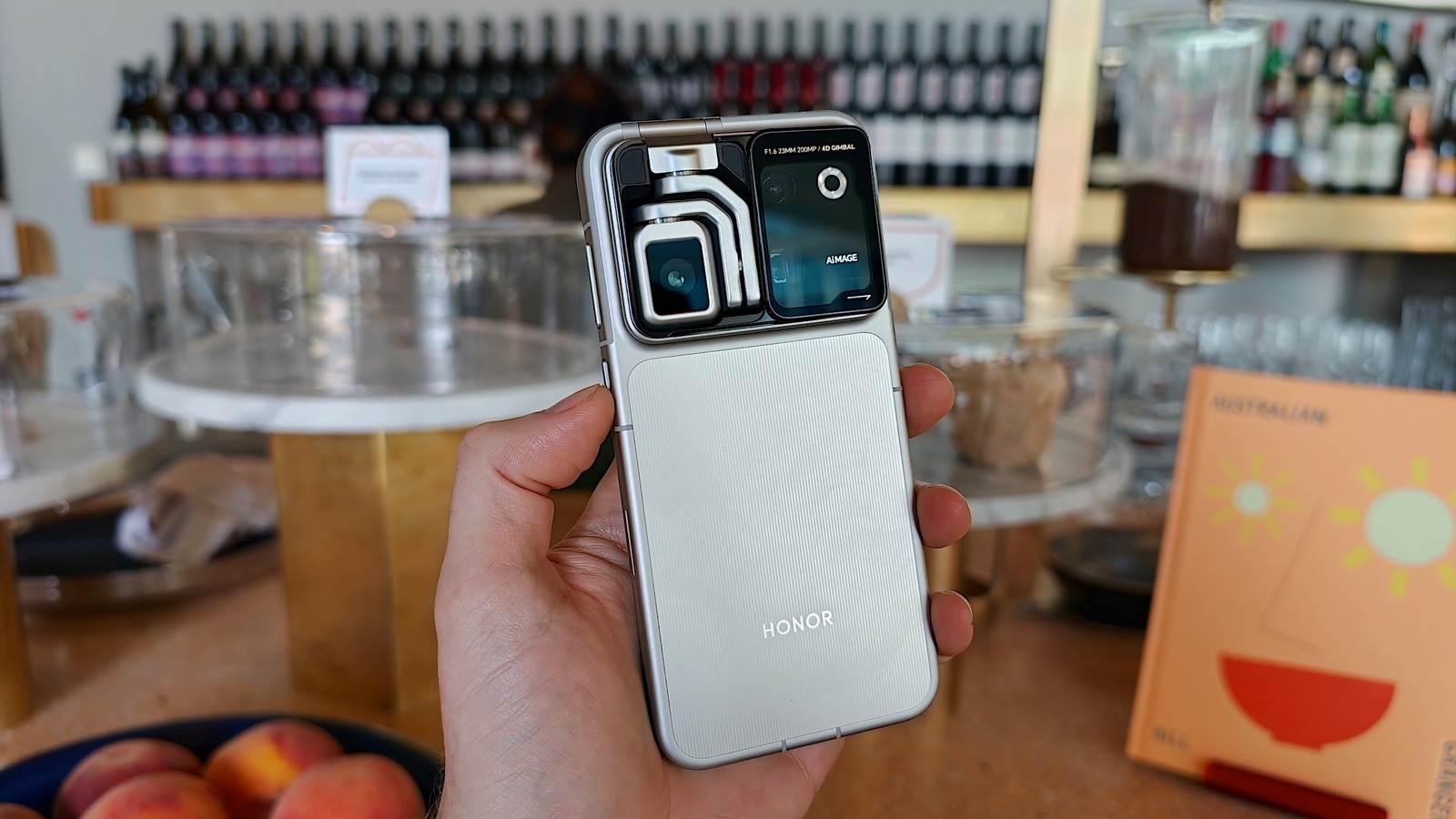
Deploying the arm is manual work. You slide the plastic cover across by hand, tap a launcher inside the camera or the AI assistant app, and the arm unfolds behind an X-ray graphic on the 6.31-inch screen [13]. Engadget's reviewer says the super-steady mode held footage level while he bounced around Kings Cross station, and that the tracking kept grabbing strangers' faces until he worked out how it ranked subjects [16][17]. That is an honest account of a first session with the hardware. It is not deployment frequency, and deployment frequency after the novelty wears off is the number that separates a camera from a trade-show flourish.
The cost structure is what makes a China-only run legible. Honor built the gimbal motor itself rather than buying one, in order to make the assembly fit inside a phone at all [5], and paired it with a compartment in the back [6] and a software program with cinema camera company ARRI [15]. Those are fixed costs, and a limited production run gives them almost nothing to spread across. Engadget reads the restriction as the sensible move with component costs continuing to rise [4].
The thing being pitched and the thing being done have come apart here. The pitch is a Robot Phone with the Yoyo assistant; Engadget's own summary is that this is less a robot than a gimbal phone [18], and a lot of Yoyo's functionality only really works in China [14]. The buyer it suits is the person already carrying a DJI Osmo Pocket next to a phone [21], and that person mostly cannot buy it. Note also how much weight one component carries: the 200-megapixel main sensor is the gimbal camera, the conventional f/1.6 camera with ordinary OIS, and by Engadget's reckoning the one you would point at your own face instead of the 50MP front camera [9][12], three roles on a single sensor [2] in a phone whose four cameras add up to 500 megapixels of nominal resolution [1].
The 2x2 worth applying to any hardware experiment like this has cost location on one axis and value portability on the other. Cost location: does the money sit in tooling and bespoke parts, or in per-unit bill of materials you can price into every region? Value portability: does the feature deliver on its own, or does it need a market-specific software stack to make sense? Bespoke tooling plus a local stack is the quadrant that produces a single-market limited run, and that is where this phone sits [5][14]. Per-unit BOM plus portable value is the quadrant where you ship everywhere and let price do the sorting.
The forcing function that goes with the grid is naming, before the limited run ships, the two numbers that would open market two, and who owns them. Call them the 30-day deployment rate for the mechanism and the mechanical return rate. If neither has an owner inside the company, the limited run is doing marketing work rather than answering the component-cost question it was supposedly built to answer.
Ranked by verification strength, evidence, and original report placement.
Honor revealed the Robot Phone at MWC 2026 in Barcelona, where it was arguably the most exciting device on display.
Despite the international reveal, the Robot Phone will not officially launch beyond China; the device just went on sale there.
Honor says it has made the tiniest gimbal in the world, manufacturing its own 2.6-gram gimbal motor to ensure it fits inside a phone.
The gimbal folds away inside a tiny compartment on the back of the phone.
The Robot Phone measures 9.6mm thick, not including the camera unit.
The gimbal delivers three-axis stabilization to the Robot Phone's 200-megapixel primary camera.
Distinct publishers with included, body-backed reporting in this cluster.
1 article · August 31, 2026
Follow any of these and your For You feed starts watching them — no settings page required.
product
Beijing's humanoid games clocked a 9.39-second sprint, on the same card where a robot caught fire1 distinct publisher
product
The Z Fold 8's real spec gap is one digit wide, and it is the digit that lets sand in1 distinct publisher
invest
Beijing fielded 2,000 humanoids the same month Washington banned importing them1 distinct publisher
product
Carrier gatekeeping keeps three of the world's top five phone makers off the US test bench1 distinct publisher
Evidence-backed comparisons of source perspectives and observed adoption signals. Read the methodology
Which Builder, Operator, and Investor concerns the observed source mix emphasized—not a truth score.
Evidence, demonstrated adoption, hype gap, incentives, and confidence are assessed independently, each on its own current evidence. How these are measured.
One reviewer's hands, one company's spec sheet
There are exactly two kinds of evidence here and no third. Engadget's reviewer physically jostled his way around Kings Cross with the arm deployed and reports the footage held — a real test, if an uninstrumented one. Everything structural comes straight from Honor: the 2.6-gram motor, the world's-smallest superlative, 9.6mm, the megapixel ladder. Nobody else in our coverage has touched the phone, and the reviewer volunteers that his time with the camera was brief.
Genuinely shipping, in one country, in small numbers
This clears the bar most trade-show marvels never reach — you can actually buy it, for 9,999 yuan, today. Then it stops: one market, no unit figures, no channel detail, a run sized only to 'cover initial demand', and Engadget's guidance to everyone else is to import. Honor's own follow-on is a spokesperson saying future devices could launch abroad, which is intent, not distribution.
The branding oversells; the write-up mostly doesn't
'Robot Phone' and a resident assistant called Yoyo promise autonomy; what ships is a folding gimbal arm you uncover by hand, and the assistant is the part that largely stops working outside China. Engadget punctures this in its second paragraph — less a robot than a gimbal phone — and adds the price, durability and IP54 caveats itself. What is left floating is Honor's 'tiniest gimbal in the world', the one claim in the story with nothing behind it but the company saying so.
Barcelona attention, Chinese inventory
Honor unveiled this at MWC, made it the most photographed object in the hall, put a spokesperson on record about devices that might one day sell abroad, and then kept the phone home — publicity in the West without the risk of stocking it there. Engadget's half of the exchange is early access to that object. Neither motive is concealed, and the piece works against the pitch where it counts: the yuan price converted upward for Western readers, the moving parts flagged as a failure risk, IP54 only with the arm stowed.
Enough to believe it works, not that it lasts
Believe the stabilization: someone tested it with his own legs and said so plainly. Beyond that, one publisher, one short session, no battery, image-quality or endurance work, and a mechanism whose likely failure modes — a hinge, an arm, a cover slid open and shut daily — are precisely what a brief hands-on cannot see. The strategy read is explicitly hedged and the production volume is unknown even to the reviewer.