Product1 distinct publisher3 min readPublished
The Verge's tally from five days in the National Speed Skating Oval is worth more to anyone buying a humanoid than an edited demo reel, because it shows the spread of outcomes instead of the best take.
The Product Desk · Product desk

product
Unitree gave back $30bn and still sits near five times its pre-float valuation1 distinct publisher
leadership
A humanoid beat Bolt's 100m time. Then the stretcher team came out.2 distinct publishers
invest
Beijing fielded 2,000 humanoids the same month Washington banned importing them1 distinct publisher
build
Unitree's 8,000x book is now the comparable every humanoid banker will quote2 distinct publishers
Compiled by The Product DeskSomething wrong?How this is made
Last year's inaugural games produced a winning 100 metres of 21.50 seconds and a best standing high jump of 0.95 metres [6][7]. Measured against this year's marks, the sprint lost 12.11 seconds, a cut of about 56 percent in twelve months [1], and the standing jump came in roughly three times higher [2]. That is hardware iterating in public at a rate a procurement team should take seriously, and it is also why the wreckage matters: the machines setting those marks were the same class of machines coming apart on camera.
What the results table does not carry is which mode produced which number. The Verge's Robert Hart, who covered the five days, does not break the records down by autonomy level [18], so the 9.39 seconds is either a robot or a robot plus a pilot taking a scoring penalty, and a buyer reading the leaderboard cannot tell which. Records are a peak measurement by construction. A demo video is a best take by construction. Neither answers the question an operator has, which is what the thing does on the four hundredth repetition with nobody watching.
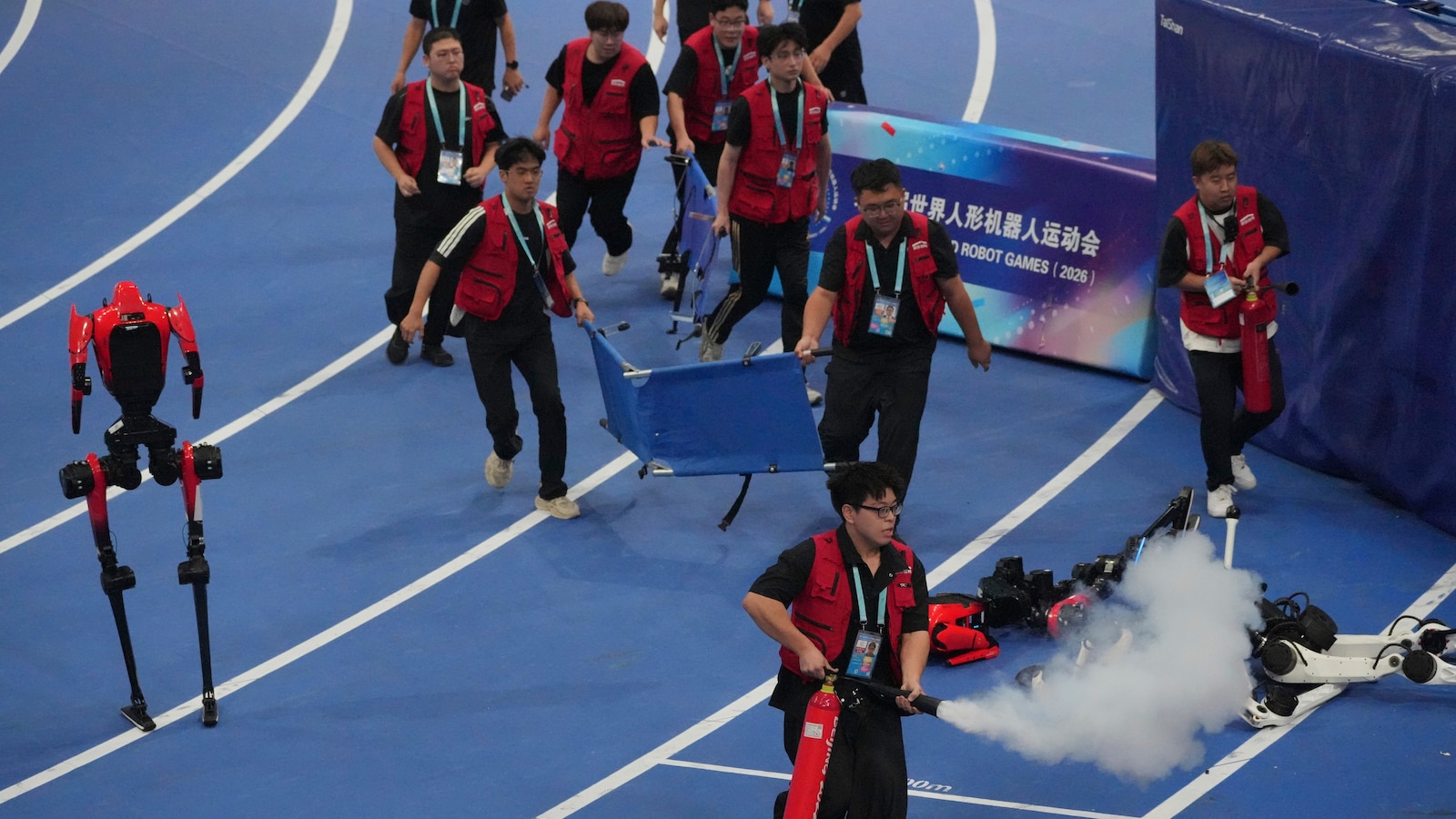
Two axes are worth more here than speed and height. First, is the task structured, with known geometry and a start signal? Second, does the robot close the loop, or does a person? Sprinting and jumping sit in the structured corner with the loop closed by the machine, and that is where the headline numbers came from. The unglamorous events sat in the other corner: soybeans lifted with tweezers, powder weighed, blocks stacked [14]. Those looked worse on television for the same reason they matter more, because the geometry changes every time and nobody rings a bell to start.
The teams building these machines are demonstrating peak capability under contest conditions, on a floor with crash mats and a crew. A warehouse needs something else entirely: mean time between interventions on one dull task, in a building with people in it. Those are different products at this stage, and the games are unusually honest about the distance between them, mostly because the failures happened in front of judges rather than in an edit bay.
So when a humanoid arrives in your building next quarter, skip the reel and ask for the maintenance log instead. How often does it fall on your task. How often does a person have to step in. And how many hours pass from the crate showing up to the first unit of useful work, which is the figure vendors are least eager to hand over. A vendor who answers with stadium footage has answered a different question, and the answer to that one is already public.
Ranked by verification strength, evidence, and original report placement.
The second World Humanoid Robot Games was a five-day event that wrapped this week in Beijing, and was far bigger than the inaugural edition held last year.
Both this year's and last year's games were staged in Beijing's National Speed Skating Oval, a former Olympic venue.
Alongside sprinting, football, boxing and weightlifting, the event card included bed-making, parcel delivery, shelf stacking, clothes folding, hammering nails and a firefighting contest.
Many events required robots to operate autonomously, including gymnastics, football, tug of war, table tennis and some track events, while others allowed human assistance via teleoperation, albeit with a scoring penalty.
At last year's games the winning 100-meter sprint was 21.50 seconds.
Distinct publishers with included, body-backed reporting in this cluster.
1 article · August 30, 2026
Follow any of these and your For You feed starts watching them — no settings page required.
Evidence-backed comparisons of source perspectives and observed adoption signals. Read the methodology
Which Builder, Operator, and Investor concerns the observed source mix emphasized—not a truth score.
Evidence, demonstrated adoption, hype gap, incentives, and confidence are assessed independently, each on its own current evidence. How these are measured.
One newsletter, one venue, no second timer
Every number that matters here — 9.39 seconds, 2.88 meters, and last year's 21.50 and 0.95 — comes from a single Verge newsletter written in the first person, and the only secondary attribution inside it is China Daily's entrant count. Robert Hart was in the building, which is worth a great deal for the falls and the fire; it is worth much less for a mark that supposedly beats Usain Bolt, which normally arrives with a timing protocol rather than a column. The missing autonomy attribution is the specific weak joint, because it decides whether the sprint is a robotics result at all.
Contest entries, not shipped units
What is demonstrably being taken up is a competition. 666 teams from 157 companies and 200 universities is genuine institutional breadth, and the confirmed April half-marathon plus a planned robot-run hotel show the pipeline of stage appearances continuing. But the work events on the card — shelf stacking, parcel delivery, clothes folding — were there precisely because those jobs are not yet being done for pay, and our coverage contains no deployment, order or usage figure for any machine that medalled.
The record travels without its asterisk
The Verge does much of its own puncturing: the piece that reports beating Bolt also reports a finisher on fire, a barbell toppling a robot into the judges' table, and teleoperation permitted for a scoring penalty. The gap opens downstream of the reporting, because 9.39 seconds is the fragment that survives retelling and it survives without the sentence that would qualify it. A sprint mark whose control mode is unknown, set on a card where machines left on stretchers, is being carried as evidence of humanoids nearing usefulness in factories and homes — which is more than the day's results can hold.
Host, entrants and columnist all want the extremes
Beijing gets a spectacle in an Olympic venue and has made embodied AI a stated national priority; entrants get a medal table where two names can dominate a thin international field; and the arithmetic that makes the field look global comes from a state-run newspaper. On the other side of the page sits a writer who opens by admitting a fondness for robot fail videos. Records at one end and fire at the other serve everyone in the chain — the per-event protocol that would settle what any of it means serves no one, and duly does not exist.
Firm on what happened, thin on what it means
The eyewitness layer is hard to get wrong — legs, sparks, flames and stretchers either happened or they did not, and one reporter watched. Everything interpretive is shakier: a single outlet, a single venue, no control-mode attribution and no independent measurement. One timing sheet, or a Chinese-language entrant list, would move this assessment materially in either direction.