Science1 publisher3 min readPublished
One pot, 1,000 gene fragments: the DNA writing bottleneck starts to move
A Nature Biotechnology paper reports a hybridization-driven synthesis method that builds over 1,000 distinct gene fragments in a single reaction, then uses it to find PETase variants beating the standard enzyme.
The Scientist · Science desk
Drafted by a language model from the sources cited here and checked against its claim ledger before publication. How we use AISend a correction
What happened
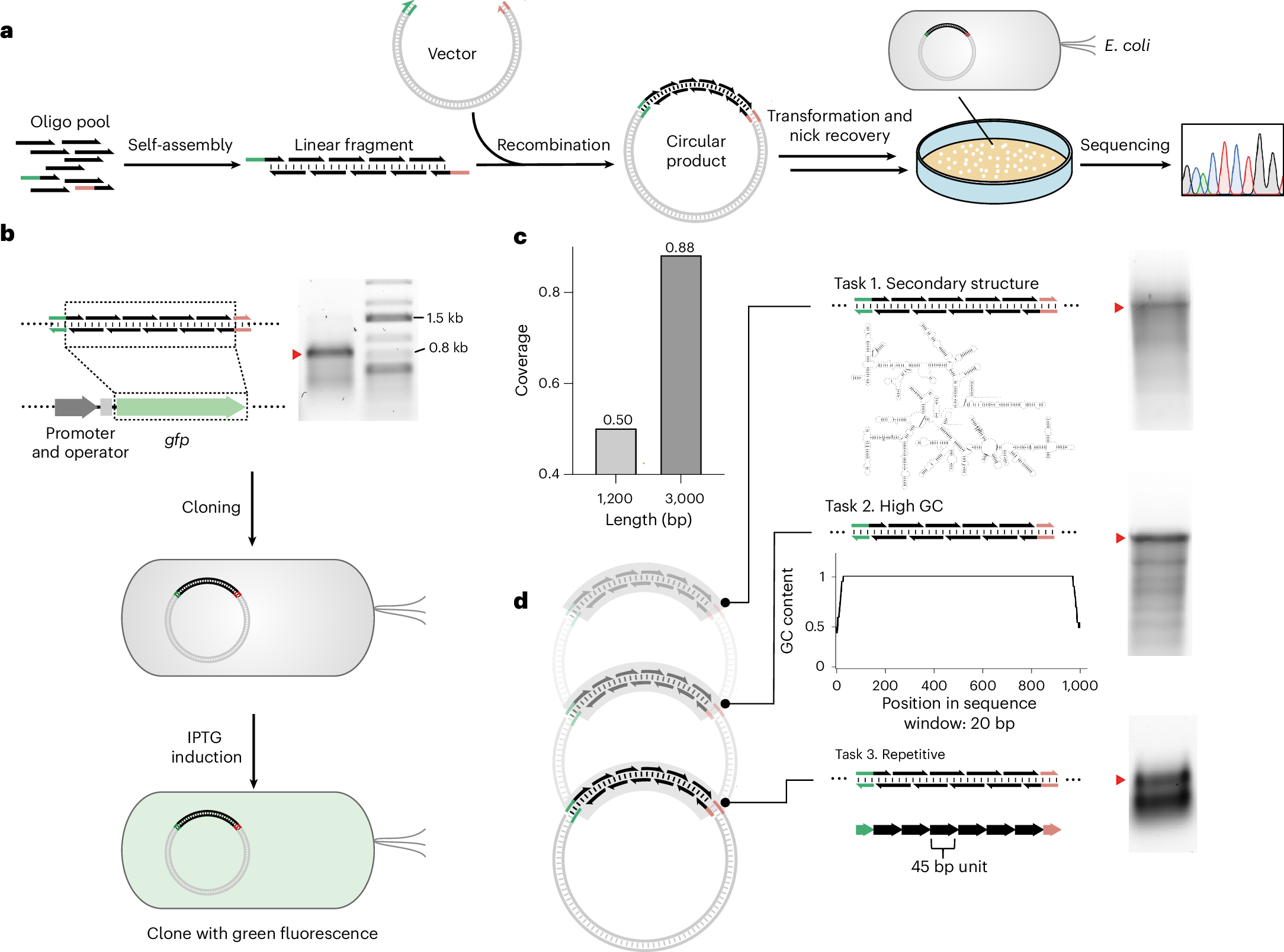
- A paper published on nature.com, "High-throughput synthesis of DNA fragments by molecular self-assembly of overlapping oligonucleotides", presents a high-throughput gene synthesis method driven by hybridization called Molecular Self-Assembly Induced Cloning.
- The authors adopt microchip-based oligonucleotide synthesis, enabling the production of over 1,000 distinct gene fragments in a simple one-pot reaction.
- The paper's abstract opens by stating that the limitations of DNA synthesis technologies are a fundamental bottleneck in synthetic biology.
- The paper's reference list includes Hoose, A., Vellacott, R., Storch, M., Freemont, P. S. & Ryadnov, M. G., "DNA synthesis technologies to close the gene writing gap", Nat. Rev. Chem. 7, 144-161 (2023).
- The method is described as overcoming molecular crosstalk and oligo misalignment across genes.
Compiled by The ScientistSomething wrong?How this is made
Why it matters
A group reporting in Nature Biotechnology describes a gene synthesis method, Molecular Self-Assembly Induced Cloning, that produced more than 1,000 distinct gene fragments in what the authors call a simple one-pot reaction [1][2]. The reason to care is stated in the paper's own first line: the limitations of DNA synthesis technologies are a fundamental bottleneck in synthetic biology [3]. That framing is not idiosyncratic to these authors; their reference list includes a 2023 Nature Reviews Chemistry survey titled "DNA synthesis technologies to close the gene writing gap" [4].
The failure mode being attacked is specific. When many different genes are assembled from short oligonucleotides in the same vessel, segments from one gene hybridize with segments from another, and segments land in the wrong register within a gene; the authors name these molecular crosstalk and oligo misalignment [5]. Their answer is to split the work between the tube and the cell: orthogonal self-assembly of overlapping DNA segments in vitro, then the DNA repair machinery of host cells in vivo to finish the job [6]. Cells take up the assembled target fragments, which then serve as templates for recovery and cloning [7]. The oligonucleotide feedstock comes from microchip synthesis [8].
The performance claim in the abstract is qualitative and worth reading precisely. The authors report near-zero misalignment, which they describe as an indispensable feature of the parallel synthesis, while oligo synthesis errors remain at a constant but controllable level [9]. In other words, the per-base error rate inherited from chip oligos does not go away; the contribution is that it does not compound into scrambled products as gene count rises. That is the property that matters for anyone building libraries, because misassembly is a correlated failure and base errors are not.
The demonstration is an industrially relevant one: massive variant libraries of PETase, the plastic-degrading enzyme, from which the authors report discovering higher-potency variants than the gold standard enzyme [10]. The abstract does not state how much higher, how large the libraries were, or what the residual error rate per base actually is [11]. Sequencing data are deposited at NCBI under accession PRJNA1470352 [12], but the full text sits behind a paywall at $39.95 per article [13], so the error curves and activity measurements are not checkable from the free abstract.
The intellectual lineage is visible in the citations and is useful for calibration. The same reference list includes Ong et al., who in 2017 reported programmable self-assembly of three-dimensional nanostructures from 10,000 unique components [14], and Gibson's 2009 one-step assembly of overlapping oligonucleotides in yeast [15]. It also includes Plesa et al., who in 2018 achieved multiplexed gene synthesis by physically separating reactions in emulsions [16]. The claimed advance here is doing the multiplexing chemically, in one compartment, rather than buying orthogonality with droplets.
What to watch: whether near-zero misalignment survives past 1,000 fragments and at longer fragment lengths, whether the PETase variants hold up in conditions resembling actual plastic waste rather than assay buffer, and whether any commercial synthesis provider adopts a method whose second step requires living cells.