Product20 publishers3 min readPublished
Apple's $1,999 foldable iPhone Duo ships October 23, crease barely visible at September launch event
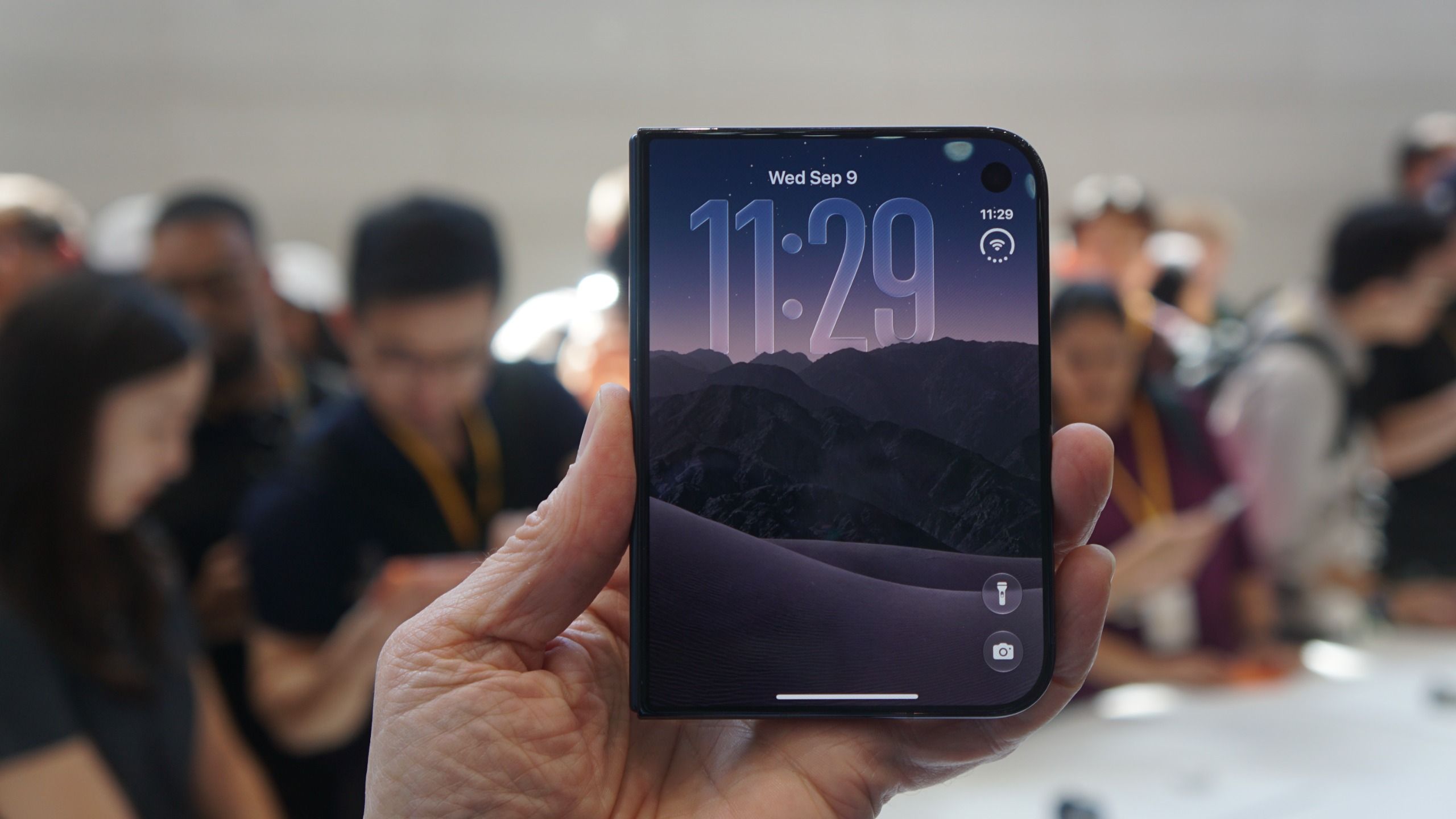
Hands-on video shows almost no crease on the iPhone Duo, but Galaxy Z Fold8 owners saw theirs appear after a week or two of use, which puts the first honest read on Apple's hinge in early November rather than on launch day.
The Product Desk · Product desk
What happened
- Apple introduced the iPhone Duo, its first foldable iPhone, in a September 9 press release tied to its Surprise and Shine event.
- Photos and video from Apple's post-keynote hands-on session show a crease on the unfolded inner display that is barely perceptible, if visible at all.
- Counterpoint Research counted about 20 million foldables sold in 2025, less than 2 percent of all smartphones shipped that year.
Compiled by The Product DeskSomething wrong?How this is made
Why it matters
- decision Buyers have to commit at pre-order on October 16, a fortnight before the kind of daily-use crease evidence that showed up on the Galaxy Z Fold8 could exist for the Duo.
- cost The monthly number that determines whether anyone can absorb $1,999 sits inside Apple Upgrade, and the launch coverage carries the plan's name without a single term, so nobody can budget against it yet.
- constraint Apple's own battery figures mean the more a buyer uses the big screen they paid for, the shorter the day gets, which limits how much of a workday the inner display can realistically carry.
- contradiction Macworld and Tom's Guide came out of the same event disagreeing on whether the Duo has a telephoto lens, so anyone choosing it for photography work is speccing against unsettled reporting.
The crease evidence is a few hours at a demo table. Photos and video from Apple's hands-on session after the keynote show a crease on the iPhone Duo's inner display that is barely perceptible [6], and Apple's own explanation is a nano-texture finish plus optically clear adhesives that let the display layers glide as the screen folds [8]. Cult of Mac makes the point that the newest Android foldables also looked clean on day one, and that user testing of the Galaxy Z Fold8 turned up a visible crease after a week or two of normal daily use [7]. Set that against Apple's calendar. Units reach buyers on October 23 [3], so the comparable evidence on the Duo arrives roughly between October 30 and November 6 [3]. Pre-orders open October 16 [3], which is when most of the commitment happens.
The price sheet decides the rest. $1,999 buys 256GB, and 2TB is $3,199 [2], a $1,200 step for storage alone [1]. Macworld puts the base price at about twice an iPhone 17 Pro [5]. The variable that will actually move units is financing, and it is the least documented thing in the launch coverage: Cult of Mac names the plan, Apple Upgrade, with no monthly figure, no term length and no trade-in condition attached [14]. Nothing in the material says how many Duos Apple expects to sell, and no rival has priced against it yet. The only market number on the table is Counterpoint Research's count of about 20 million foldables sold in 2025, under 2 percent of smartphones shipped [4], a share that implies more than a billion phones shipped that year [4].
Apple's battery claims, as reported by Tom's Guide, are 44 hours using only the outer screen and 31 hours on the inner one, with 24 hours if both get even use [12]. Opening the phone costs about 30 percent of the runtime [2]. That figure is also the cleanest read on whether the second screen is doing anything for its owner. The 5.4-inch outer display carries 90 percent of an iPhone 18 Pro's screen area [9], so a buyer who mostly keeps it shut has paid for a normal-sized iPhone with a titanium frame and a hinge built from more than 100 components [11]. Depth of use on the inner display, not how often the thing gets opened, is the measure worth tracking.
Day-one specs are softer than they look, too. Macworld reports two 48MP outside cameras, wide and ultra-wide, and no telephoto [16]. Tom's Guide reports a 48MP Fusion Ultrawide plus a 2x telephoto [17]. Both were written from the same event.
So the grid worth drawing before October 16 has two axes. One: does this person have a weekly task that genuinely fails on 5.4 inches, the side-by-side or Pencil-markup work that iOS 27's reworked layout and the promised USB-C Apple Pencil support are built for [19][20]. Two: can that task wait two weeks for crease and hinge reports from people who folded the thing 200 times. Yes and yes is a pre-order. Yes and no is a mid-November order. A no on the first axis means paying twice an iPhone 17 Pro for a phone whose main screen area is 90 percent of one, which John Ternus, Apple's CEO, called the most transformational change to iPhone since the original [21].
What to watch
- Apple Upgrade's actual terms: monthly cost, contract length, and whether a trade-in is required.
- Two-week user reports on whether the nano-texture inner display shows a crease under angled light after daily folding.
- Whether Apple's published tech specs confirm or contradict the 2x telephoto that Tom's Guide reported.