Build1 publisher2 min readPublished
Routing every query into Google AI Mode cut publisher clicks by 18.8 points
A preregistered trial pushed one arm's entire seven-day query stream into AI Mode. The 18.8 point drop in outbound clicks is therefore the effect at full substitution, and a publisher's own exposure share scales it.
The Engineer · Build desk
What happened
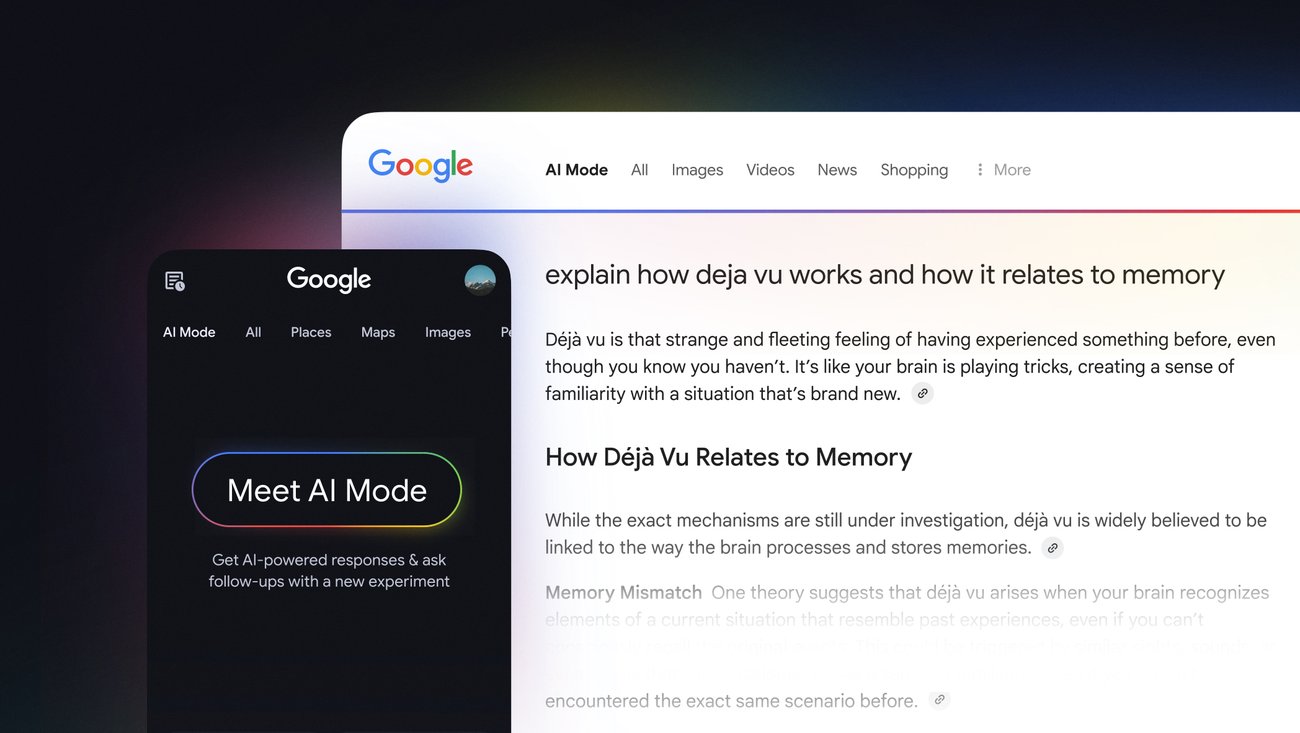
- A preregistered field experiment put a browser extension on 1,100 US participants and randomly assigned them for seven days to one of three Google Search experiences.
- The AI Mode group also recorded fewer daily Google search sessions and reported lower trust in the information they found through Google.
- In the third arm, with AI Overviews hidden and AI Mode unavailable, external traffic could rise.
Compiled by The EngineerSomething wrong?How this is made
Why it matters
- exposure Sites whose audience skews toward high-volume searchers absorb more of the loss than an average-user estimate implies, because the effect grew with daily search volume.
- decision One aggregate traffic number stops working as a content performance signal. Acquisition planning moves onto intent-split reporting.
- contradiction Time in product rose while sessions and trust fell, so engagement gains inside the answer do not predict anything about downstream web engagement.
Every query in the AI Mode arm went into AI Mode [5]. Everyday use is more selective, as the write-up notes among the study's limits [8]. So 18.8 points is the effect at full substitution, measured against an arm running unmodified Google Search, and what Google's current mix does to a given site is a separate number [1][5].
To move the number onto a publisher's own referral curve you need a second figure: the share of your incoming search demand that resolves inside an AI answer. Multiply 18.8 by that share. At one query in ten, linear scaling gives about 1.9 points of outbound click rate [1]. Linearity is an assumption. Effects were larger for heavier Google users, so the per-user response is not flat [6].
The destination breakdown is more useful than the headline. Reddit click-through fell about 21.2 percentage points, news sites about 12.5, Wikipedia about 9.9 [4]. In my view that ordering tracks how completely a generated answer stands in for the destination. Reddit's drop is roughly 2.1 times Wikipedia's [3].
Two of the measured effects point the same way for a publisher. The AI Mode group clicked out less often and also ran fewer daily Google search sessions [1][3]. Referrals per user per day is sessions multiplied by outbound clicks per session, and both terms moved down [2].
Session length went the other way. Participants stayed in the AI-mediated experience longer, and the extra time did not produce more engagement with the open web or better sentiment [7]. They also reported lower trust in what they found through Google [3].
The write-up states the headline result as external clicks falling 18.8 percentage points [1]. It states the central finding as a reduced share of participants who clicked through to outside sites [10].
The authors of AI in Search Reduces Publisher Referrals Without Improving User Experience: Experimental Evidence limit the claim themselves, cautioning that the results reflect AI Mode's design and implementation during the experiment and should not be treated as a forecast for every future version of Google Search or every market [9]. Participants were US-based and recruited in March 2026 [8]. In the third arm, with AI Overviews hidden and AI Mode unavailable, external traffic could rise [11].
For planning, the dev.to write-up recommends tracking informational, comparison, branded and conversion-oriented queries separately instead of judging search performance through one aggregate traffic number [12]. A page can stay visible inside a search journey and still lose visits when the answer satisfies the immediate need [13].
What to watch
- A replication outside the US, or after Google changes AI Mode, tests whether 18.8 points is a property of the product or of that week's build.
- Any disclosure of AI Mode's share of query volume would supply the exposure multiplier this result needs.
- The No AI Search arm's traffic increase is the result a larger sample could most easily overturn.