Build1 publisher3 min readPublished
Google's Dive deeper test inserts an AI overview ahead of the publisher's page
Robby Stein said the Discover experiment starts on video cards and opens a short topic overview with links to related stories. Google has published no referral data, so publishers cannot size the effect yet.
The Engineer · Build desk
What happened
- Google Search VP Robby Stein publicly announced a Google Discover test called Dive deeper on September 18, 2026, which inserts an AI-generated topic overview between a Discover card and the publisher content behind it.
- Google calls this a live experiment, and did not disclose countries, languages, traffic results, rollout dates or an opt-out mechanism.
- PPC Land reported that independent researchers observed code flags that may point to broader formats including article cards, which Google has not confirmed as an expansion.
Compiled by The EngineerSomething wrong?How this is made
Why it matters
- exposure Ad impressions, subscription starts, affiliate revenue and lead volume all sit downstream of a Discover click, and they are exposed to a fall in click share that leaves every publisher link visibly in place.
- constraint A publisher trying to read this surface has to build its own instrumentation, because the referral patterns and optimisation tactics learned on Search results pages do not port to a recommendation feed.
- decision Every Discover-dependent site has to decide now whether to snapshot its referral mix, because once the interface changes there is no clean before-period left to compare against.
- contradiction Google's statement extends only to video cards while the code flags PPC Land reported point at article cards, and which of those holds decides whether a text-first publisher is in scope at all.
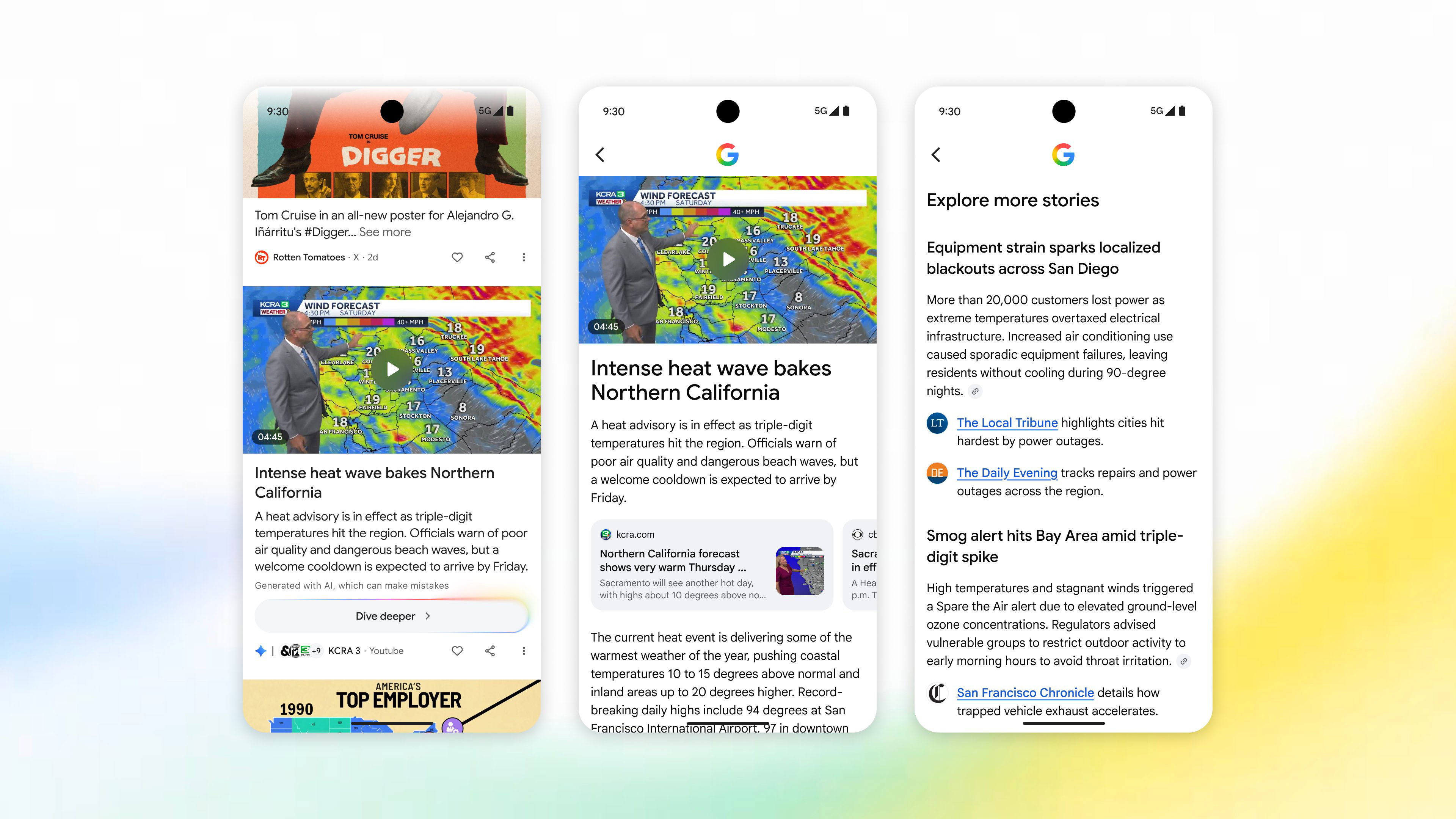
Count the screens in the flow the reporting describes. A tap on "Dive deeper" opens an AI-generated summary, and behind that sits a second screen of related-source cards and an "Explore more stories" area [4]. So two Google-hosted screens sit in front of the publisher page that a card tap used to open on its own [16].
The publisher links survive the change [9]. A link can hold its position and still take a smaller share of clicks, and the dev.to write-up leaves both readings open: a concise overview may satisfy some users before they visit an external article, or it may give the links that follow enough context to make them more useful [9]. Google has released no referral or click-through data, so neither outcome can be quantified [8].
Google has not said which countries or languages the test runs in, what it did to traffic, when it might roll out, or how a publisher would opt out, and it calls this a live experiment [7].
Discover is a recommendation feed, and on the dev.to piece's reading publishers cannot assume Search behaviour, referral patterns, or optimisation tactics transfer to it [10]. The Search Console Discover report is the only shared yardstick, and the useful version of it is segmented by content type [14].
The same piece argues for measurement and distribution resilience, and for establishing a baseline for Discover performance before any change reaches an audience, so a real shift in referrals can be told apart from normal Discover volatility [13]. Its list of signals runs to landing-page engagement from Discover referrals, including returning users, pages per visit, subscription starts, leads and ad-view depth, plus video performance, topic-level patterns and referral concentration [14]. Those are all things a publisher can measure without Google's cooperation.
For this test to move a given publisher's numbers, that publisher's Discover traffic has to arrive through video cards. The experiment begins there [5], and Google's public statement covers video cards only [12]. PPC Land reported that independent researchers observed code flags that may point to broader formats, including article cards, and those flags are not a confirmed expansion [11]. Google also plans to test multiple designs in the coming weeks, so the prominence of the publisher links in the version people eventually see is not fixed by the one that was demonstrated [6].
Stein's own description of the feature puts the links inside the overview: a short topic overview with prominent links to related stories, community reactions, and original reporting [3]. Whether "prominent" survives design iteration is the thing to measure. From the outside, only the sites on the receiving end can measure it [15].
What to watch
- Whether the test reaches article cards. Google's statement covers video cards only, and the PPC Land code flags are unconfirmed.
- Whether Google publishes referral or click-through data from the experiment, or names the countries and languages it runs in.
- How prominent the publisher links are in the other designs Google says it will test in the coming weeks.