Invest2 publishers3 min readPublished
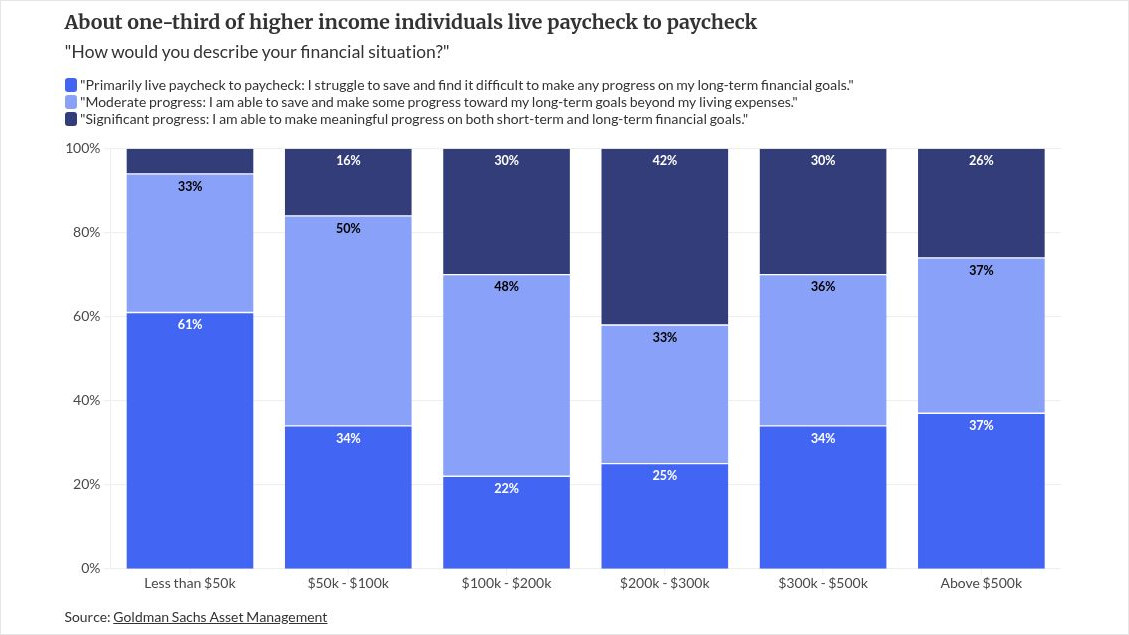
Goldman finds 37% of people earning over $500,000 live paycheck to paycheck
Goldman Sachs Asset Management's retirement survey found that 37% of people earning more than $500,000 live paycheck to paycheck. Goldman cautions that this strain may mean something different for retirement at that income, so the figure is a reason to look at rich clients' budgets.
The Investor · Invest desk
Drafted by a language model from the sources cited here and checked against its claim ledger before publication. How we use AISend a correction
What happened
- Goldman's coarser income bands show a U-shape: 42% of workers under $100,000 and 36% above $300,000 live paycheck to paycheck, against 23% between $100,000 and $300,000.
- The survey covered 5,106 people, made up of 3,612 workers and 1,494 retirees aged 45 to 75.
- Day-to-day expenses, housing costs and debt payments are increasingly cutting into respondents' ability to save, according to the survey.
- Two-thirds of Gen X, millennial and Gen Z respondents expect to delay retirement because of competing financial priorities.
- Thirty-four percent of respondents said they will probably look for another job for financial reasons.
Compiled by The InvestorSomething wrong?How this is made
Why it matters
- contradiction Goldman's own caveat, that high earners' concerns may carry different retirement implications, means the 37% cannot be used as proof that top earners are under-saved. What it supports first is a conversation about the client's budget.
- decision Advisors who adopt Goldman's line will spend client meetings on asset mix, annuities and private markets, and less time pressing for higher contribution rates.
- exposure Retirees who keep substantial equity exposure at 65, as Lee recommends, carry market risk into the years when they are drawing income from the portfolio.
Put side by side, the finer income bands reported by American Banker place the top of the scale closer to the bottom than to the middle. The 37% above $500,000 is 5 points below workers earning under $100,000 and 15 points above the 22% earning $100,000 to $200,000 [4][1]. Most of the climb happens at one threshold. The share rises from 25% in the $200,000 to $300,000 band to 34% at $300,000 to $500,000, a 9-point step, then adds 3 points above $500,000 [3][4][2]. American Banker's finer bands and The Daily Upside's coarser ones agree with each other [3].
Paycheck to paycheck describes monthly cash flow, and Goldman's write-up is careful about how far that finding stretches. "Certain financial concerns also appeared among some higher-income households, although the nature and retirement implications of those concerns may differ from those experienced by lower-income households," the survey results said [6].
The 37% supports more than one reading. One is liquidity: a household with a large retirement balance and heavy fixed costs can spend every monthly dollar and still be on course. Another is real under-saving at high incomes. A third is noise. The 5,106 respondents are split across at least five income bands, and a 3-point gap between the top two may not hold up in a bigger sample [1][4][2].
I think the second reading has the better evidence behind it. According to The Daily Upside's account of the survey, high earners report delaying financial goals, worrying about retirement savings and struggling to pay off monthly credit card debt at rates that look similar to those of lower earners [7]. The view is wrong if Goldman's balance data shows that the $500,000-plus households who answered yes hold savings at or above target. The published results do not split balances by income.
Goldman's prescription moves the advice away from contribution rates. "If workers' saving ability is being constrained by a variety of forces, the answer among the industry cannot be continuing to tell people to figure out how to save more," said Christopher Ceder, senior retirement strategist at Goldman [8]. Wyatt Lee, head of target-date strategies at T. Rowe Price, pointed to private credit and private equity. He said both have historically generated excess returns over comparable public-market investments [16]. "If you're just playing in the public markets, your opportunity set is limited," Lee said [10]. On retirees, he said, "We're recommending that they should still have a substantial exposure to equities, and they just shouldn't be fully de-risked" [11]. He added that demand for annuities has risen and that advisors "are ideally placed to be able to talk about them because many individuals are reluctant to annuitize on their own" [12].
Each of those remedies changes where existing assets sit, and both men work for asset managers [9][18]. A household above $500,000 that spends its whole paycheck has the same monthly budget after a change of asset mix. Leah Schwarz, managing director of Perspective Wealth, which partners with Steward Partners, describes her approach in cash-flow terms. "The numbers don't lie, and so I think I consistently show people, 'Hey, this is where you are. This is what you can generate,'" she told Financial Planning [17].
What to watch
- Whether Goldman publishes savings balances or contribution rates by income band, which would show whether the $500,000-plus paycheck-to-paycheck group is actually behind.
- The number of respondents in the over-$500,000 band, which decides whether its 3-point gap over the $300,000-$500,000 band means anything.
- Whether 401(k) plan menus add the private credit, private equity or annuity options Lee described for participants.