Science1 publisher3 min readPublished
Argentine skeleton suggests saber-toothed marsupial relatives outlasted their supposed extinction
Eric del Campo's team names Pampaluctor calibar, a roughly 100-kg saber-toothed marsupial relative from rocks younger than its group was thought to reach. Its presence beside the first North American carnivores weakens the case for a quick takeover, though one skull-less skeleton cannot say how the natives finally vanished.
The Scientist · Science desk
Drafted by a language model from the sources cited here and checked against its claim ledger before publication. How we use AISend a correction
What happened
- Members of a local museum found the fragments in 2014 in a seaside cliff on the Argentine pampas, in rocks dated to the end of the Pliocene or the early Pleistocene.
- Sparassodonts, mostly meat-eating relatives of marsupials with more than 50 known species, were thought to have vanished from South America by the mid- to late Pliocene.
- The only other relatively large carnivore known from the period was a 25-kg scavenging raccoon relative, alongside weasels and foxes that had probably arrived from North America.
- The study ranks Pampaluctor among the youngest sparassodonts ever found and probably the top predator of its time.
Compiled by The ScientistSomething wrong?How this is made
Why it matters
- constraint Any account of a fast northern takeover now has to fit a native predator about four times the mass of the largest carnivore known to have lived beside it.
- precedent Together with the terror birds, this makes late survival a pattern among native groups, so their published last-appearance dates look more like lower bounds than extinction dates.
- exposure The late-survival claim depends on a family assignment made without teeth or skull, so a cranial find from rocks of the same age would confirm or overturn it.
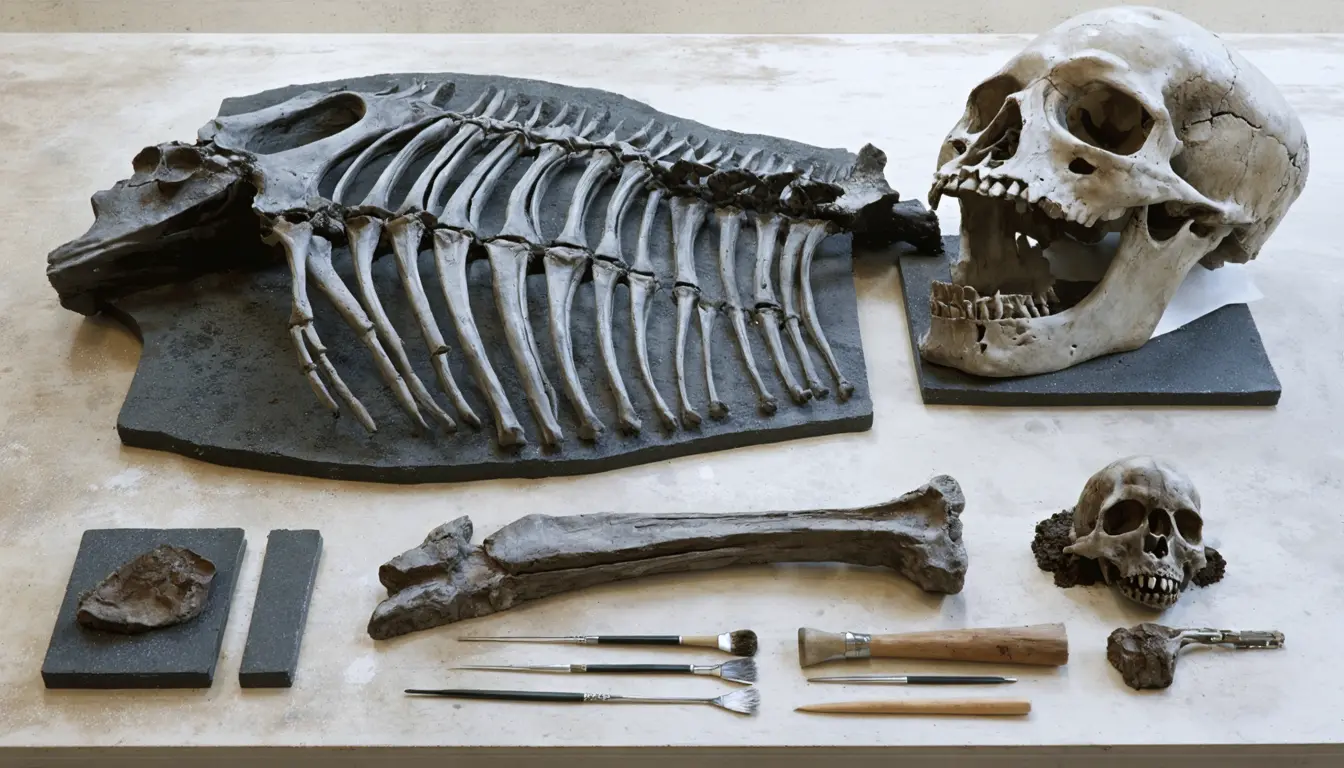
Thylacosmilids are known for their long, knifelike teeth, much like those of saber-toothed cats [10]. This one was found without them. The recovered skeleton includes strong neck bones, a shoulder blade, various leg bones and two tail bones, and no skull [11]. The team compared the bones with those of living and extinct species. They resembled other thylacosmilids but never quite matched, and the authors take that mismatch as evidence of a new species [5]. The saber-tooth label is an inference drawn from the neck down. "We wanted to shift away from using 'smilus' and instead focus more on the fact that we had no cranial remains," del Campo said [14]. The genus uses "luctor," Latin for "to wrestle," and the species name honors a 19th-century gaucho who tracked thieves and rescued lost people [20].
That inference took years. The fragments fit only one group of large predators, and that group was supposed to be extinct already, so the fossil had no identity [1]. Del Campo began to suspect a thylacosmilid later, as a bachelor's student [4]. He is now a paleontologist at the Argentine Museum of Natural Sciences in Buenos Aires and the study's lead author [2]. The paper appears in Alcheringa: An Australasian Journal of Palaeontology [3].
The bones also suggest how it hunted. Thick neck bones and heavily muscled front legs point to an animal that pinned prey down instead of chasing it [19]. "I would describe Pampaluctor as a strong ambush hunter, not particularly graceful, relying instead on overpowering prey with brute force rather than giving chase," del Campo said [13]. The mass estimate comes from a single thigh bone, and on that basis the authors call it possibly one of the largest mammalian predators known from South America [12].
Del Campo states the older view plainly: "Historically, it was believed that some native South American animals (both carnivores and herbivores) had lost to the more 'modern' northern ones when North and South America fully connected..." [6] Of the new animal, he said: "The finding of Pampaluctor shows that native South American animals lived longer than previously assumed and interacted with the first 'northern newcomers.'" [7]
I think the evidence supports the first half of that sentence more firmly than the second. One dated skeleton moves a last appearance later and puts a large native predator in the same window as weasels and foxes from the north [15]. That bears on the speed of the turnover. It cannot show how many thylacosmilids were left, or whether northern mammals still displaced them over a longer span. The fossil's date range also straddles an epoch boundary [8], and the published account does not say how the cliff layer was dated.
Del Campo places Pampaluctor among a growing set of South American species, the giant flightless terror birds among them, that turn up thousands or millions of years after they were thought to have died out [16]. "All of this shows that the story of these groups is far from resolved. I think it is exciting that these classic South American animals are being found in more recent times," he said [17].
What to watch
- A tighter date for the cliff layer, placing the specimen firmly in either the late Pliocene or the early Pleistocene.
- Further sparassodont or thylacosmilid specimens of similar age elsewhere in South America, which would show whether Pampaluctor was a lone holdout or part of a surviving population.