Science1 publisher2 min readPublished
Helsinki MEG recordings sort 263 depression patients into five connectivity profiles
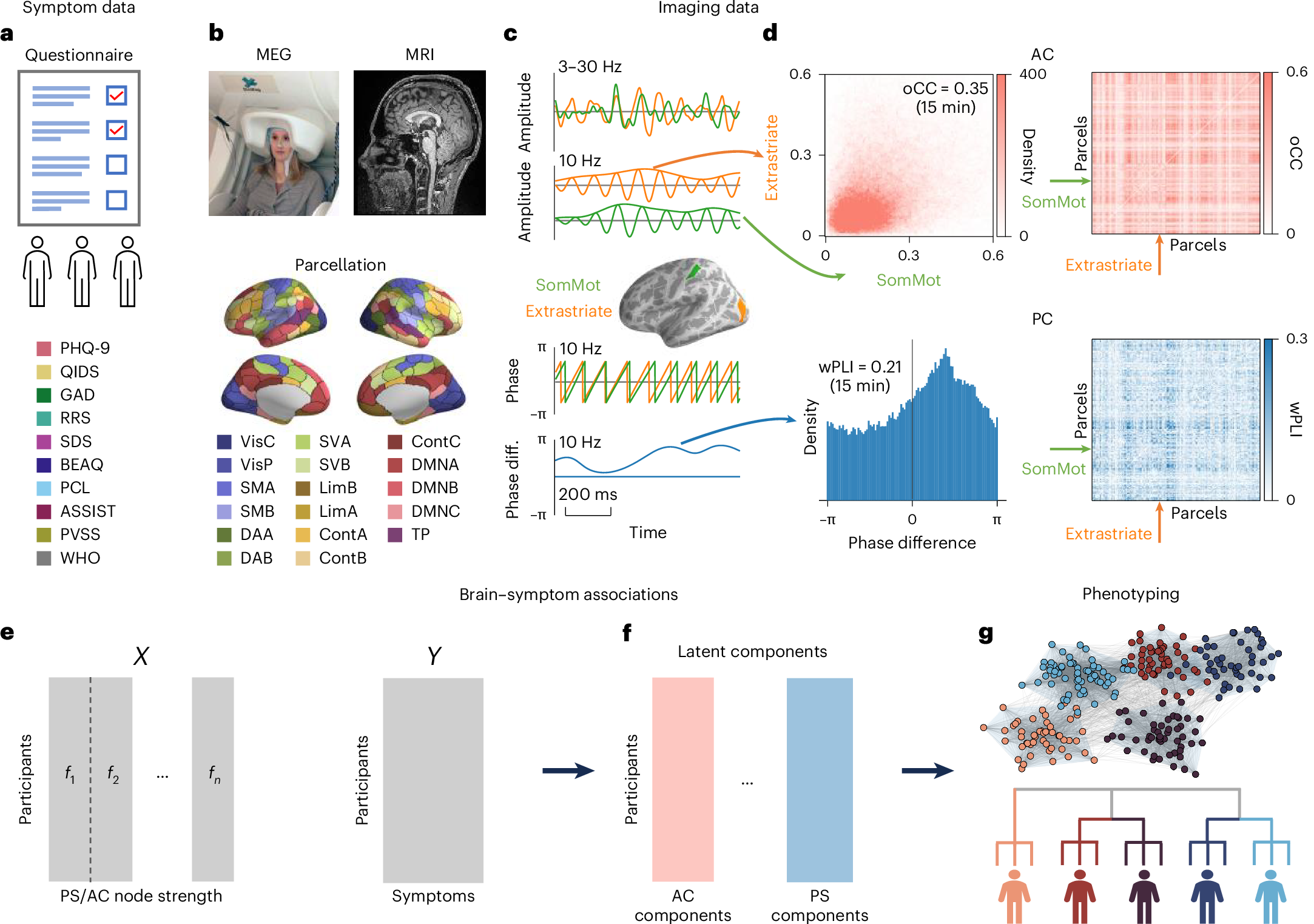
Magnetoencephalography in 263 patients and 75 controls yielded five connectivity groups, one with widespread reductions in coupling and one with the strongest coupling in the study, each tracking a different symptom mix.
The Scientist · Science desk
What happened
- Neuroscientists at the University of Helsinki measured whole-brain functional connectivity with magnetoencephalography in 263 people diagnosed with major depressive disorder and in 75 healthy controls.
- Clustering that connectivity produced five patient groups, one of them showing widespread and pronounced reductions in coupling alongside prominent post-traumatic stress symptoms.
- All five groups differed from the controls in how strong their coupling was, in which brain regions were involved, and in the rhythmic frequencies at which the communication happened.
Compiled by The ScientistSomething wrong?How this is made
Why it matters
- constraint A patients-versus-controls connectivity average has no stable direction once the sample mixes subtypes of opposite sign, so an earlier study's recruitment mix constrains its result more than its size does.
- decision Testing subtype-matched treatment means recruiting and powering five arms; at the size of this sample the average arm holds about 53 patients before any dropout.
- capability Millisecond, frequency-resolved coupling gives psychiatry a candidate stratifying measure that slower imaging modalities could not resolve.
- precedent The University of Helsinki presents these profiles as a foundation for biomarker-guided treatment. The next study has to show a subtype predicting who responds to which intervention.
Opposite signs inside one diagnosis complicate case-control designs. If one subtype couples well below controls and another above them, the mean of a mixed sample falls between the two, and which side of the control mean it lands on depends on how many of each subtype were recruited [18]. Two research groups could publish opposite directions for the same disorder and each be describing its own sample accurately.
Satu Palva, who directs the Neuroscience Center at the University of Helsinki [10], said: "What was particularly interesting was the contrasting patterns of brain activity found under the umbrella of the same depression diagnoses. In some individuals, the functional connectivity between brain regions was stronger than usual, while in others it was weaker" [9]. Strength was not the only axis. The five profiles also differed from controls in which regions were involved and in the frequencies at which the coupling occurred [8].
Five groups drawn from 263 patients average 53 patients each [15], and clusters of unequal size mean at least one group is smaller than that. Each group was compared against the same 75 controls, roughly one control for every 3.5 patients [21]. The release reports the profiles and their symptom correlates; it does not give the size of each group, describe a replication cohort, or report treatment outcomes [19].
Group 5 pairs the strongest inter-regional coupling in the study with pronounced substance abuse and notably fewer trauma-related symptoms [7]. That pairing was measured in one sitting. A single MEG session alongside a symptom assessment cannot establish whether heavy use altered the coupling or the coupling came first [20], and the same holds for the widespread hypoconnectivity and prominent PTSD symptoms in Group 3 [5].
The population behind the stratification question is large. Depression affects roughly 332 million adults, about 5.2 percent of the world's adult population [13], and in countries such as Finland it is the leading cause of prolonged illness absences and disability pensions [14].
The University of Helsinki says the findings explain conflicting past research and pave the way toward personalised psychiatric care [11]. The first claim follows from the opposite signs the study reports. The second needs a study that assigns treatment by MEG subtype and then measures who improves.
What to watch
- Whether the five clusters, and their group sizes, survive in an independent MEG cohort.
- A trial that allocates treatment by MEG subtype and reports response rates per subtype.
- Whether the hyperconnected substance-use group's coupling changes when use changes, which would order cause and effect.