Invest2 publishers3 min readPublished
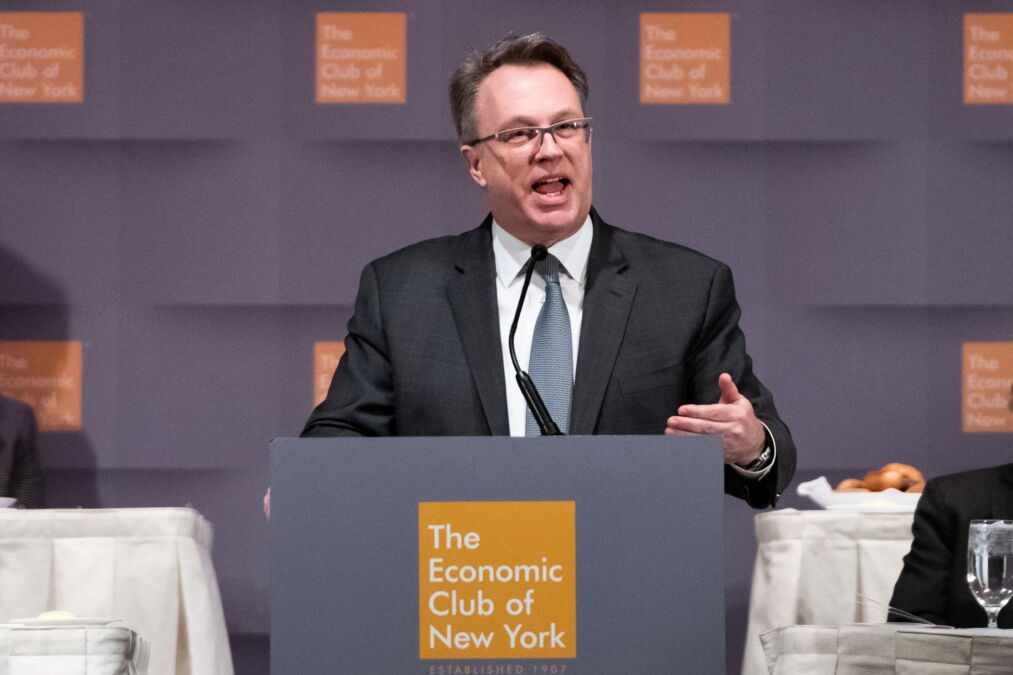
New York Fed's Williams backs market bets on one more rate hike this year
New York Fed President John Williams called one more rate hike this year reasonable, citing AI investment demand and energy prices with inflation at 3.4%. Sixteen of 18 Fed officials project at least one more move, so borrowers should plan on a policy range of 4% to 4.25% or higher by year-end.
The Investor · Invest desk
What happened
- The Fed voted unanimously last week to raise its benchmark rate by a quarter point, to a range of 3.75% to 4%.
- Williams noted that inflation has now been above the Fed's target for five years.
- On the neutral rate, he described a "tug of war" between fiscal policy and faster growth on one side and demographics weighing it down on the other.
Compiled by The InvestorSomething wrong?How this is made
Why it matters
- exposure Debt-financed AI projects face rates that Williams partly attributes to AI investment demand, while the productivity he expects from that spending is still years away.
- decision A treasury plan that assumes a hold through December sides with the two of 18 officials who did not signal another hike.
- constraint With the policy rate only about half a point above August inflation, a cut before year-end is hard to reconcile with a chairman who called last week's move a removal of accommodation.
Williams put AI on both sides of the inflation problem. Demand driven by AI investment was one of two reasons he gave, alongside high energy prices, for there still being a lot of work to do [1]. The payoff comes later. "With AI investment, I expect productivity growth to pick up in the coming years," he said, adding that AI is only a small factor currently [7]. In his account the spending shows up as demand this year and as productivity some years out. He also warned that the gains may not be shared equally if a few large firms dominate the technology [8].
Last week's quarter-point increase took the range from 3.5% to 3.75% [1] up to 3.75% to 4% [3]. One more quarter point would make it 4% to 4.25% [2]. Subtract August's 3.4% inflation [5] from each midpoint and the policy rate sat about 0.2 points above inflation before the hike, sits about half a point above it now, and would sit about 0.7 points above it after another move [3]. It is a crude real rate, built on one month of headline data. It squares with Chairman Kevin Warsh's description of last week's decision as removing a "dose of accommodation" [6]. Inflation is 1.4 points above the 2% goal [4], and "Inflation's been above target for five years," Williams said [9].
I'd plan around at least one more hike this year. Williams said market forecasts showed investors thought "it's likely that another rate hike may be appropriate by the end of the year. That seems to me a reasonable way of thinking about it" [2]. He described an economy with "remarkable resilience despite significant shocks" and a labor market that is "solid" [10], so he did not cite weak growth as a reason to wait. Since the hike, several policymakers have argued higher rates might be needed [13]. The hedge came next. "But we have to see. We're going to collect the data and do what we did between July and September," he told a London conference run by the National Institute of Economic and Social Research [11]. The period he named ended in last week's unanimous vote to raise [3].
Against that, energy is one of the two drivers Williams named [1], and a drop in energy prices would remove half his stated case while AI demand stayed. Two of the 18 policymakers did not signal another hike [5]. On the neutral rate, the level at which policy neither drags on inflation nor boosts it, Williams described a "tug of war" between fiscal policy and higher growth on one side and factors such as demographics on the other [12]. If the fiscal side wins, a 4% range restrains less than the half-point real-rate figure suggests, and the "at least" in the officials' projections starts to matter [4]. The reports do not describe the projected path beyond 2026, so treating higher-for-longer as a multi-year base case goes further than the officials' reported numbers [4].
The view is wrong if the range is still 3.75% to 4% when the year ends and inflation is at or above August's 3.4% [3][5].
What to watch
- The next monthly inflation readings against August's 3.4%, with energy prices broken out.
- The Fed's next economic projections, for whether officials extend the hiking path into 2027 or revise their neutral-rate estimates.
- Speeches from the officials whose projections showed no further hike, for a stated case to hold at 3.75% to 4%.