Build1 publisher3 min readPublished
Feagine's Fi0 is a cross-embodiment claim with no benchmark attached
The Shenzhen company announced its Fi0 foundation model on August 13 alongside three soft manipulators, and published no training corpus, parameter count, evaluation protocol, or access terms.
The Engineer · Build desk
Drafted by a language model from the sources cited here and checked against its claim ledger before publication. How we use AISend a correction
What happened
- Feagine Robotics announced Fi0 on August 13, describing it as a first-generation foundation model for carrying task and world knowledge across robot bodies while adapting actions to each body's morphology and current state. Feagine is based in Shenzhen.
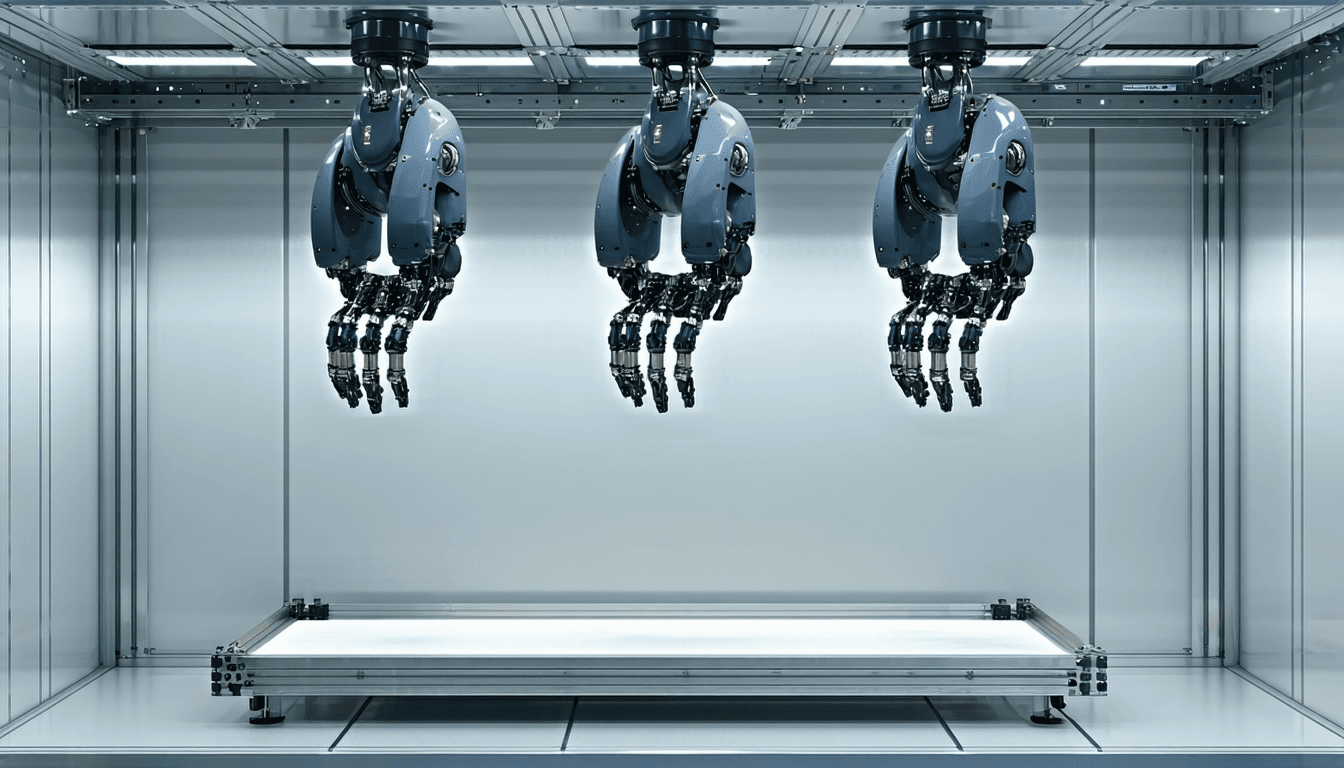
- Feagine presented Fi0 alongside three tendon-driven biomimetic soft manipulators: A01, A02 and A03.
- Feagine has not published training-data details, benchmark protocols, cross-body success rates, or public access terms for Fi0.
- Fi0 stands for Foundation Intelligence Across Embodiments.
- The published descriptions establish intended design but do not provide the training corpus, parameter count, implementation details, evaluation protocol, or benchmark results needed to assess performance.
Compiled by The EngineerSomething wrong?How this is made
Why it matters
Feagine Robotics announced Fi0 on August 13, describing it as a first-generation foundation model that carries task and world knowledge across robot bodies while adapting actions to each body's morphology and current state [1]. What the Shenzhen company did not publish is anything that would let an outside team check that: no training-data details, no parameter count, no benchmark protocol, no cross-body success rates, and no public access terms [3][5].
What is on the record is architecture-shaped language. Fi0 stands for Foundation Intelligence Across Embodiments, and Feagine's own technical overview says the model takes language, vision, human demonstrations, environment state, and a structured representation of the robot as context [4][6]. It names components for encoding skills, connecting camera viewpoints, representing embodiment, and predicting action outcomes [7]. Feagine says action generation is conditioned on kinematics, geometry, sensors, end effectors, actuation, and dynamic state rather than on a robot identifier [11]. That establishes intended design. It is not implementation detail, an evaluation protocol, or a result [5].
The hardware is the concrete part of the launch. Fi0 arrived alongside three tendon-driven biomimetic soft manipulators [2]:
- A01: one flexible segment, two degrees of freedom, 750 grams, 200-gram payload [8] - A02: two flexible segments, four degrees of freedom, 30-centimeter arm, 400-gram payload [9] - A03: three flexible segments, a press-release figure of 6+1 degrees of freedom, 50-centimeter arm, 600-gram payload [10]
The spread is genuinely useful. Payload triples from A01 to A03 [12], A03's arm is about 67 percent longer than A02's [13], and segment counts, reachable workspaces and contact behaviour all differ, which is what would make the trio a practical rig for testing whether a model separates task-level knowledge from morphology-specific control [14].
The most testable assertion in the announcement is that a human demonstration can become skill context at inference time for a task not directly covered in training, with no parameter update first [16]. Feagine states this; it is not an independently validated result [16]. Nothing in the official material or the retrieved independent coverage supplies cross-body success rates, comparisons against per-robot policies, safety metrics, latency, failure recovery, or evidence that Fi0 is available to outside researchers [17]. Interesting Engineering reported the same launch and the same hardware configurations, and noted that broader hardware, task and real-world testing is still required [19].
So the launch establishes a product line and a research direction, not transfer between bodies [20]. For anyone triaging robotics foundation models this year, that distinction is the whole story: the A-series gives Feagine a controlled physical setup, and controlled setups only pay off when the runs are published.
Watch for reproducible evaluations of the same tasks across A01, A02 and A03, with controlled baselines and disclosed data and safety constraints [18], and for any sign that a party outside Feagine can run the model at all [17]. Until one of those appears, Fi0 belongs in the roadmap column, not the vendor-comparison spreadsheet.