Science1 publisher3 min readPublished
MIT's FRB survey finds the missing baryons four million light years out, past where simulations put them
A cross-correlation of 2,870 CHIME fast radio bursts with about six million DESI galaxies puts diffuse plasma far wider than feedback models allow. That makes the models mis-tuned, not merely fuzzy.
The Scientist · Science desk
Drafted by a language model from the sources cited here and checked against its claim ledger before publication. How we use AISend a correction
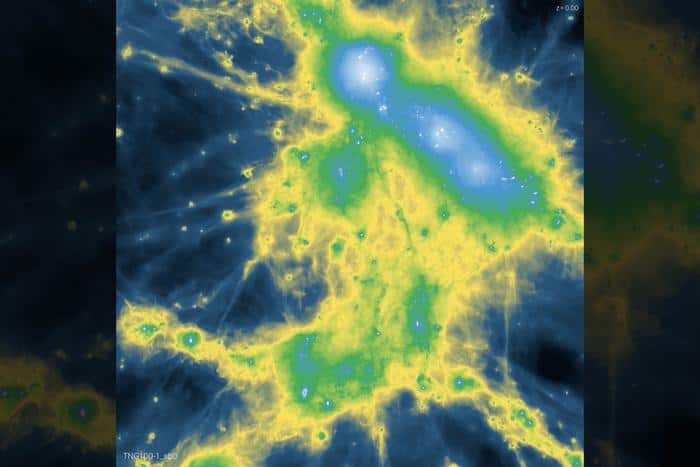
What happened
- Astronomers at MIT, analysing signals from extragalactic fast radio bursts, say the "missing matter" in the universe is distributed further away from galaxies than most theoretical simulations predict.
- The best current models of the universe suggest close to 90% of baryonic matter is "missing".
- Masui: "A galaxy is maybe a few 100,000 light years across, and we found missing matter out to about four million light years. That's further than the simulations predict."
- The result backs the idea that missing matter is projected out from a galaxy by highly energetic events such as jets from supermassive black holes and explosions from old dying stars.
- The team cross-correlated the locations of millions of galaxies with the dispersion of nearly 3000 background FRBs on length scales of 0.1 to 50 Mpc.
Compiled by The ScientistSomething wrong?How this is made
Why it matters
A team at MIT led by Haochen Wang and Kiyoshi Masui cross-correlated the dispersion of nearly 3,000 background fast radio bursts against the positions of millions of galaxies and concluded that the universe's missing baryonic matter sits further from galaxies than most theoretical simulations predict [1][5]. The work, published in Physical Review Letters [15], is interesting less as a detection than as a calibration result: the disagreement has a direction, and the direction points at a number that simulators set by hand.
The background: ordinary matter built from protons and neutrons makes up stars, galaxies and everything visible, but the best current models imply close to 90% of it is unaccounted for [2], leaving roughly a tenth located [4]. It is hard to see because it is thin, about one proton per cubic metre [6]. Fast radio bursts, first detected in 2007 and lasting a few milliseconds or less, get stretched in time as they cross that plasma, and the more of it they cross the more they are dispersed [c7a][7]. Earlier work had already used the effect to confirm that intergalactic space holds tenuous clouds and filaments of diffuse plasma [8].
This study maps how far out the plasma reaches. The team used 2,870 bursts from the CHIME catalogue, correlated against about six million galaxies from DESI, across length scales of 0.1 to 50 Mpc [9][5]. CHIME, a radio telescope in British Columbia that scans the whole northern sky, has detected about 4,000 FRBs since becoming operational [10][11], so the analysis draws on roughly 72% of its haul [1]. DESI, mounted on the Mayall Telescope at Kitt Peak National Observatory near Tucson, measures light from over 30 million galaxies and was built to constrain dark energy [12][13]; the galaxy sample used here is about a fifth of that [2].
Below about 1 Mpc the missing matter does show up around galaxies and clusters, as expected, but spread across a large radius rather than packed into a dense ball [14]. "A galaxy is maybe a few 100,000 light years across, and we found missing matter out to about four million light years," Masui says. "That's further than the simulations predict" [3]. That is an extent of order 13 to 40 galaxy diameters [3], and it runs against the intuition that galactic gravity pulls material inward [17].
Wang and Masui read this as evidence that the gas is being thrown out by jets from supermassive black holes and explosions from dying stars, and that those processes are stronger and much more violent than assumed [4][16]. That is the operational point. Feedback strength in a cosmological simulation is a tuned prescription, not a derived quantity; a result that puts gas systematically farther out than predicted says the tuning is low, and every prediction that depends on where the baryons sit inherits a bias with a sign rather than a wider error bar. Wang argues the study also establishes FRBs as a cosmological probe in their own right, alongside galaxies and the cosmic microwave background [18].
Worth watching: whether simulation groups revise feedback energy budgets or attribute the gap to how halos are matched to galaxies; whether the signal holds as CHIME's catalogue grows past 4,000 bursts [11]; and whether the same cross-correlation behaves at the upper end of the 0.1 to 50 Mpc range [5], where the measurement is least constrained by individual halos.