Science1 distinct publisher3 min readPublished
The age of a richly furnished burial in southwest Poland rests on the style of a greenish serpentinite axe, and the bone work that would confirm it, along with the claim of decapitation, is still to come.
The Scientist · Science desk

Compiled by The ScientistSomething wrong?How this is made
Dating a burial from the shape of one object inside it is ordinary practice, and here it is the weakest joint in the chain. Stone axe forms change through time in ways typologists can put into order, which is how a serpentinite axe yields a Middle Neolithic estimate [2]. What that dates directly is the axe. The skeleton and the other objects in the deposit inherit the date by association [5], and the inheritance holds only if the grave was filled in one event and left alone afterwards. The account of the find reports no radiocarbon or other absolute measurement [14]. Pawel Dabrowski of Wroclaw Medical University says the next step is to analyse the remains from both Stone Age graves, with the first results expected later this year [13].
The setting is what makes that testing worth doing rather than assuming. A circular feature holding a Neolithic assemblage, opened inside a cemetery three thousand years younger [3], is precisely the case where an object and a body can end up in the same soil without belonging to the same moment.
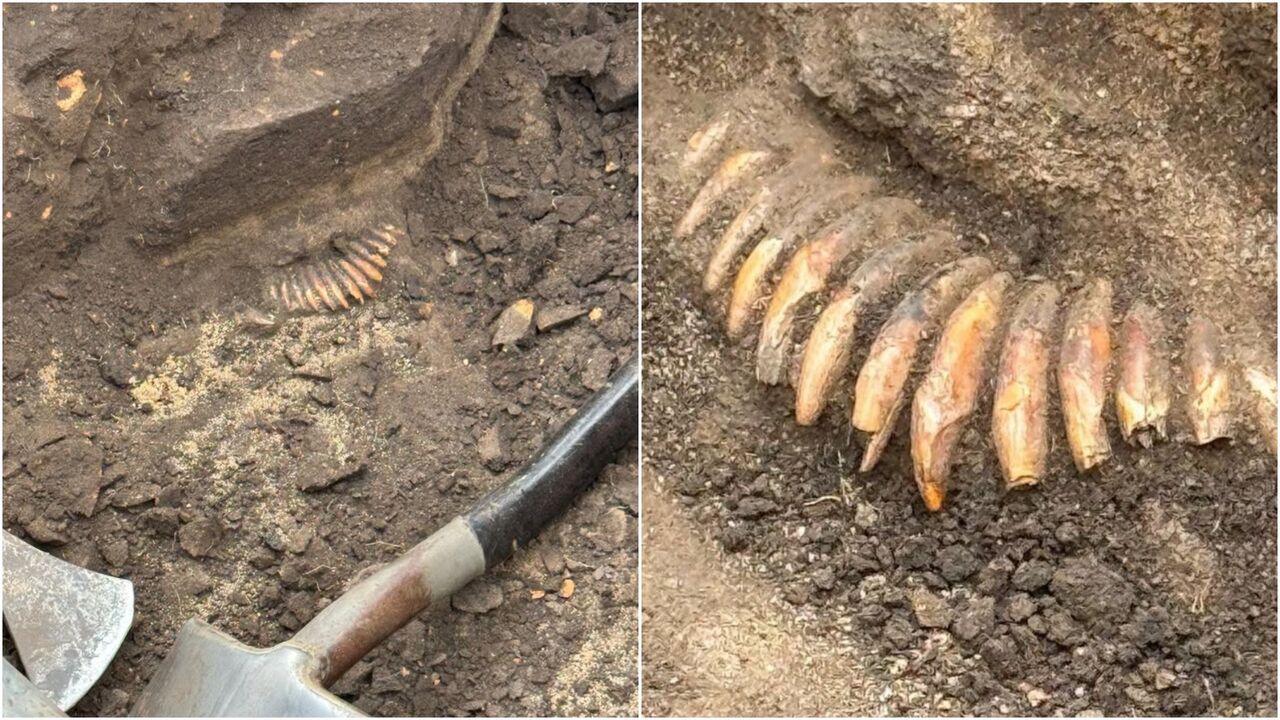
The drilling carries more weight than the tally, which makes the necklace the firmer observation: a hole through the root of each of the 42 teeth is deliberate work, not a by-product of butchery [6]. Species attribution is softer ground. Dabrowski gives the incisors and canines as belonging to large mammals such as wolves, deer and bears, with humans listed as a possibility rather than a finding [7], and that last entry is the one that would change what kind of object this is.
From the goods, Dabrowski reads a warrior or a hunter, and because of the necklace, possibly the leader of a family clan [8]. That inference wants a comparison set. One other burial of this kind is known nearby, furnished with axes, flint tools and amber beads, with calf bones that suggested an animal sacrificed at the grave [10]. This find takes the regional total from one to two [15]. Two graves cannot describe a distribution of grave wealth, so the status reading rests on what is in this grave, not on where it ranks among its neighbours. The second one entered the record almost by accident: "We were practically packing up, and then we discovered a circular shape in the ground and began digging," Dabrowski said [4].
Of the three, the skulls sit least settled. The excavators think the two may be decapitated heads placed as gifts or offerings, and say further analysis is needed to confirm or rule decapitation out [9]. Whether the heads came from people killed for the purpose, were lifted from older burials, or arrived at some other point in the grave's history remains an open question in the account as reported. The Corded Ware attribution carries a similar conditional, offered as a possibility for both graves [12], and it rests on the same stylistic reasoning as the date.
The pending analyses are pointed at relatedness and at how these people lived nearly 5,000 years ago [13]. Kinship is the part typology cannot reach: it decides whether the two graves record one community's practice or two unconnected deposits in the same few fields.
Ranked by verification strength, evidence, and original report placement.
Archaeologists excavating a Roman-period cemetery in Poland found the grave of a man buried with two decapitated human heads, a necklace made from 42 mammal teeth, and a battle axe.
"We were practically packing up, and then we discovered a circular shape in the ground and began digging," said Pawel Dabrowski, a biological anthropologist at Wroclaw Medical University, in a Sept. 2 translated statement.
The grave, found near Wroclaw in southwest Poland, held the nearly complete skeleton of an adult male buried with amber beads, a flint blade and a battle axe made of serpentinite, a greenish metamorphic rock.
The style of the stone axe suggests the burial was made around 2900 B.C., during the Middle Neolithic period, according to the statement.
The buried man was from the Stone Age, three millennia older than the Roman-period cemetery in which the grave was found.
Dabrowski said the arrangement of the 42 teeth was precise and that all of them had holes drilled through their roots, so they must have formed a kind of necklace.
Distinct publishers with included, body-backed reporting in this cluster.
1 article · September 5, 2026
Follow any of these and your For You feed starts watching them — no settings page required.
science
One grave, 81 in the whole corpus: the Suzdal chamber burial with a horse and a dog1 distinct publisher
science
Tooth wear from 460 English sites pushes the ox-plough peak into the 12th century1 distinct publisher
science
Zircon ages tie a caldera buried under eastern England to Scandinavia's Kinnekulle ash1 distinct publisher
science
A drug-insensitive enzyme in the mouse gut strips 80% of metformin's glucose-lowering effect1 distinct publisher
Evidence-backed comparisons of source perspectives and observed adoption signals. Read the methodology
Which Builder, Operator, and Investor concerns the observed source mix emphasized—not a truth score.
Evidence, demonstrated adoption, hype gap, incentives, and confidence are assessed independently, each on its own current evidence. How these are measured.
One excavator, two statements
Everything here comes from Pawel Dabrowski's translated statements of Sept. 2 and Sept. 4, retold by Live Science. The date rests on axe typology, the necklace on drilled roots, and the species list on an identification with no specialist named. None of it has passed through publication, a laboratory result, or review by a second archaeologist.
Too early to measure
Uptake of a find like this would show as publication, museum accession, or other specialists engaging with the Corded Ware attribution. The reporting carries none of that, and the laboratory work that would generate it is still ahead.
Headline harder than the body
Live Science's headline and first sentence say the man was buried with decapitated heads; six paragraphs later the same piece says analysis is needed to confirm or rule out decapitation. The 2900 B.C. date gets similar treatment, presented as settled when its only support is the shape of one axe.
The dig speaks for itself
The only voice is the institution that made the find, announcing weeks after the trowel work and before any publication. Nothing commercial is at stake, but the details that travel — severed heads, drilled canines, a clan leader — are the ones the statements lead with, and no outside specialist was asked to weigh them.
Traceable but untested
Provenance is unusually easy to follow here: a named researcher, two dated statements, one retelling, and clear internal caveats. What that buys is confidence about where the claims come from rather than whether they hold, and the analyses due later this year could revise both the age of the grave and the decapitation.