Science1 publisher2 min readPublished
Nature Photonics review makes the case for ultrathin crystals in reprogrammable quantum light chips
Three researchers from the TMOS research centre argue in Nature Photonics that 2D materials could make fixed quantum photonic chips reprogrammable. Their case is firmest for switches, since they concede ultrathin light sources still trail quantum dots on brightness and purity.
The Scientist · Science desk
What happened
- Igor Aharonovich, Ken Crozier and Dragomir Neshev of the TMOS research centre published a Nature Photonics review on making quantum photonic circuits programmable.
- Many photonic components can already be integrated on a single silicon chip, but today's devices are mostly fixed once they are manufactured.
- The review finds that no single material platform yet combines efficient energy coupling, fast low-energy switching and scalability.
- Van der Waals crystals can be tuned by changing how their layers are stacked or twisted, and small electrically powered mechanical systems already tune them on chip.
Compiled by The ScientistSomething wrong?How this is made
Why it matters
- decision Groups picking an emitter today still have to choose between tunability and performance, because by Crozier's account van der Waals sources give up brightness, purity and coherence to quantum dots and color centers.
- constraint The authors' target is reconfiguring several components at once, so a better tunable source or a faster modulator on its own does not close the gap they describe.
- capability If a programmable platform works, the authors expect it to support quantum neural networks and distributed quantum computing on hardware that can be retasked after it is built.
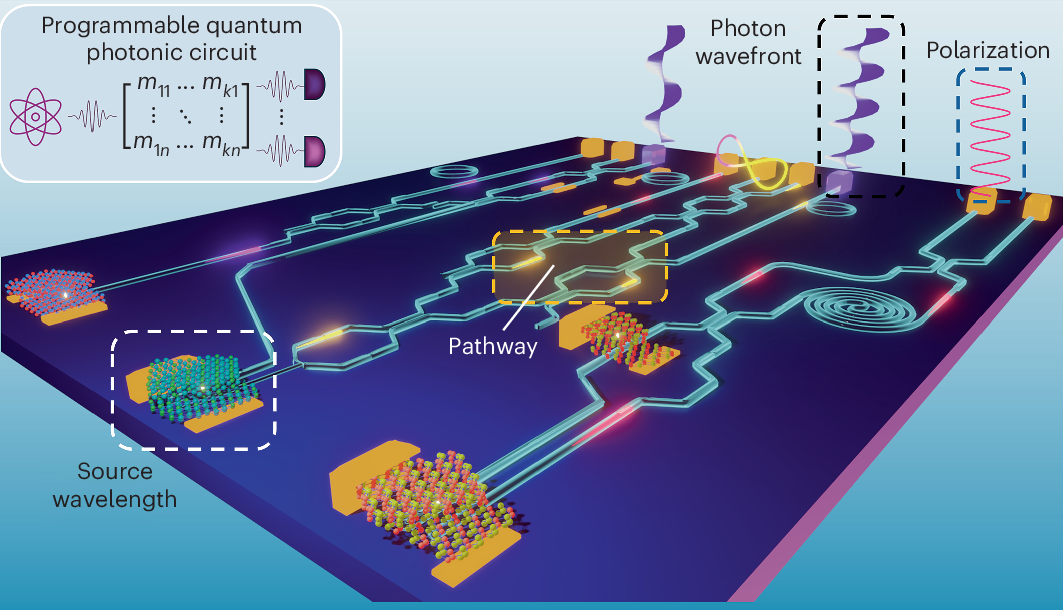
A review surveys other groups' experiments. It has no control group, so the useful test is narrower: do the studies the authors cite show the bottleneck is where they say it is? They name the gap themselves. "Nonetheless, a missing link for the goal of programmable quantum photonics remains: multifunctionality," the authors said [4]. "For many applications, one needs a system that can perform multiple functions, which requires multiple components to be reconfigured simultaneously." [4] Their example asks whether a chip could "alter the source wavelength as well as its polarization and route the emitted photons to different detectors" [5].
In the authors' account, light is worth the effort because photons have low decoherence and can carry information encoded in multidimensional quantum states [15]. Getting the full benefit takes sources that control frequency, amplitude, phase and polarization. Those controls are what allow states such as quantum vortices and vector beams [6].
The materials argument holds up best for switching. The review calls dynamic modulation a "critical block" for programmable quantum photonics [18]. It describes the traditional ways of manipulating phase and frequency as bulky, lossy and slow to switch [11]. The authors believe 2D materials may eventually be versatile enough to meet every criterion [13]. "Essentially every component of a future quantum circuit can be engineered using 2D material components," Aharonovich said [14].
The case for sources is weaker. The most widely used sources today rely on nonlinear processes such as spontaneous parametric down-conversion, and the authors see considerable potential in single-photon sources instead [7]. Crozier is clearly taken with what stacking can do. "It's remarkable how much control is possible simply by changing how these ultrathin materials are stacked on top of one another," he said [9]. He also said: "However, van der Waals crystals do not yet compete with current leading sources, for example, quantum dots and color centers, in terms of brightness, photon purity and coherence: more work is needed." [10]
The phys.org account does not include brightness, purity or coherence figures, so a reader cannot tell how big that gap is or how much work "more work" means. I think the review makes a stronger case for 2D materials as switches than as emitters. That view holds only if a 2D modulator on a chip is shown to meet the coupling, switching and scalability criteria together, which the review says no platform does yet [12].
The authors are also setting out their own centre's direction. "Programmable quantum photonic systems are an important future development for the center," Neshev said [17].
What to watch
- Published head-to-head figures for a van der Waals single-photon source against a quantum dot or color center on brightness, purity and coherence.
- A 2D-material modulator on a silicon photonic chip reported with coupling, switching energy and speed measured together.
- A single chip that retunes source wavelength, polarization and photon routing at the same time, the review's own test case.