Science1 publisher3 min readPublished
The STING adjuvant problem was a timing problem, and someone finally put a timer in the particle
A lipid nanoparticle that carries antigen mRNA, STING mRNA and a delayed-release activator addresses the reason cGAS-STING adjuvants keep failing: the agonist shuts down antigen translation.
The Scientist · Science desk
Drafted by a language model from the sources cited here and checked against its claim ledger before publication. How we use AISend a correction
What happened
- The development of cGAS-STING agonists as mRNA vaccine adjuvants has been hampered by widespread STING expression and by the observation that codelivered STING agonists suppress antigen mRNA translation.
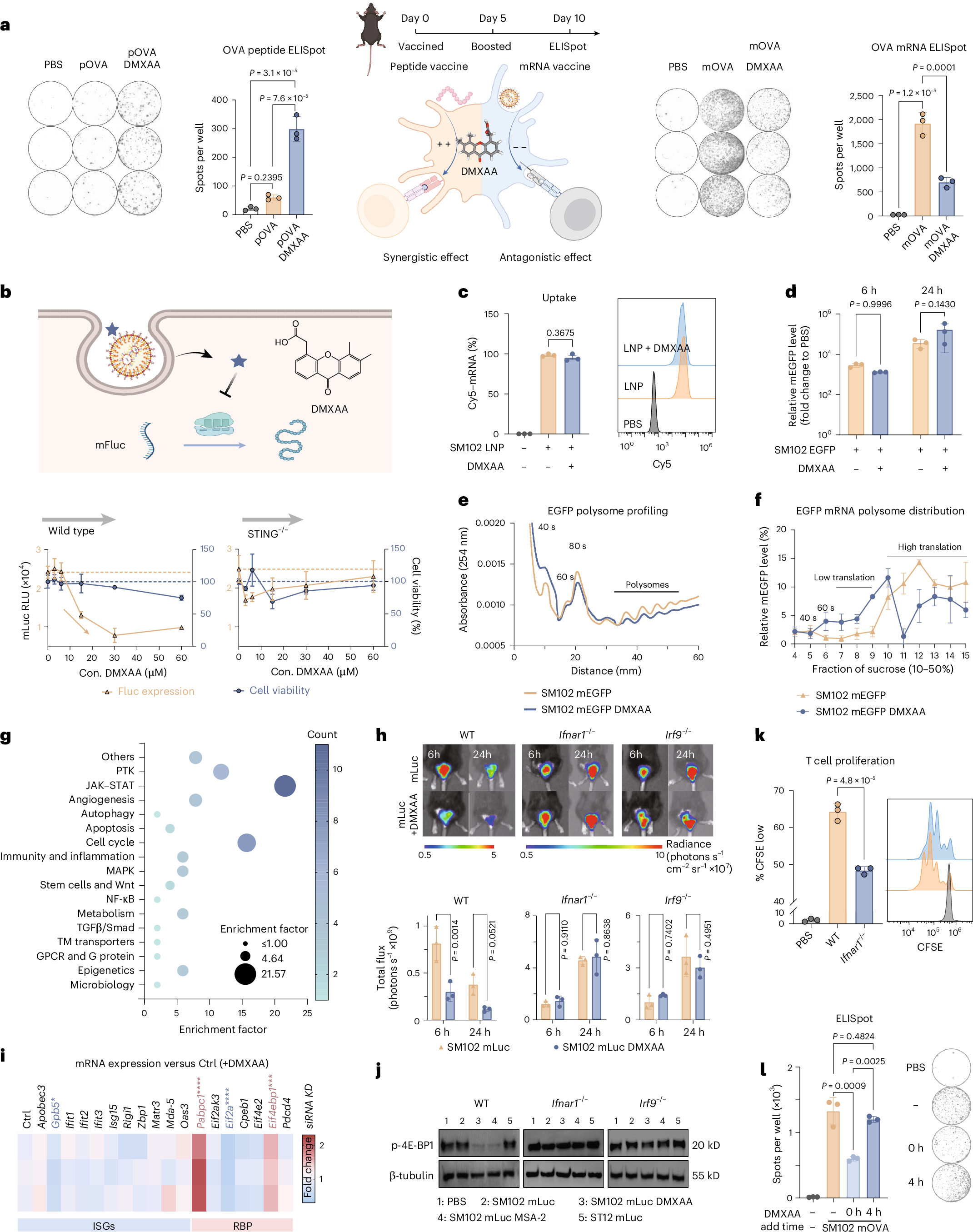
- The authors engineered synchronized STING (Syn-STING): a lipid nanoparticle codelivering antigen mRNA, mRNA encoding full-length STING transmembrane protein, and a bioorthogonal-like delayed-release STING activator, DMXAA.
- DMXAA release is controlled by a biodegradable linker, enabling localized mouse STING activation while avoiding systemic endogenous human STING recognition.
- In humanized STING mouse models, the authors tested human papillomavirus E7 and ovalbumin antigens with mouse STING or a human STING mutant engineered for DMXAA specificity.
- Intratumoral or subcutaneous LNPs are preferentially internalized by myeloid cells, preserving antigen expression fidelity, achieving localized STING activation in antigen-presenting cells and preventing systemic regulatory B cell differentiation and immunocyte apoptosis.
Compiled by The ScientistSomething wrong?How this is made
Why it matters
A group publishing on nature.com has built an mRNA vaccine particle that carries its own STING agonist and keeps it inert until after the antigen has been translated [8] [2]. The result worth copying is not the tumor curve; it is the diagnosis, that codelivered STING agonists suppress antigen mRNA translation, which is a mechanistic reason this adjuvant class has underperformed rather than a formulation nuisance [1].
The authors name two obstacles: STING is expressed widely, and agonists delivered alongside antigen mRNA suppress its translation [1]. Their construct, Syn-STING, answers both with three separable moves. First, delay: the agonist DMXAA is held by a biodegradable linker so release is timed rather than immediate [3]. Second, supply the receptor rather than rely on the host's: the same lipid nanoparticle carries mRNA encoding full-length STING transmembrane protein alongside the antigen mRNA [2]. Third, restrict the pharmacology: release is engineered to activate mouse STING locally while avoiding recognition by systemic endogenous human STING [3]. Tests used humanized STING mouse models with human papillomavirus E7 and ovalbumin antigens, paired with either mouse STING or a human STING mutant engineered for DMXAA specificity [4].
The reported consequences read like a checklist of the failure modes of free agonists. Given intratumorally or subcutaneously, the particles were preferentially internalized by myeloid cells, preserved antigen expression fidelity, produced localized STING activation in antigen-presenting cells, and prevented systemic regulatory B cell differentiation and immunocyte apoptosis [5]. That last item matters: it says the cost of a co-delivered agonist is not only a quieter antigen but a systemically suppressed compartment, which is consistent with the group's own citation of work showing STING can constrain antigen-presenting cell function [10]. Downstream, the authors report robust adaptive responses with Th1-biased T cell immunity [6], plus suppressed tumor growth, prolonged survival, and negligible anti-STING immunity [7]. The immunity point is not throwaway, since the design delivers mRNA encoding a protein the host already expresses broadly [1] [2].
Timing-controlled STING dosing itself is not new. The paper's own reference list includes PLGA microparticles for long-term pulsatile release of a STING agonist [c9a], polymer-conjugated agonists [c9b], and a polyvalent agonist that prolongs innate pathway activation [c9c]. What changes here is co-packaging: the timer, the receptor and the antigen travel in one particle to one cell, so the delay is measured against the translation window it is meant to protect rather than against a systemic schedule.
Two cautions before anyone treats this as a platform. The full text is paywalled at USD 39.95 per article [11], and the abstract supplies no effect sizes, no delay interval and no dose [12], so the size of the translation rescue is unknown from what is public. And on the authors' own account, DMXAA specificity against human STING required engineering a mutant receptor [4], which means a human product needs either that mutant delivered as mRNA, with whatever expression and tolerability questions that raises, or a different activator fitted to the same linker chemistry.
Worth watching: whether the delay window is reported as a tunable parameter with a measured antigen-expression curve; whether the myeloid targeting holds subcutaneously without a tumor to concentrate the dose [5]; and whether the pattern transfers from E7 and ovalbumin [4] to an infectious-disease antigen, where the safety bar for a self-protein-encoding adjuvant is considerably higher.