Science1 publisher2 min readPublished
ATLAS finds strong evidence of entanglement between two Z bosons from a Higgs decay
The two bosons decay before any instrument can touch them, so the team read their spins from the angles of the leptons left behind in 13 trillion electron volt proton collisions. Physical Review Letters has the result.
The Scientist · Science desk
What happened
- An international team using the ATLAS experiment at CERN's Large Hadron Collider reports strong evidence of quantum entanglement between the spins of paired Z bosons, particles that last a fraction of a second.
- The bosons came out of Higgs decays produced by protons traveling at 99.99% of the speed of light, in collisions carrying 13 trillion electron volts.
- Until this measurement, whether entanglement holds among the short-lived particles made in highly energetic collisions had not been tested.
Compiled by The ScientistSomething wrong?How this is made
Why it matters
- capability Foundational tests of quantum mechanics can now be run inside data that collider groups already collect for particle searches, using decay angles as the readout.
- constraint The hardware side of quantum information is untouched: the Z bosons are gone in a fraction of a second, so the computing, communication and sensing applications that rest on entanglement gain no new resource from them.
- precedent With top quarks in 2023 and Z bosons now, both from ATLAS, further tests become a question of which recorded decays carry usable spin information.
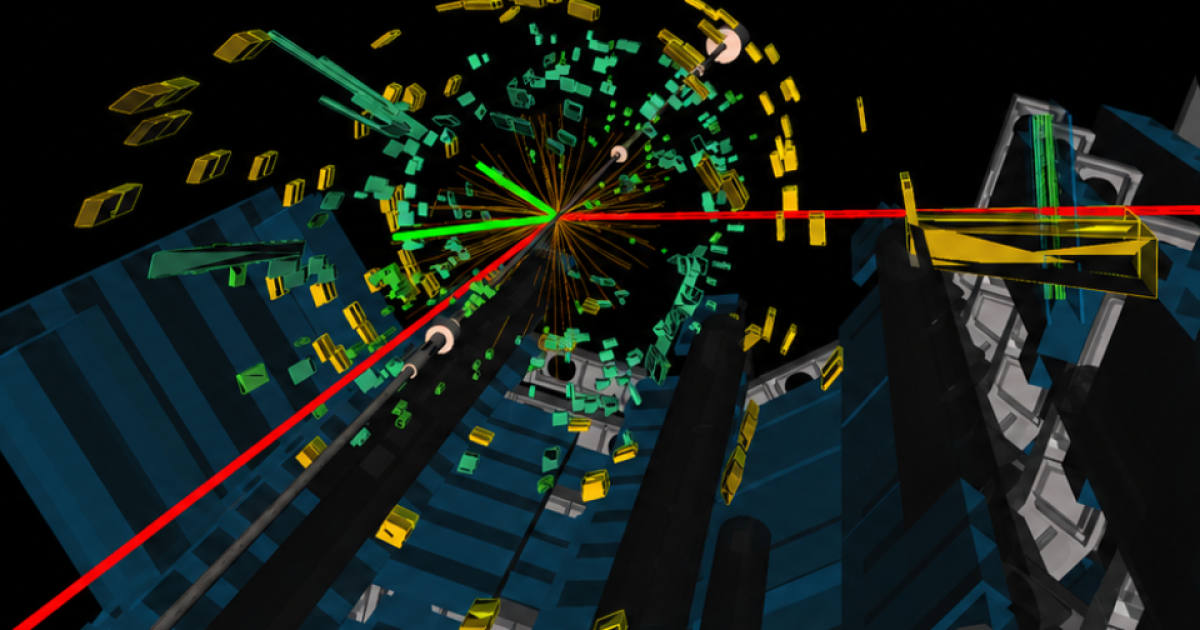
The bosons themselves never reach the detector. Each one decays first, and ATLAS records the charged leptons left behind [2][8]. Every Z boson goes to a pair of electrons or muons, so a single Higgs decay leaves four leptons to reconstruct [6][17]. The angles at which those leptons come out are the surviving trace of the parent spins, and it was from those angles that the team inferred the spins and tested them for entanglement [8].
The paper is in Physical Review Letters, with Oxford physicists among the authors [5]. The phys.org account calls the outcome strong evidence and one of the highest-energy confirmations of entanglement recorded, and it does not give a statistical significance or the number of collisions analysed [3][4][18]. That same account describes entanglement as one particle affecting another [19]. The analysis produced a correlation between two spins, each of them reconstructed after both bosons had already decayed [8].
"Using particle colliders allows us to test quantum mechanics at energies a trillion times higher and over distances smaller than the size of the nucleus. This probes some of the extreme conditions where quantum mechanics might break down, which would have profound consequences for the foundations of science," said Alan Barr, a professor in Oxford's Department of Physics and a co-author of the study [10].
Barr was among the first to propose that colliders could be used for this, having worked on the construction of the LHC [12]. His ideas fed a 2023 ATLAS analysis that found entanglement between pairs of top quarks, the heaviest known elementary particle [13].
"We're used to thinking of entanglement as something delicate, seen in laboratory experiments with single photons. Finding it alive and well among particles as heavy and short-lived as Z bosons, created in some of the most violent collisions we can produce on Earth, shows just how fundamental and robust this quantum effect really is," Barr said [11].
Entanglement had already been shown in photons, electrons and trapped ions [14], all systems an experimenter prepares and controls. This pair arrived as the decay products of a Higgs boson, itself made by smashing protons together at 99.99% of the speed of light [6][7]. At 13 trillion electron volts, the two spins were entangled [3][7].
What to watch
- Whether the Physical Review Letters paper reports a significance figure and an event count for the Z boson result.
- Whether an independent experiment reproduces the Z boson spin correlations at comparable energies.
- Whether other decay channels already recorded at ATLAS get the same spin-correlation treatment.