Invest3 publishers3 min readPublished Updated
Dangote's $16 billion Lamu refinery needs neighbors' crude that Uganda wants to refine at home
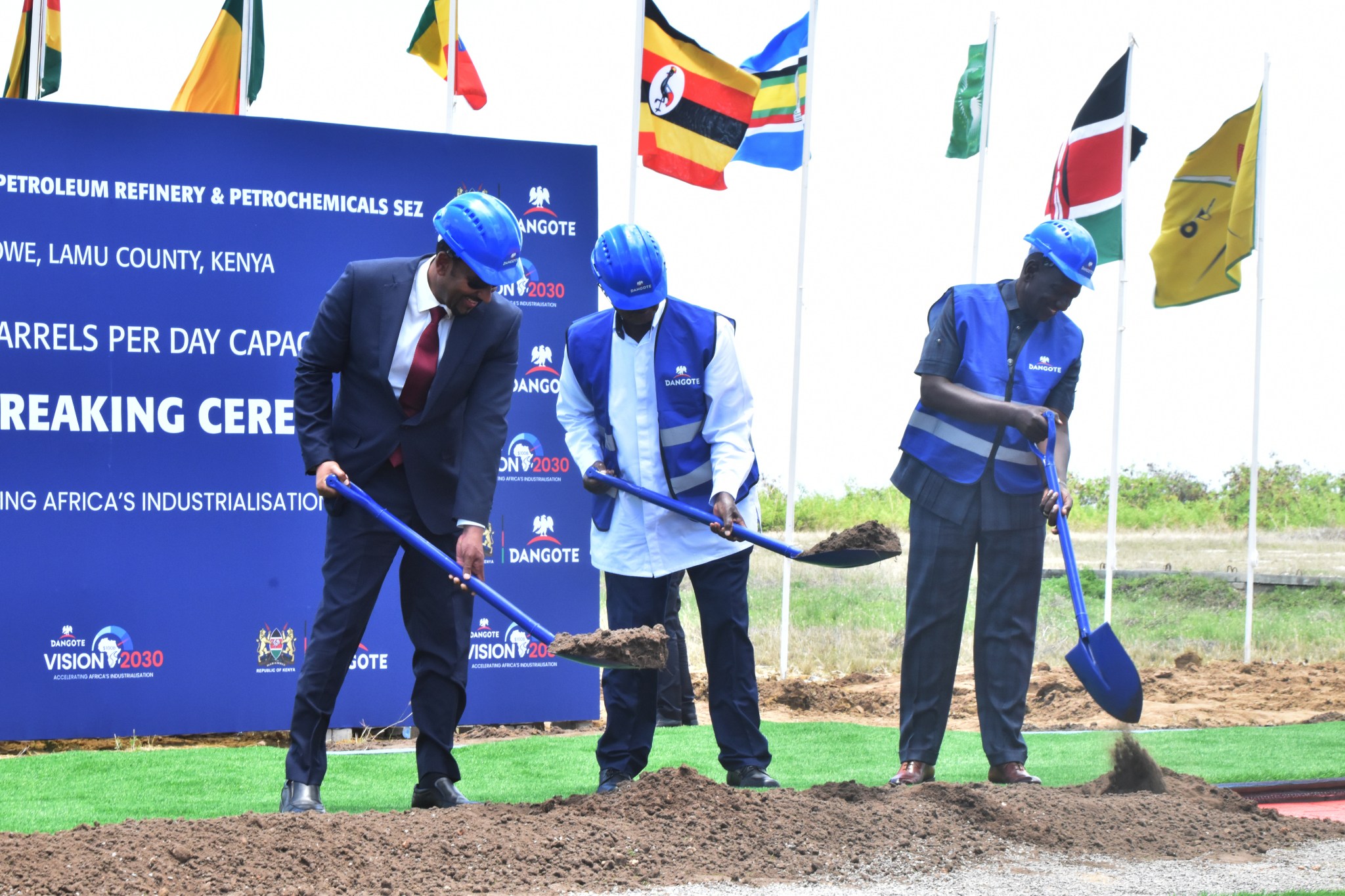
Aliko Dangote broke ground on a $16 billion, 700,000-barrel-a-day refinery in Lamu, Kenya, with five heads of state at the ceremony. The plant will run on neighbors' crude, and Uganda's president says his country will still build its own refinery.
The Investor · Invest desk
Drafted by a language model from the sources cited here and checked against its claim ledger before publication. How we use AISend a correction
What happened
- Construction at Lamu is scheduled to take 40 months, according to Fortune.
- Dangote said East African countries consume much more than the 700,000 barrels a day the plant will refine.
- The refinery was first planned for Tanga in Tanzania before Dangote said Lamu offered deeper water, firmer ground and deep-sea access.
- A Kenyan court let a group claiming the site maintain the status quo until an October hearing, though the order did not stop the groundbreaking.
Compiled by The InvestorSomething wrong?How this is made
Why it matters
- constraint Lamu has to fill 700,000 barrels a day from neighboring producers, so any crude Uganda keeps for its own plant is crude Dangote must find somewhere else.
- contradiction Dangote defended the project on fuel demand while Museveni spoke about where crude should be refined, so the two leaders' statements address opposite ends of the same plant.
- cost Every 10% of capacity left without crude ties up about $1.6 billion of the $16 billion build, a cost borne by the project's owners, Dangote Group among them.
- exposure The October land hearing could keep the status-quo order in place just as the 40-month build is meant to start, with residents already protesting over compensation.
Sixteen billion dollars for 700,000 barrels a day comes to about $22,900 per barrel of daily capacity [18]. Run flat out for a year, the plant would process about 255.5 million barrels [19], so the build cost is roughly $63 for each barrel of one year's throughput [20]. Those figures assume the plant runs at capacity. According to Fortune, it will rely on oil from neighboring countries [6].
One of those neighbors was at the ceremony. Uganda's President Yoweri Museveni joined Kenya's William Ruto in shoveling soil at the site [1], and said, "For Ugandan crude, I didn't want to export any crude, I wanted to refine it locally" [13]. He also said the region needs "more than one or two refineries" [12]. Semafor reported that Lamu already faces competition from upcoming projects in Tanzania and Uganda [11].
Dangote made his case on demand [7], for a region that Semafor says has historically relied on fuel imported from the Middle East [14]. "Africa must industrialize Africa," he said [5]. That answers who buys the refined products. Museveni was talking about the crude going in [13], and the reports do not include Uganda's expected output or the capacity of its planned plant.
Dangote Group, which will build Lamu and holds a stake in it [4], plans to list shares of its Nigerian refinery on the Nairobi Securities Exchange in December, following a Lagos IPO two weeks ago [15]. Kenyan investors will be able to buy into that plant, which Semafor credits with making Nigeria a fuel-producing powerhouse [17], years before their own refinery is due in 2030 [3].
Three outcomes follow from here. In one, Museveni's refinery stays small and most Ugandan barrels still go to the coast [12]. In another, the Ugandan and Tanzanian projects both get built and compete with Lamu for the same crude [11], and the plant runs below its 700,000 barrels a day [2]. In the third, the build slips before crude matters at all [10]. Residents who claim the land have sued, dozens protested for more compensation on Tuesday [9], and environmental activists say the project threatens the coast's marine ecosystem [16].
I expect the second outcome to be the main risk to the $16 billion [1]. The demand half of Dangote's argument is the stronger half; the feedstock half is where it can fail. The counter-thesis rests on Museveni's own word, "small" [12]. A small plant would take only a slice of Ugandan output, and his presence at the groundbreaking suggests he expects both plants to run [1]. A published supply agreement naming volumes near 700,000 barrels a day would prove this view wrong [2].
What to watch
- The capacity Uganda sets for its "small refinery", which decides how much Ugandan crude stays inland.
- Demand for the December Nairobi listing of Dangote's Nigerian refinery, the first test of East African investors' appetite for the group's shares.
- Details of the Tanzanian refinery project Semafor cites, including whether it would draw on the same regional crude.