Science1 publisher2 min readPublished
CHIME detects the 21 cm hydrogen signal from its own data alone for the first time
CHIME, a Canadian radio telescope, detected the 21 cm glow of distant hydrogen in 94 nights of its own data, without checking against any other telescope. The team sees a cheaper route to studying dark energy, though so far the paper establishes only that the signal is real.
The Scientist · Science desk
What happened
- Until this paper, CHIME had to confirm its hydrogen observations against other telescopes, a step Live Science describes as expensive and time-consuming.
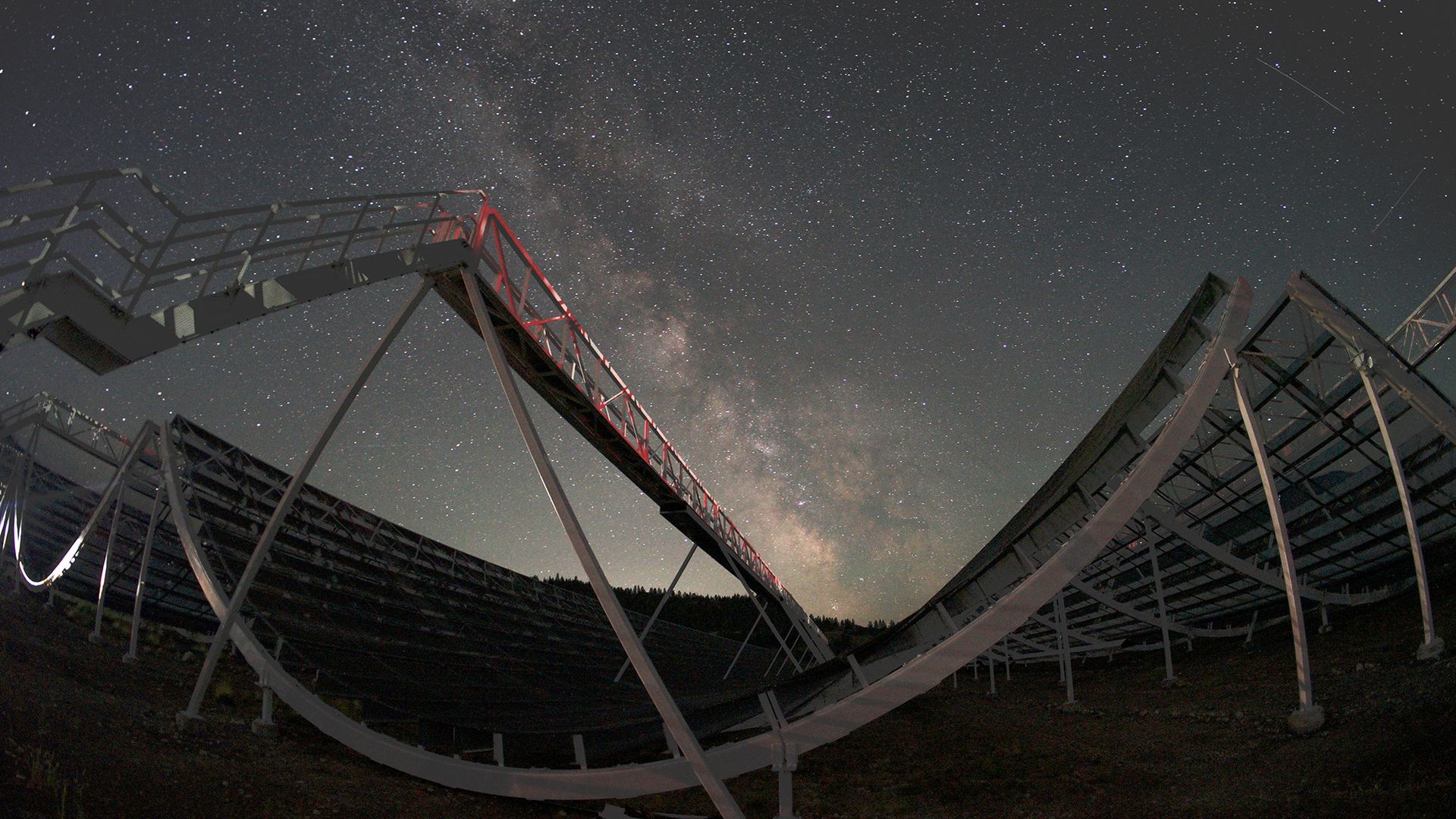
- CHIME is a set of radio telescopes, mostly near Penticton in British Columbia, that maps the entire northern sky every day.
- The 2019 data took about seven years to verify before the paper appeared in The Astrophysical Journal on Sept. 28.
- A companion paper puts the neutral atomic share of hydrogen at about 2%, a figure co-author Shabbir Shaikh called broadly consistent with other telescopes.
Compiled by The ScientistSomething wrong?How this is made
Why it matters
- cost Dropping outside confirmation removes an expensive step from every future CHIME hydrogen analysis, though the reported account does not say what that step cost.
- capability With its signal confirmed internally, CHIME's future hydrogen measurements can be set against other telescopes' results as separate evidence.
- decision Groups weighing hydrogen mapping against other dark-energy methods now know one instrument can confirm the signal alone, but have no expansion-rate constraint from it to compare yet.
"We worked very hard to convince ourselves that this wasn't a false alarm," said Arnab Chakraborty, a co-author and postdoctoral fellow at the University of Toronto [8][9]. "After all the tests, the signal remained. That gave us confidence we were seeing real hydrogen from the distant universe." [8]
The caution fits the target. Hydrogen's "faint radio emission acts like a cosmic tracer, revealing how matter is distributed across space," Chakraborty said in a statement [17]. The paper's title reports the detection "in autocorrelation" near redshift 1 [1]. Here that means the signal was drawn from CHIME's data alone, with no second instrument's observations involved [2]. The team wanted a measurement that did not rely on other telescopes at all [11].
The sample behind the claim is small. Those 94 nights date from 2019 [5], and the team says it still has seven other years of CHIME observations to go through [16]. The detection rests on part of one year from a record of about eight [1].
According to the authors, CHIME could give scientists a new, cost-effective way to study dark energy, the poorly understood force behind the universe's accelerating expansion [7]. The thing this paper doesn't tell you is whether that promise holds. The route the study describes is to map hydrogen at different times in cosmic history and read clues about the expansion from each epoch [15]. This detection sits near a single redshift [1]. The instrument's reach is wider: Live Science reports CHIME can detect radio signals from as early as 3 billion years after the Big Bang [12].
I think the standalone detection is the part of this story the evidence supports today. A dark-energy survey built on hydrogen mapping, cheap or otherwise, is so far the authors' projection [7].
What to watch
- A CHIME analysis that maps hydrogen at several redshifts from the remaining years of data, the step a dark-energy constraint needs.
- A published cost for the outside-telescope checks CHIME has now dropped, the number the 'cost-effective' claim rests on.
- Whether other telescopes' neutral-hydrogen estimates keep agreeing with the companion paper's roughly 2% figure.