Product7 publishers3 min readPublished Updated
OpenAI points Images 2.5 at the edits that used to degrade the rest of the frame
OpenAI leads on lighting and speed, but the claims that decide whether a team can ship an asset are about holding a subject consistent across turns and leaving untouched regions alone, and neither arrives with a number.
The Product Desk · Product desk
What happened
- OpenAI is rolling ChatGPT Images 2.5 out to ChatGPT, ChatGPT Work and Codex users across all tiers on desktop, mobile and web, with both API variants open to developers.
- OpenAI says 2.5 holds detail the user did not ask it to change, including in busy scenes with several subjects, where Images 2.0 often degraded that detail during targeted edits.
- The company puts image generation latency at up to 50% lower than Images 2.0, the headline performance number in the release.
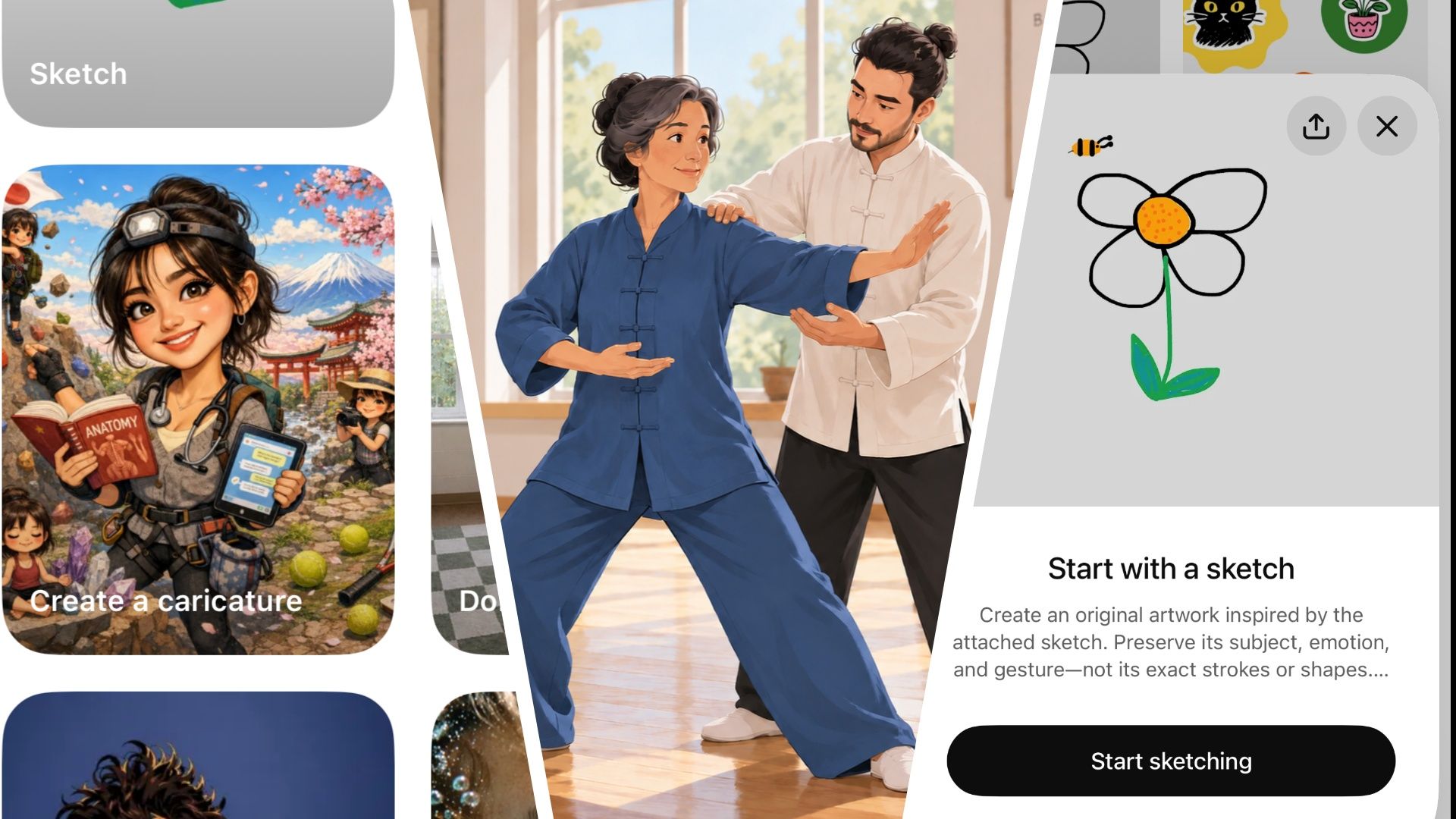
- A new Sketch tool lets users draw a rough layout by finger, stylus or mouse inside ChatGPT and have the model build a finished image on that reference.
- TechRadar reports that the Edit toolbar of Markup, Comment, Remove BG, Erase and Resize had already been arriving quietly in ChatGPT during August, with no formal announcement.
Compiled by The Product DeskSomething wrong?How this is made
Why it matters
- decision Anyone building on the API now has to choose per asset rather than accept the default, because Flare is tuned for volume and Sunburst for tighter control across edits, and that routing rule has to be written down by someone.
- constraint Because every preservation claim is qualitative, a team cannot promise a client the same face twice on the strength of the announcement, and has to fund its own acceptance test first.
- capability With each edit stored as its own version, a bad edit costs a scroll backwards instead of a restart from the first prompt, which is insurance that pays whether or not the stability claim holds up.
- exposure Assets leave with C2PA metadata and invisible watermarking attached, so a brand shipping this work is publishing a machine-readable provenance trail its clients can read.
TechRadar's reviewer describes the loop that came before this release: re-prompt an image that came back wrong, watch it come back wrong in a new way, then abandon it and start from the first prompt [16]. The two claims that speak to that loop are narrower than the release notes. OpenAI says identifiable details, including distinctive facial features, now carry across multiple generations and edits inside a single conversation [5], and that earlier edits stay stable as later ones are applied, each one building on the last [6].
Most of the rest is the pitch. More natural lighting and richer textures [2]. Templates for flyers and product photos, inline comments, and prompt sharing so a colleague can pick up your idea [8]. TechRadar, after 24 hours with it, says calling the feature surface overcrowded would be an understatement [17], and the genuinely useful thing it found sits outside the model: comments in the Edit toolbar work as instructions pinned to a point in the picture, carried out when you hit send [14]. That takes the job of saying which element you mean off the prompt and puts it on the canvas.
The speed numbers need a squint. OpenAI told 9to5Mac that Flare delivers higher-quality images than GPT-Image-2 at 50% lower latency [10], while SiliconANGLE reports the company describing Flare as between two and four times as fast as GPT-Image-2 [9]. Halving latency doubles the images you get per minute, 1/(1-0.5) = 2, which is the floor of that range and the only part of it the latency figure supports [20]. A capacity plan built on 4x will come up short.
What none of the reporting carries is a rate [22]. There is no published figure for how often a subject stops looking like itself by the fifth edit, and no benchmark for changes landing outside the region named in the prompt. That leaves the acceptance test to whoever owns the workflow, and it is a cheap one: ten reference photos of the subject you actually use, a five-edit chain on each, then two counts, subjects still recognisable at the end and changes that landed where nobody asked for them. The sort that matters is whether the subject has to stay identical across assets and whether an asset gets edited more than once. Only the corner where both are true needed this release. Single-pass social images were fine before it.
Who it is for is in OpenAI's own positioning: Sunburst trades speed for precision and is built for premium visual workflows with tighter control across edits, such as campaign creative and polished product imagery [11]. That describes the team producing the same mascot at forty sizes across a fortnight of revisions, which is also the team best placed to find out whether the edit-stability claim survives contact with a real brand guideline.
What to watch
- A published drift or collateral-edit rate, from OpenAI or an independent test, would turn the central claim from copy into a spec teams can hold a vendor to.
- Whether the Edit toolbar that TechRadar saw arriving in August is folded into the official 2.5 changelog, since the boundary between the two is currently guesswork.
- API pricing for Sunburst against Flare, which none of the launch coverage carries and which decides whether edit control is affordable per asset.