Science1 publisher2 min readPublished
WashU team ties a widening biological age gap to cancer before 55
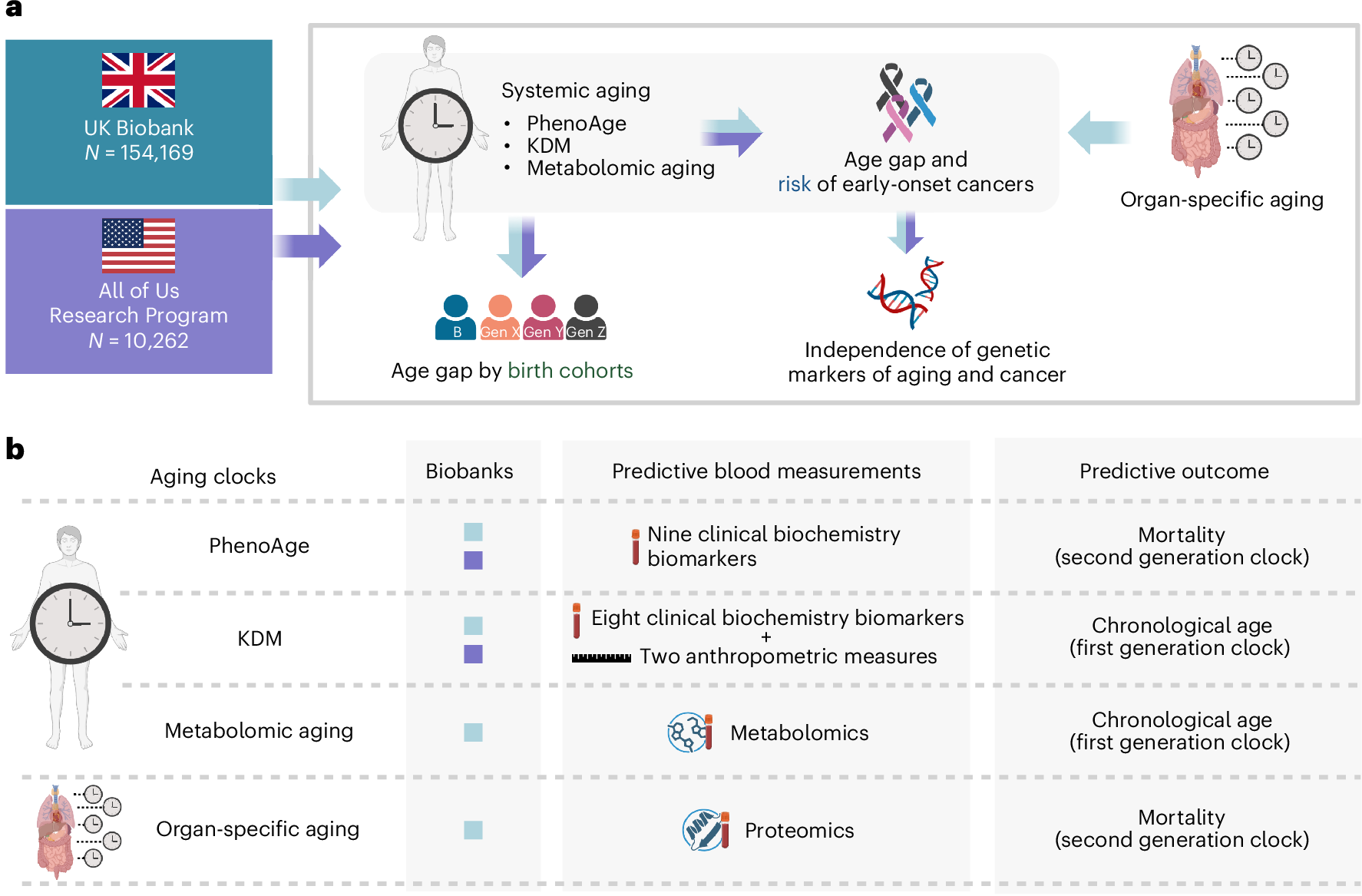
A Nature Medicine study from Washington University reports that more recent generations look biologically older than earlier ones did at the same age, and that a larger gap goes with higher risk of early-onset cancer.
The Scientist · Science desk
What happened
- Researchers at Washington University School of Medicine in St. Louis reported in Nature Medicine that younger generations show signs of aging faster biologically than older generations did at the same ages.
- Cancer risk rose as the gap between a person's biological age and their chronological age widened, and early-onset cancer in the study means a diagnosis at 55 or younger.
- Greater biological age acceleration was linked to higher early-onset cancer risk overall, with specific patterns at lung, gastrointestinal, uterine and colorectal sites.
- The researchers say measurements of accelerated aging could eventually help doctors find younger people at unusually high risk, so prevention or screening could start earlier for them.
Compiled by The ScientistSomething wrong?How this is made
Why it matters
- constraint Acting on this in clinic will have to wait: the public summary omits the participant count and the size of the risk increase, and those are what would show whether the gap adds anything to chronological age.
- capability If the tissue pairings hold up, a risk test would have to measure organ systems separately; one summary aging clock would average immune aging together with fat tissue aging and lose the signal.
- decision Anyone weighing earlier screening for adults under 55 has to pick a threshold gap at which to act, and the association here rises continuously with the gap, so the threshold has to come from somewhere else.
- precedent A replicated generational gap would turn early-onset cancer research toward finding the specific modern exposures that produce it, which is how Cao described her group's aim.
Biological age is a composite. It is built from measured changes in cells, organs, metabolism and other physiological systems, then set against the number of years a person has actually been alive [9].
The WashU-led team reported that the composite does not move as one piece: aging did not appear to affect every organ system in the same way [11]. An immune system that looked biologically older was linked to early-onset lung cancer. Older-looking fat tissue was associated with early-onset colorectal cancer [7][8].
That is a more demanding claim than a single score would be. If an old-looking body raised the risk of everything at once, tissue and tumor site would not line up. They did, at least for two of the four cancer sites the release lists [15]. A pairing like that can be tested in another cohort, and it can fail.
The release did not say how many people were studied, which cohorts they came from, or how much risk rose per year of excess biological age [14]. Whether the gap is useful depends on those numbers, because chronological age already predicts cancer strongly [10]. A new measure is worth ordering only if it adds information beyond age and beyond the risk factors Cao's group has already worked through, among them obesity, metabolic dysregulation, alcohol consumption, sedentary behavior, poor diet quality and cesarean delivery, none of which explained much of the trend by itself [12].
Direction of causation is the harder problem, and a generational comparison does not simplify it. A tumor that is present but undiagnosed can change metabolism and immune markers, so a body that measures old and a diagnosis that follows may be two readings of the same disease. People born in different decades also differ in what they have been exposed to, which allows a widening biological age gap and a rising early-onset cancer rate to share a cause without either one producing the other [2][3].
Yin Cao, a molecular epidemiologist and associate professor of surgery and of medicine at WashU Medicine [13], put the program in terms of exposure rather than of screening. "Our ultimate goal is to decode how modern environments become biologically embedded to drive cancer risk, transforming prevention from broad recommendations to personalized interventions," Cao said [5]. She added: "This brings us closer to identifying risk earlier and developing prevention strategies that are tailored to an individual's biology" [6].
The work is running through international efforts involving research members of Siteman Cancer Center, based at Barnes-Jewish Hospital and WashU Medicine, and Cancer Grand Challenges, which the National Cancer Institute and Cancer Research U.K. co-founded [16].
What to watch
- The effect sizes in the Nature Medicine paper itself, and whether the biological age gap improves prediction over chronological age alone.
- Whether the immune-to-lung and fat-tissue-to-colorectal pairings replicate in an independent cohort with different birth years.
- Whether the Cancer Grand Challenges work names specific modern exposures that produce the generational gap.