Product1 distinct publisher3 min readPublished
The Class IIb certification only covers screening cases the AI calls clearly normal, and the trial behind it measured AI-assisted double reading, which makes the monitoring layer the part a programme is really buying.
The Product Desk · Product desk

science
A single CD19 CAR-T infusion held three of six refractory rheumatoid arthritis patients drug-free2 distinct publishers
science
Text watermarks land on 2 December. The detection they imply does not.1 distinct publisher
invest
Tort doctrine routes the rogue-agent bill to the company that deployed the agent1 distinct publisher
invest
Ceffu moved $120M out of Ethena's custody wallets, and nobody has said why1 distinct publisher
Compiled by The Product DeskSomething wrong?How this is made
The radiologist's day in an organised programme is a queue of batches, and most of what is in them is normal. Vara puts that share at around 97% [5], and European screening reads every mammogram twice [6], so 1,000 screens carry roughly 970 normal examinations and as many as 1,940 reads spent confirming nothing is there [1]. Autonomous triage takes both reads off the subset the AI is prepared to call clearly normal. How large that subset is, the announcement does not say [22], so nobody outside Vara can size the staffing case yet.
What a programme buys here looks more like a governance instrument than a classifier. Vara credits the certification less to the model than to ATMON, its Autonomous-Triage Monitoring layer [8], which sets each site's operating point, tracks mammography hardware changes, system health and daily performance signals, watches cancer detection and recall rates, and reverts the site to full radiologist reading when those numbers leave defined limits [9]. Chief technology officer Stefan Bunk rests the case on "seven years of continuous monitoring of how our AI performs in the real world, on every single case" [10]. Vara is opening ATMON to every customer, including those whose national guidelines bar autonomous triage and those with no intention of adopting it [11]. That makes the monitoring record the thing a site can start collecting on Monday, with the autonomous mode as what a long enough record eventually buys. Vara also presents ATMON as the human oversight the EU AI Act demands of high-risk systems, and its two documents put that in different tenses [20].
PRAIM, published in Nature Medicine, screened 463,094 women at 12 German sites between July 2021 and February 2023 [12], a window of about 20 months [5], with 119 radiologists reading 260,739 of those cases with AI support [13], which is 56% of the cohort [2]. Detection came out at 6.7 cancers per 1,000 with AI against 5.7 in the control group, a relative increase of 17.6% [14], or one extra cancer per 1,000 women screened in absolute terms [3]. The paper records that participating radiologists chose for themselves whether to use the AI, which leaves the two groups short of randomised [16]. Vara's release describes the study as nationwide and puts the cohort at 461,818, a figure the paper does not carry [17] and 1,276 women below the published number [4].
The two-by-two worth drawing here separates what a programme would actually run from what it actually holds. One axis is the mode: AI-assisted double reading, or autonomous closure. The other is the evidence: a vendor trial of assisted reading, or a site's own monitored detection and recall series at its own operating point. Three of those cells describe practice that already exists somewhere in Europe. The fourth, autonomous closure defended by a trial of a different mode [15], is the cell where a missed cancer arrives and no reader's name sits on the case file. The evidentiary path that follows is to run ATMON in assisted mode and treat the reversion log as the asset acquired, moving to closure only once the local series is long enough to defend in front of a review panel. The price of that patience is paying for monitoring without collecting the read savings, possibly for a year or more, while the shrinking radiologist workforce and widening screening ages [7] press in the other direction.
Ranked by verification strength, evidence, and original report placement.
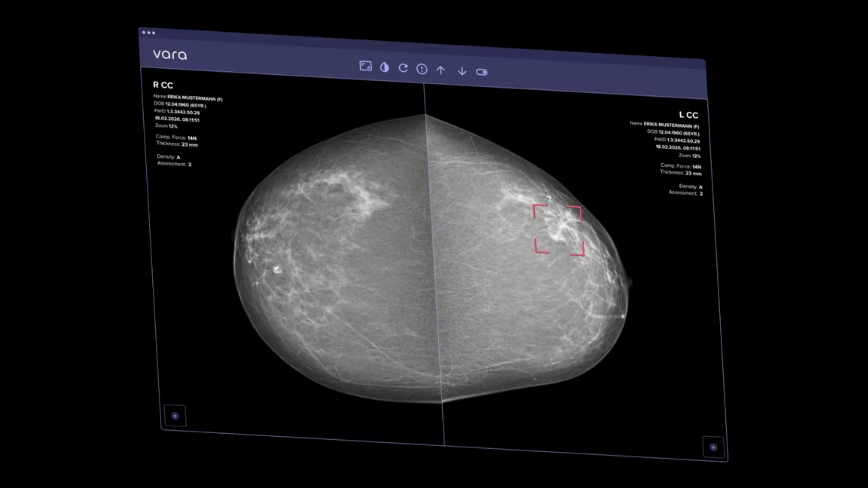
Vara, which trades as MX Healthcare GmbH, announced a Class IIb CE certification under the EU Medical Device Regulation covering what it calls autonomous triage in organised breast cancer screening, described as the world's first regulatory clearance for AI that closes a breast screening case with no radiologist reading it.
Under autonomous triage, the AI reports the examinations it classifies as clearly normal and no radiologist reads them; every other examination still goes to at least one radiologist.
The autonomous triage mode covers organised population screening only, not symptomatic patients or diagnostic work.
Vara puts the share of screening mammography images that turn out normal at around 97%.
Screening programmes across Europe read every mammogram twice.
Vara credits the certification less to the model than to the safety layer wrapped around it, which it calls ATMON, for Autonomous-Triage Monitoring.
Distinct publishers with included, body-backed reporting in this cluster.
1 article · September 3, 2026
Follow any of these and your For You feed starts watching them — no settings page required.
Evidence-backed comparisons of source perspectives and observed adoption signals. Read the methodology
Which Builder, Operator, and Investor concerns the observed source mix emphasized—not a truth score.
Evidence, demonstrated adoption, hype gap, incentives, and confidence are assessed independently, each on its own current evidence. How these are measured.
Large paper, wrong mode
Three documents carry this story and only one of them was reviewed by anyone outside Vara. PRAIM is a serious piece of work — 463,094 women, 12 sites, Nature Medicine — but it watched radiologists read with AI help, the readers picked their own arm, and it never tested a case being closed unread. Everything specific to the certificate rests on the company: ATMON's drift controls, the seven years of case-level monitoring, the 97% normal share. The notified body that actually assessed the file is not named, and the share of examinations the AI would close is never given, so the two numbers that would let an outsider size the claim are both missing.
Certificate, no switch flipped
Not one programme has turned this on. Adoption runs through national guidelines, nobody is obliged to move, and Vara expects no one to move quickly — its own stated expectation, not a sceptic's. What is deployed is the older assisted-reading product, and even there the company gives its German footprint three ways across three of its own pages: 50%, 60%, roughly 50%, at 250,000 or over 150,000 screenings a month. ATMON going out to customers who are barred from autonomous triage is distribution of a monitoring tool, not uptake of unread reporting.
Milestone outruns its trial
"World's first" is accurate as far as breast imaging goes and Vara leans on it hard, while the trial it cites in the same breath tested radiologists reading with AI, and the release inflates that trial into a nationwide study of 461,818 women — a cohort the paper does not contain. Muff's post claims an EU AI Act obligation that does not bite until August 2028. The relative 17.6% detection lift reads larger than the one extra cancer per 1,000 women it describes. The overstatement lives in the company's materials; The Next Web's account pulls most of it back, which is why this sits well short of the top of the scale.
Seller supplies the file
Strip out PRAIM and every fact here comes from a company announcing a certificate it wants programmes to buy: the 97% normal share, ATMON's behaviour, the seven years of monitoring, the market share, the volumes. The tell is directional drift — the figures move upward in the chief executive's own post relative to the wire release, and the AI Act obligation hardens from future to present in the same document. Vara also has an interest in the milestone framing itself, since a Class IIb autonomous-triage certificate is a barrier that competitors now have to clear.
One outlet, checking well
A single publisher on a single day, with no independent clinical or regulatory voice — that caps how far this can be trusted. What lifts it is the quality of the checking: The Next Web reads the release against the Nature Medicine paper, catches the cohort mismatch, dates the AI Act obligation to 2 August 2028, and lines up three of Vara's own footprint figures side by side. The specifics that survive are the ones a document trail supports. The certificate's substance — assessor, triage threshold, site-level thresholds in ATMON — remains taken on the company's word.