Science1 publisher2 min readPublished
A label-free polygenic score improved prediction for non-European and admixed biobank participants
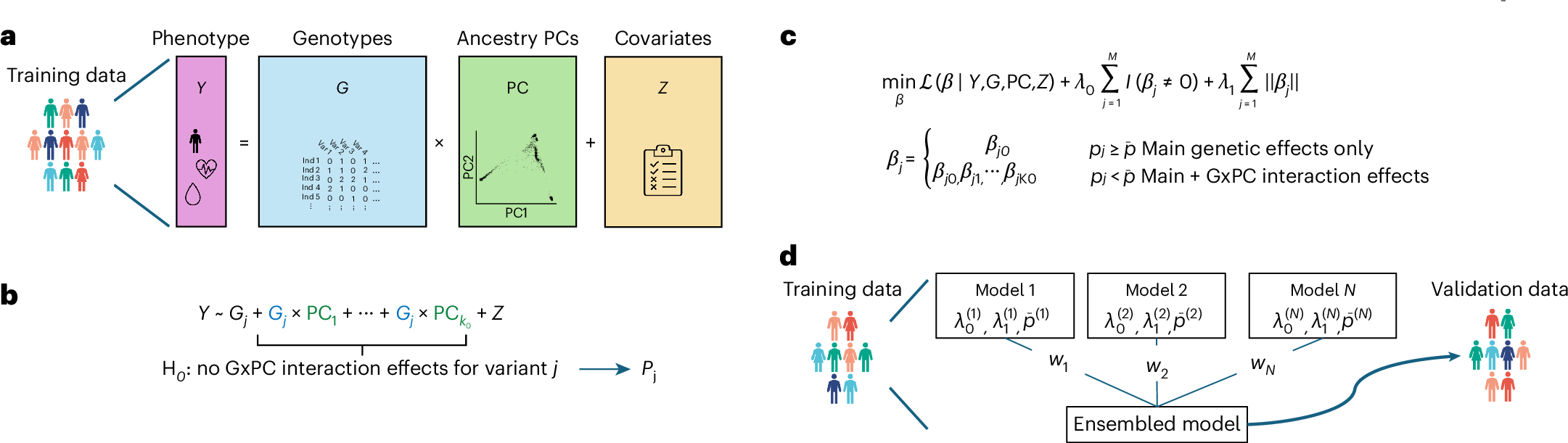
SPLENDID fits one penalized regression that treats genetic ancestry as a continuum, and its authors report more accurate prediction in All of Us and UK Biobank than methods that first sort people into ancestry groups.
The Scientist · Science desk
What happened
- They report significantly better prediction accuracy than existing methods, with the gains concentrated in non-European and admixed ancestries.
- Existing multi-ancestry methods need every individual assigned to an ancestry group, and the authors note that clinical decisions are typically not based on ancestry and that many people fit no pre-specified group.
- SPLENDID's software for R 4.2.0 and its tutorials are posted on GitHub, and the simulated multi-ancestry genotype data used in the paper are on the Harvard Dataverse.
Compiled by The ScientistSomething wrong?How this is made
Why it matters
- capability An admixed patient can be scored without anyone first deciding which ancestry group to file them under, so the labeling question stops being a prerequisite for producing a number at all.
- constraint Building a model this way needs individual-level biobank data, which both cohorts release only on request with approval and training, so cohort access becomes the gate on who can fit one.
- decision Anyone choosing a scoring method for a diverse patient population now has a label-free candidate to benchmark, and convention is no longer a reason to keep the ancestry-stratified pipeline.
- precedent If validation studies pick up this comparison, ancestry-grouped scores become the option that has to argue for itself in the next round of clinical implementation work.
The comparison here is one model against several. The other implementations the paper points to are PRS-CSx, CT-SLEB, PROSPER and iPGS [9], and each needs an individual assigned to an ancestry group before a score comes out [2]. The method the authors cite as PROSPER is titled "An ensemble penalized regression method for multi-ancestry polygenic risk prediction" [13]. SPLENDID uses the same broad machinery, penalized regression on individual-level data, and emits a single set of weights with no labels attached [1].
The denominators are two separate cohorts: 224,364 participants in the All of Us Research Program and 340,140 in UK Biobank, 564,504 people in total, plus simulations [4][16]. The reported advantage concentrates in non-European and admixed ancestries, which is where the labelled multi-ancestry methods were introduced to help [5][2]. The abstract states that the improvement was significant; its size and the traits it holds for are not in the abstract, and Nature sells the full article for $39.95 [17][18].
Accuracy in a research cohort is upstream of a changed clinical decision. The authors write that SPLENDID "stands as a valuable tool for robust risk prediction across diverse populations, reduced health disparities in genetic research, and fairer clinical implementation" [6]. The first of those three is what a biobank analysis can test. Calibration in a clinic population, and whether a score changes what a doctor does, are different studies.
The labeling requirement and the data requirement are also different problems. SPLENDID's stated input is large-scale individual-level data [1], and both biobanks release that only on request, with approval and training required [10]. The no-labels property belongs to the model that comes out of the fit [1]. The study's own data list includes 1000 Genomes genotypes and population labels [20], along with GWAS summary statistics from GLGC, GIANT and BCX [12].
I would now put the burden of proof on the labelled pipeline. If a program sorts patients into ancestry groups, the justification has to be something better than the software expecting it, because on the authors' own comparison the unsorted model predicted better in the groups that sorting was meant to serve [5]. That argument applies to work already under way: the same paper cites ten chronic disease polygenic scores selected, optimized and validated for clinical implementation in diverse US populations [14].
What to watch
- The effect sizes and per-trait results in the full paper, and whether the gain covers the diseases already used in clinical polygenic score programs.
- An independent replication of the comparison against PRS-CSx, CT-SLEB, PROSPER and iPGS in a third cohort.
- Whether calibration holds across the ancestry continuum in a clinic population.