Product1 publisher3 min readPublished
California's first heavy AV truck permits arrive with a lawsuit already attached
Aurora and Kodiak can now test autonomous trucks in their home state, but the April 28 rule change behind the permits is being challenged by Teamsters California in Alameda Superior Court.
The Product Desk · Product desk
Drafted by a language model from the sources cited here and checked against its claim ledger before publication. How we use AISend a correction
What happened
- California's Department of Motor Vehicles has issued the state's first permits to test autonomous trucks on public roads, to Aurora Innovation and Kodiak AI.
- Kodiak has already put a handful of trucks to work, mostly around its Mountain View office.
- A rule change on 28 April lifted California's ban on testing autonomous vehicles weighing more than 10,000 pounds.
- The pre-existing weight restriction had kept both Aurora and Kodiak out of their home state for years.
- The permits are narrow: a safety driver has to stay behind the wheel, and testing is barred on roads posted at 25mph or below unless the truck is taking a direct route between destinations.
Compiled by The Product DeskSomething wrong?How this is made
Why it matters
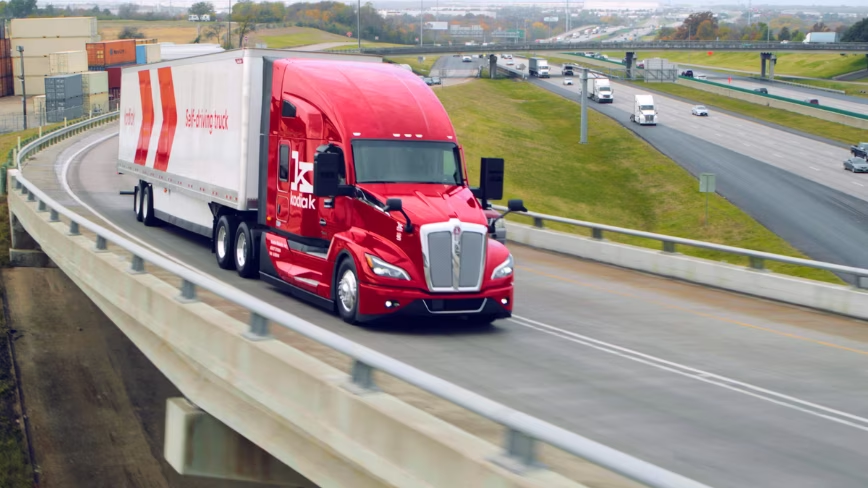
California's Department of Motor Vehicles has issued the state's first permits for testing autonomous trucks on public roads, to Aurora Innovation and Kodiak AI, and Kodiak has already put a handful of trucks to work, mostly around its Mountain View office [1][2]. The regulations underneath those permits are being contested in court, which means any product plan that assumes California heavy-duty testing is planning on a permission a judge has been asked to void [6].
The unlock was administrative, not legislative. On 28 April the DMV lifted California's ban on testing autonomous vehicles above 10,000 pounds, a restriction that had kept both companies out of their home state for years [3][4]. That route exists because the legislature tried the other one: lawmakers passed a bill in 2023 requiring human operators in autonomous trucks, and Governor Gavin Newsom vetoed it, leaving the DMV to write the terms [11].
What the permits actually authorise is modest. A safety driver has to remain behind the wheel, and testing is barred on roads posted at 25mph or below unless the truck is taking a direct route between destinations [5]. That is a testing regime, not a freight product. The revenue work is elsewhere: Aurora began driverless freight in Texas in May 2025 and runs routes including Fort Worth to El Paso and Laredo to Dallas, and Kodiak started there in January 2025 [12][13]. Both fit their hardware and software to production semi-trucks rather than building cabless vehicles from scratch, so the California fleet is a variant of an existing platform rather than a separate programme [14].
Teamsters California filed a writ petition in Alameda Superior Court on 5 August, days before the permits were granted, asking a judge to repeal the regulations outright [6]. The union's argument is procedural. It says the DMV sidestepped requirements to study and publish the economic impact of allowing driverless heavy trucks, and failed to properly weigh the risk to other road users [7]. "Such a critical decision with life-and-death consequences must involve public input and transparency," said Peter Finn, a Teamsters California co-chair, "that is why Teamsters California is taking the DMV to court" [8]. Ninety-nine days separated the rule change from the filing [15].
The union is also not treating the court as the only venue. Co-chair Victor Mineros said it would keep fighting "in the courtroom, at the ballot box, and into the next administration," and gubernatorial candidate Xavier Becerra has committed to reversing the DMV rules if he wins [9][10]. Because the framework is regulation rather than statute, a reversal of that kind does not need the legislature to act [16].
For operators, the practical read is that California is now a data-collection and validation jurisdiction with a safety driver in the seat, and its status can change through a court order or a change of administration without anything happening on the technical side [5][6][10]. Watch whether Alameda Superior Court reaches the merits of the procedural claim or sends the DMV back to do the economic-impact work [7]; whether the DMV responds by producing that analysis rather than defending its absence [7]; and whether the gubernatorial race turns the rules into a campaign commitment with a date attached [10].